


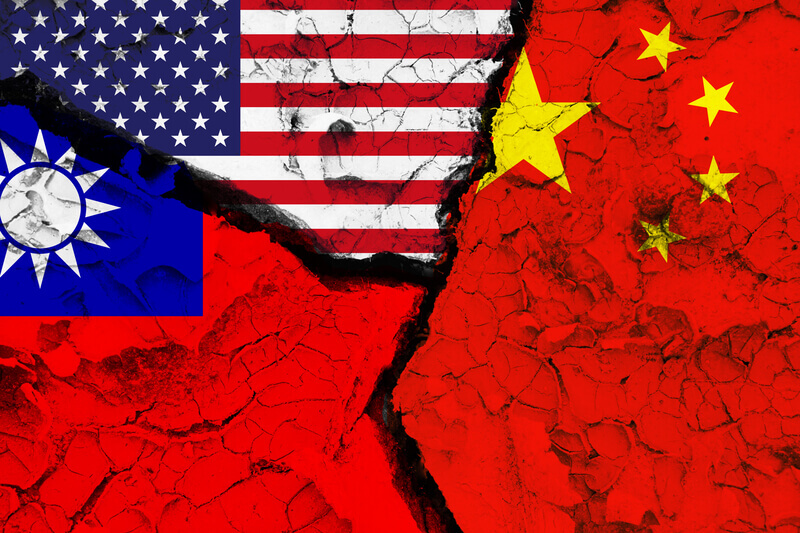
A new report from the Heritage Foundation analyzing a potential conflict between the United States and China was so precise—and so unsettling—that the Trump administration requested portions of it be redacted before public release, even though the analysis relied entirely on publicly available information. The report underscores not only the growing role of artificial intelligence (AI) in modern war planning but also the sobering reality that the U.S. military faces structural weaknesses that could prove decisive in a high-intensity conflict with Beijing.
The report, titled “TIDALWAVE: Strategic Exploitation and Sustainment in a U.S.–China Conflict,” uses an AI-enabled model to simulate thousands of iterations of a U.S.–China war over Taiwan. Unlike traditional tabletop exercises, TIDALWAVE tracks how losses in aircraft, ships, fuel, and precision munitions compound over time, revealing how quickly modern warfare can drive even a powerful nation to the breaking point.
According to the report, “existing programs of record do not adequately address shortfalls in the resources required to combat the PRC effectively, despite the increasing risk of confrontation.” That conclusion, grounded in open-source data rather than classified intelligence, forms the backbone of TIDALWAVE’s warning to Congress and defense planners.
The AI model drew on more than 7,000 open-source government, academic, industry, and commercial data points to assess both U.S. and Chinese vulnerabilities. Its findings are stark. In most high-intensity scenarios, the first 30 to 60 days of conflict determine the war’s long-term outcome. Early losses in aircraft, ships, fuel throughput, and munitions rapidly compound and cannot be recovered on operationally relevant timelines.
TIDALWAVE finds that the United States would culminate (reach the point at which it can no longer sustain operations) far sooner than China. In some scenarios, up to 90 percent of U.S. and allied aircraft positioned at major forward bases in Japan and Guam are destroyed on the ground during the opening phase of the conflict, as Chinese missile strikes simultaneously hit runways, fuel depots, command facilities, and parked aircraft. The implication is straightforward: hardening, dispersal, and missile defense are not “nice-to-haves.” They are prerequisites for operational survival.
Precision-guided munitions emerge as another critical vulnerability. Long-range anti-ship missiles, air-to-air interceptors, and missile defense systems begin to run short within five to seven days of major combat operations. Across most scenarios, those munitions are exhausted within roughly 35 to 40 days, leaving U.S. forces unable to sustain high-tempo combat.
Fuel, however, is the most decisive factor of all. The report makes a crucial distinction: in most possible scenarios, the United States does not typically run out of fuel—it loses the ability to move fuel under fire. Chinese doctrine explicitly prioritizes attacks on tankers, ports, pipelines, and replenishment vessels. Even limited disruptions are sufficient to drive fuel throughput below survivable levels, forcing U.S. commanders to sharply curtail air and naval operations despite fuel remaining in aggregate stockpiles.
By contrast, the report assesses that China is capable of sustaining high-intensity combat for months longer under the modeled assumptions. Although Chinese ammunition stockpiles begin to decline after roughly 20 to 30 days, substitution effects and industrial resilience extend Beijing’s ability to fight well beyond the point at which U.S. forces culminate.
The implications extend far beyond the battlefield. TIDALWAVE concludes that once a Taiwan conflict begins, the United States is highly unlikely to prevent massive global economic fallout. Disrupted shipping lanes, destruction of critical infrastructure, and the collapse of Taiwan’s semiconductor production would trigger an estimated $10 trillion global economic shock—nearly a tenth of global GDP.
As Fox News reported, it was the precision and operational relevance of these findings that prompted senior U.S. national security officials to request redactions before the report’s public release. According to the authors, those officials were concerned that adversaries could exploit the analysis to identify or remediate vulnerabilities.
“Redactions were made at the request of the U.S. government to prevent disclosure of information that could reasonably enable an adversary to (1) remediate or ‘close’ critical vulnerabilities that the United States and its allies could otherwise exploit, or (2) identify or exploit U.S. and allied vulnerabilities in ways that could degrade operational endurance, resilience, or deterrence,” the report explains.
Notably, the Trump administration’s concerns were not about classified leaks. The report used only open-source information. An unredacted version was provided to authorized government recipients for internal use, underscoring how much can now be inferred about military readiness through publicly available data—especially when processed at scale by AI-enabled models.
A Department of War spokesperson declined to comment on discussions surrounding the report’s publication, stating only that the department “does not endorse, validate, or adjudicate third-party analyses,” while emphasizing the importance of protecting information that could affect operational security if aggregated or contextualized.
That redaction story is the headline—but it’s not the only reason TIDALWAVE matters. The report’s most unsettling contribution may be what it implies about the trajectory of war planning itself; namely, a future where AI can fuse “harmless” data points into something operationally actionable, fast enough to shape real-world decisions. If an open-source model can map weaknesses so convincingly that the federal government asks for black ink, the era of assuming “it’s public, so it’s safe” is over.
And Beijing is watching this shift as closely as Washington is.
Several former PLA officers who defected to the West in the late 1990s and early 2000s told this author that, in their view, the CCP has long treated a Taiwan confrontation as a legitimacy test—one that could decide the regime’s future.
They stressed that, historically, internal CCP rhetoric often outpaced actual war planning. Before Xi Jinping, they said, party congresses routinely invoked Mao’s call to reclaim Taiwan, but most senior leaders still favored prosperity over conflict—and many war planners privately doubted the regime would risk everything on a roll of the dice.
But as China’s leadership hardened after the 2010s, those officers described a more dangerous mindset. Some Chinese plans, they said, envisioned two weeks of air and sea attacks followed by a rapid seizure of Taiwan and key sites in “just over three days,” with diplomats prepared to warn NATO of a potential nuclear response if the West intervened. After 2014, the same officers argued, Beijing’s willingness to entertain high-risk scenarios increased—especially as Russia’s threats appeared to influence Western behavior. As one assessment put it, “Putin’s overt willingness to threaten NATO seemed to diminish Western resolve.”
They also pointed to draft regional concepts that contemplated strikes “behind enemy lines” and even “possible” attacks on the U.S. mainland—ideas they described as more reckless than earlier schemes. Some PLA circles, they said, repeated rumors that the CCP had considered bombing an American city like Los Angeles.
Those claims, they acknowledged, were not based on classified access and should be treated as rumor—but the fact that such talk circulated at all, they argued, reflected the radicalization of strategic thinking under Xi. More concretely, they said the CCP “aimed to strike U.S. allies,” especially the Philippines, as part of a broader effort to isolate the region and fracture U.S.-led coalitions.
Even inside China’s system, they contended, there is unease about what a Taiwan war would actually require. In light of the regime’s rhetoric, they said, many PLA professionals still question the feasibility and quietly doubt Beijing’s ability to execute its most ambitious plans under real conditions of attrition, interdiction, and chaos.
One former planner, Lt. Col. Quán Chāngpǔ, framed it bluntly: ideology sets the stage for strategy, shaping both international ambition and battlefield maneuver. Another retired officer said the CCP’s determination to take Taiwan remains unshaken, but only a minority within the PLA “still burn with the desire to fight.” He contrasted the mood of the 1990s—when “confidence, even arrogance, ran high”—with today’s more brittle reality that certainty has faded. Russia’s “disastrous showing in Ukraine,” he added, served as “a sobering wake-up call for many.”
Another voice, Dr. Xiàhóu Li Wei, a former senior CCP security official, offered a warning that cuts to the core of regime survival. “If Xi attacks Taiwan, Beijing will fall,” he said. His argument is that the logistical and strategic burdens now exceed what the system can absorb under wartime stress—precisely the kind of cumulative failure dynamic TIDALWAVE models on the U.S. side.
Multiple former PLA officers put it in similarly apocalyptic terms. In their view, Taiwan “would be the grave of the CCP” and an “unimaginable suffering for Chinese and Taiwanese people.” Their point was not that war is impossible, but that the stakes are existential in a way the West sometimes treats as abstract.
Taken together, these accounts shouldn’t be treated as substitutes for modeling or intelligence. But they do align with the broader lesson of TIDALWAVE that high-intensity war is not a contest of slogans. It is a contest of endurance, logistics, and survivability—and it punishes illusions quickly.
TIDALWAVE also warns that the scale of losses in the Indo-Pacific would leave the United States unable to deter or respond effectively to a second major conflict elsewhere in the world. A war over Taiwan could invite follow-on aggression from adversaries such as Russia, Iran, or North Korea, fundamentally destabilizing the global security order.
The report’s authors are blunt in their assessment that existing Pentagon programs and congressional funding are too slow, too fragmented, and too modest to address the scale of the challenge. In many cases, the timeline required to fix critical vulnerabilities exceeds the likely timeline to conflict.
To avoid what the authors describe as a strategic defeat, the report urges Congress to immediately expand munitions stockpiles, strengthen fuel reserves and distribution infrastructure, harden and disperse forward bases, and accelerate sustainment and logistics reforms. Without rapid action, the United States risks entering a conflict it is structurally unprepared to fight—or sustain.
With intelligence warnings mounting that China could move on Taiwan before the end of the decade, TIDALWAVE delivers an unsettling message. The window to correct these deficiencies may be closing faster than Washington is prepared to act—and thanks to AI-enabled analysis, that reality is now harder than ever to ignore.

About the author
Ben Solis
Contributing Writer
Expertise
- • International affairs
- • History
- • Foreign policy and national security
Credentials
- • International affairs journalist, historian, and researcher (writing under a pen name)


51 Comments