


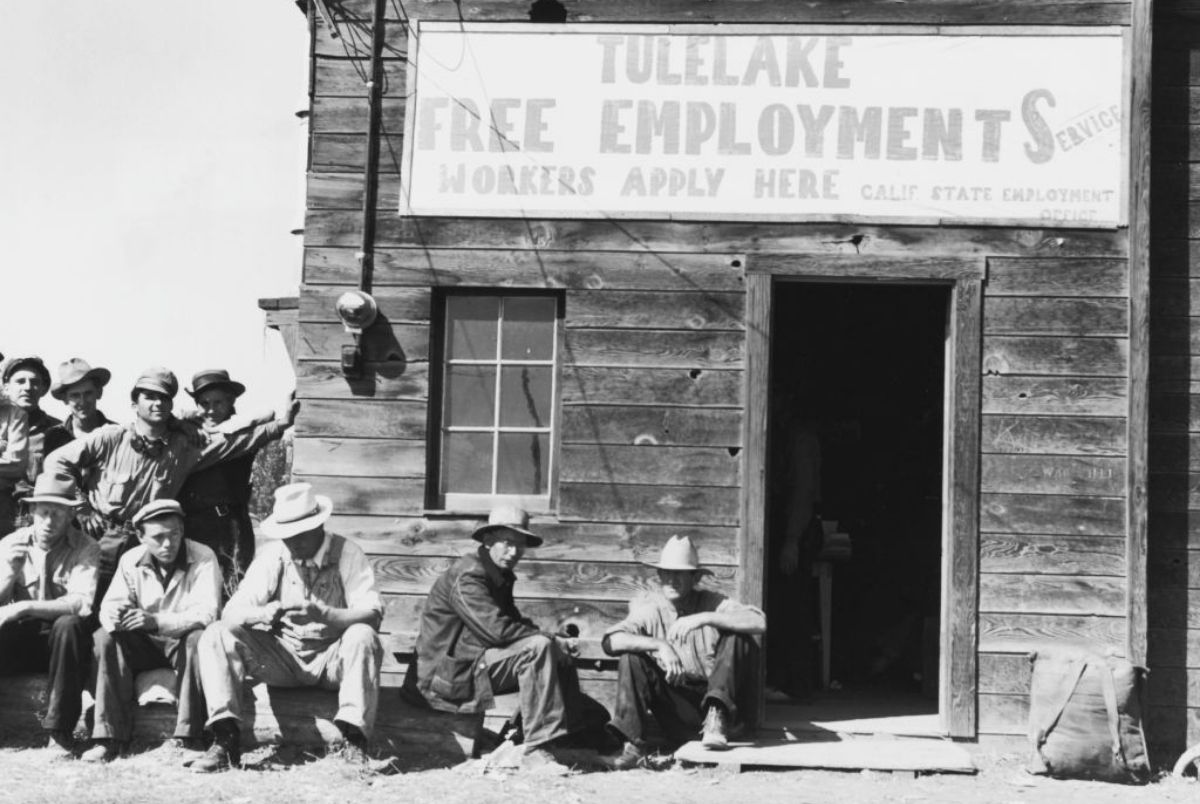
The stock market crash caused The Great Depression, and Herbert Hoover did nothing to solve it. That’s what most believe or remember being taught in school. But neither is completely accurate. If we changed “caused” to “led to” we might be on firmer ground.
Like so many things we think are true, but aren’t, let’s review the other causes and contributing factors to the most severe and prolonged economic calamity in American history.
History books often oversimplify the complex events happening in the U.S. and around the world in the 1920s. At the time of The Great Depression, only 10 percent of Americans owned any stock shares, so any “crash” or huge decline in stock prices would technically leave 90 percent of people largely unaffected.
Of course, the psychological effects of the market declines on October 24, 1929 (Black Thursday) followed by the huge panic selling and losses of October 29, 1929 (Black Tuesday) were real. Fear and anxiety spread nationwide, and people stopped buying en masse. Such a reduction in consumption would make any economy contract.
The Roaring Twenties that followed the end of World War I and the 1918-19 flu pandemic were a prosperous time in America. But the gains and wealth were not shared evenly by all. Warning signs of an economic downturn, or at least a correction, were evident several years prior to 1929.
For starters, farmers were already in their own depression due to low crop prices and weather events long before the famous stock market crash. Additionally, property values had stagnated by 1926-27, and there was an uptick in farm and home foreclosures.
Another contributing factor to The Great Depression was consumer debt. Americans seized on a relatively new concept in the 1920s – buying on credit. Also called “installment plans,” one could purchase expensive goods like furniture, appliances, and cars while paying for them over time from weekly wages. But as debt soared, the ability for Americans to continue buying began to slow economic activity by 1929.
In the lead up to 1929, an increasing number of people also started to “play the market.” This speculation that stock prices could only go up began running rampant at the same time as a new tool called “buying on margin” allowed ordinary people to buy stocks by putting up only 10 percent of the price with a broker. The scheme worked fine, until it didn’t. What goes up must come down, and any fall in prices in excess of 10 percent led to “margin calls,” effectively wiping investors out. People literally went broke in a matter of minutes.
Most economists also argue that tariff policy – specifically the Smoot-Hawley Tariff Act – contributed to The Great Depression. Although President Hoover did not sign that legislation into law until June 1930, after the stock market crash, it led to retaliatory tariffs that deepened the crisis. As international trade collapsed, U.S. farmers and manufacturers found fewer foreign markets in which to sell their products.
But arguably the single greatest cause of The Great Depression is mistakes in monetary policy from the Federal Reserve. The central bank was still new, having come into existence in 1913 under Woodrow Wilson. Concerned about rising debt and government spending, the Fed increased interest rates. But higher borrowing costs choked the economy by making it cost prohibitive for consumers and businesses to get loans. It also failed to provide liquidity for banks, causing massive bank failures, and followed a strict but needless adherence to the gold standard.
The Fed essentially slammed the brakes on the proverbial car (the overall economy) when it should have pressed down on the gas pedal (lowering interest rates to make borrowing easier) once the gravity of the economic decline was apparent. The Fed almost single-handedly turned what would have been a garden variety recession into the ten-year downturn that became known as The Great Depression.
Finally, a word about President Hoover, who gets the lion’s share of blame for the Depression, but unfairly so. His major misfortune was being the occupant of the White House when the Roaring Twenties ended and the market crashed.
Contrary to Hoover’s “do nothing” reputation, he was actually the most activist president of all his predecessors on government spending to counteract the nation’s malaise. Still, even these efforts proved inadequate for this particular emergency. Hoover remained too rigid in his belief that there should be no direct aid to people, as he believed such government assistance would destroy Americans’ work ethic, creating sloth.
His successor, Franklin D. Roosevelt, did not succeed any more in combatting The Great Depression with his own spending programs, dubbed The New Deal. It would take the massive spending and mobilization for World War II to finally beat The Great Depression.
The good news is that economists and federal officials have learned a lot since then. We still have downturns, and monetary policy has been far from perfect. But the frequency between recessions has grown to about a decade (as opposed to every few years), and nothing since the 1930s has approached the length or scale of The Great Depression.
Jeff Szymanski has a master’s degree in political science and taught high school economics and history for 15 years. He currently works in political communications for AMAC Action.


11 Comments