


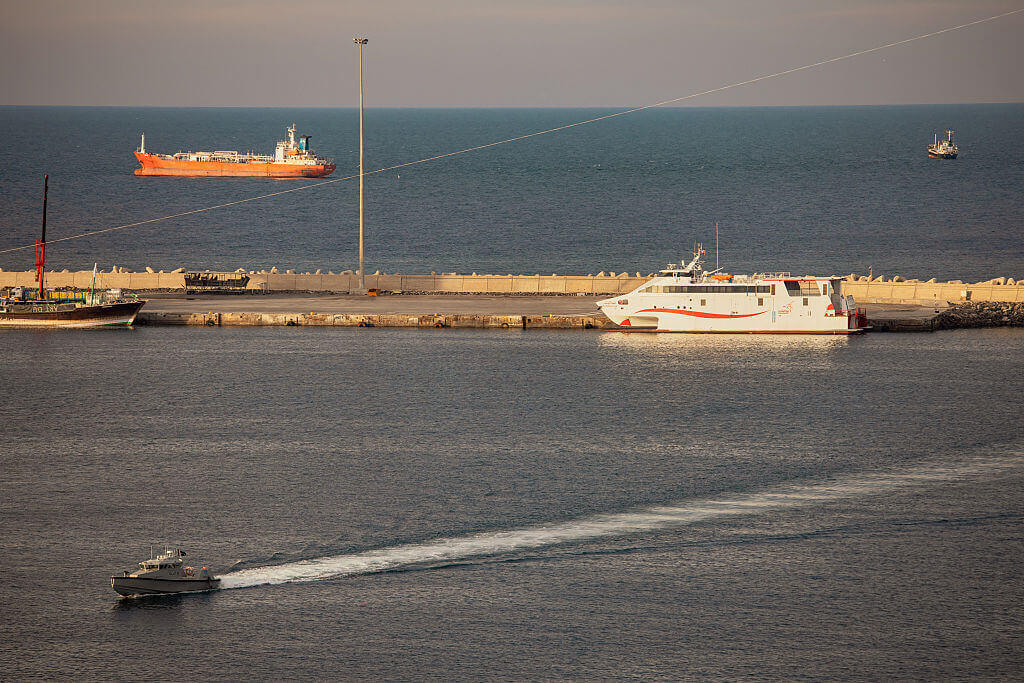
Thoughtful observers likely wonder: If the US substantially destroyed Iran’s Navy, which we did, and the US can “blockade” the Strait of Hormuz, which we can, how can Iran still “control” the Strait?
The answer is simple and frustrating. The Strait, through which much of the world’s oil flows, is narrow – 21 miles across at one point, separating the Arabian Gulf to the west (between Saudi Arabia and Iran) from the Sea of Oman to the east (between Oman and Pakistan).
While the major ships Iran possessed before their fit of irrationality have been sunk, Iran still maintains what strategists would call an “asymmetric” ability – low tech – to threaten tankers.
Iran, now a rebel force against a more powerful adversary, still has the ability to raise risk. They can still operate small, maneuverable, armed speedboats, place mines in the Strait, and use short-range missiles to threaten – potentially strike – tankers attempting to pass through with oil.
While a US warship or Carrier Battlegroup can defend itself, a tanker is vulnerable. Iranian asymmetric threats, which deliver disproportionate damage at low cost, include 4,000 “contact, acoustical, and influence-triggered” mines, hundreds of “fast attack” small boats (often called “bog hammers”) which swarm to do damage, small submarines, and anti-ship cruise missiles.
On the other side of the equation, oil and natural gas tankers are highly vulnerable, possess few countermeasures, and are expensive, perhaps $100 million apiece before being loaded with oil.
Since commerce requires insurance, rates were already high; with Iran’s threat, rates “surged,” causing tankers to stop for fear of an asymmetric attack. War risk insurance premiums are now “record high,” up 12-fold, many now three percent of the ship’s value.
In short, Iran is using the cheap trick of rebel warfare, which proves to be very costly to both the US military, trying to secure the Strait, and the commercial vessels, trying to make transit affordable, despite elevated war premiums.
So, how does this end? Several scenarios seem most likely.
The US could put indirect pressure on Iran, bombing command and control targets, critical infrastructure, and leadership, which might send them back to the bargaining table for peace.
Alternatively, the US could structure an intense, high-volume attack on Iranian facilities storing mines, boats (harbors), submersibles, and missiles, aiming to undermine the immediate threat.
While impractical, the US and allied navies might send warships with transiting tankers, permitting some – if highly delayed – commerce. This would permit some commercial delivery via the Strait.
Potentially, the US, Israel, and other allies could deploy novel technologies, such as cyber or other high-tech disabling means against indirect and direct targets, reducing the threat.
Perhaps most likely, while pursuing one or more of the foregoing, the US could push unified diplomacy, as most hydrocarbons transiting the Strait go to China, the Far East, and Europe, not the US, and so there may be room for robust, new, unified diplomacy, despite talk to the contrary.
One way or the other, and noting that Iran’s nuclear and long-range ballistic and cruise missile technologies had to be ended, the likeliest near-term prediction is for higher oil and gas prices, more kinetic military activity, and a slow grinding down of Iran’s stubborn resistance to peace.

About the author
Robert B. Charles
National Spokesman, AMAC
@Bobby4MaineAll articles by Robert B. Charles →
Expertise
- • U.S. foreign policy and national security
- • Counter-narcotics and international law enforcement
- • American politics and government
- • Leadership, character, and American history
Credentials
- • Former U.S. Assistant Secretary of State, Bureau of International Narcotics and Law Enforcement Affairs (October 2003 - March 2005)
- • Reagan White House staffer (1981-1983)
- • Deputy Associate Director, Office of Domestic Policy, George H.W. Bush White House (1992-1993)
- • Staff Director and Chief Counsel, U.S. House Subcommittee on National Security, International Affairs, and Criminal Justice (1995-1999)


34 Comments