



Democrat data firm Catalist just released the most comprehensive report to date on how President Donald Trump won the 2024 election. But as usual, the corporate media and Democrat consultant class are misreading the data – and underestimating just how devastating last November was for liberals.
Breaking down the data
The Catalist report largely confirms what many exit polls found last year. Trump made gains among minority and young voters, too many Biden voters stayed home, and infrequent voters voted Republican. But the scale of these shifts and some other trends that have thus far flown under the radar hint at much deeper problems for Democrats than just one bad election night.
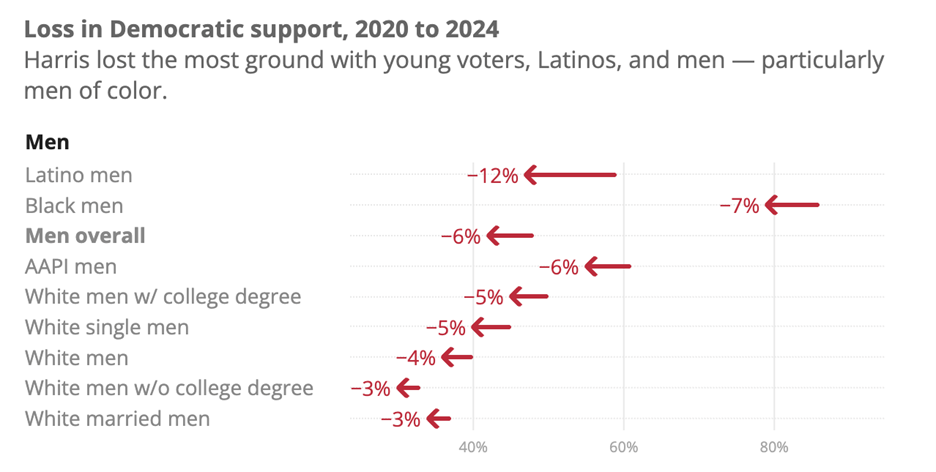
Trump’s gains among men – particularly minority men – were particularly astonishing. Among men overall, Trump performed six points better in 2024 than he did in 2020. But among black men, he performed seven points better, and among Latino men, he improved by an incredible 12 points. Kamala Harris did not improve among a single subset of men examined in the Catalist survey.
SOURCE: The Cook Political Report
Even among women, Harris struggled. Latina women moved seven points to the right. The only group among whom Harris improved over Joe Biden’s 2020 performance was married white women – and even then, she did only one point better.
In another troubling trend for liberals, the newest voters were less likely to vote Democrat. In 2024, for the first time in Catalist’s dataset, the Democrat candidate won fewer than 50 percent of the voters for whom that election was their first time ever voting – a cohort of 24 million Americans last year.
That data point alone should be setting off alarm bells for liberals. Typically, younger voters lean left and become more conservative as they age. If that trend holds but Republicans begin performing better with young people as soon as they’re able to vote, it creates a prohibitively low electoral ceiling for Democrats.
Perhaps the most important takeaway from the Catalist report is also the most nuanced. As the Cook Political Report explains, “For much of the 2024 election, the Harris campaign was convinced that they could win if the electorate looked similar to 2020, while the Trump campaign was eager to expand the electorate.”
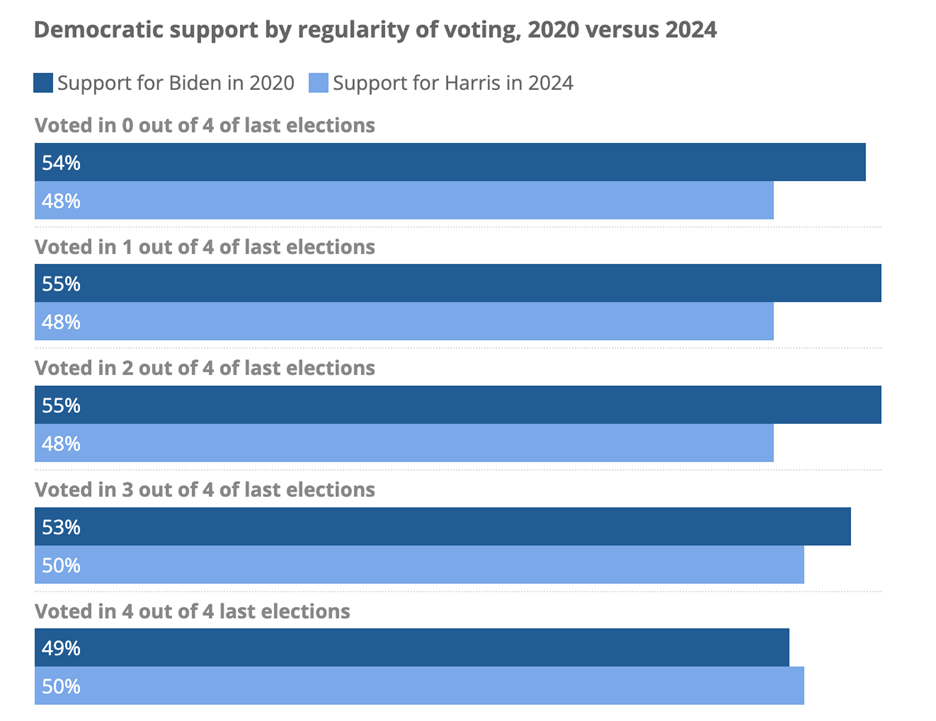
In a sense, Harris got the electorate she wanted – 47 percent of voters were “super voters,” meaning they had voted in all of the last four general elections. In 2020, that number was 38 percent. And Harris actually performed better with this subset of voters than either Joe Biden in 2020 or Hillary Clinton in 2016, winning 50 percent of their votes.
But among less frequent voters – those who voted in 0, 1, 2, or 3 of the last 4 general elections, Harris lost ground. While Biden won at least 53 percent of the vote among all of these groups, Harris failed to crack 50 percent with any of them.
Moreover, according to Catalist’s estimates, 30 million people who voted in 2020 stayed home in 2024. About 55.7 percent of that group voted for Biden.
SOURCE: The Cook Political Report
Key takeaways
Taken together, these findings offer a few insights. First, Trump was indeed successful at expanding the electorate – and shattered conventional wisdom about minority voting patterns. Liberal dreams of an “emerging Democratic majority” driven by people of color and women, so popular in the early 2000s, are now coming crashing down. The 2024 electorate, which was three percent less white than 12 years ago, produced the first Republican popular vote winner since 2004.
Second, the gender divide is real and growing. The failure of the Kamala Harris campaign to reach men was not just a media narrative – it showed up in an enormous way at the ballot box. Since last November, Democrats have failed to reckon with their alienation of men and the aggressive feminization of the party. Unless Democrats address that problem quickly, expect the rightward trend among men to continue no matter who is on the ballot.
Third, the Obama coalition is collapsing, and traditional Democrat messaging tactics are becoming less effective with voters. As Cook put it, “Had the 2024 electorate been in place in 2012, the team in Chicago would’ve been over the moon.” But in 2016, 2020, and 2024, that same coalition that delivered two terms for Obama became increasingly pro-Trump – despite Democrats and the corporate media launching a decade-long smear campaign to portray Trump as racist and sexist.
Fourth, Americans who are less political, or at least less inclined to vote, really, really didn’t like what they saw from Joe Biden and Kamala Harris, and really did like Donald Trump’s message. What the “less frequent” voter data suggests is that a majority of Americans who have not voted in every recent election were incentivized to show up at the polls to vote for a change in direction – a clear rejection of Biden’s presidency.
The media misses the mark again
Following the release of the Catalist data, The Bulwark – a vehemently anti-Trump outlet – published its own breakdown of the data. It contains this somewhat amusing line: “Republicans were not able to boost their margins in the swing states in 2024 as much as they did nationally – meaning that in the states that actually matter, where all the ad spending and stumping happens, Democrats are in a stronger position than they are in the rest of the country. That’s something.”
Really? Trump won every single swing state and cut his margin of defeat in half in states like Virginia and New Jersey. Maybe Trump didn’t improve as much in the swing states as he did nationally, but that’s only because his improvement nationally was so impressive. If anything, that analysis should lead to the conclusion that Trump’s appeal is even broader and more robust than his popular vote victory or landslide Electoral College margin would suggest.
The Bulwark then trots out a now-familiar line: that no other Republican will be able to match Trump’s margins among rural and working-class voters. “Since Trump hijacked their political party, they’ve been shedding reliable college-educated suburban voters – along with most traditional Republican values and policies,” the piece reads. “And while Trump is able to offset this loss with Saddam Hussein–level margins among working-class voters, especially in rural areas, there’s no evidence a Republican who isn’t Trump can conjure similar appeal with voters otherwise uninterested in politics.”
But wait – didn’t The Bulwark and the rest of the Never-Trump crowd just get done telling us from 2021 to 2024 that Trump would be an electoral anchor on the party? Didn’t they all blame him for Republicans’ underperformance in 2022 and insist that January 6 and left-wing lawfare would make him unelectable? Now, however, we’re supposed to believe that Republicans don’t stand a chance without him on the ballot.
Even if that analysis were correct, it would mean that another more “traditional” Republican candidate would be able to bring back those college-educated suburban voters who used to be a core component of the GOP coalition. And if that Republican candidate could maintain some subset of the rural and working-class base that Trump activated, it would leave him or her in a similarly strong electoral position.
Ultimately, what drives the political elite crazy isn’t just that Trump keeps winning – it’s that he keeps proving them wrong. Again and again, they’ve declared him finished and out of step with the American public. Yet each time, he defies the odds, redraws the political map, and reshapes the electorate in ways they neither understand nor control.
Trump didn’t just win in 2024. He shattered long-held assumptions about voter behavior, media influence, and party loyalty. What Democrats and the media fail to realize, and what each new revelation about last November proves, is that the old playbook no longer works – and that the outsider the elites tried to cancel is now the defining figure of a new political era.

About the author
Shane Harris
Editor in Chief
@ShaneHarris513All articles by Shane Harris →
Expertise
- • U.S. politics and elections
- • Public policy and conservative commentary
- • Issues affecting older Americans
Credentials
- • Editor-in-Chief, AMAC Newsline
- • Former Associate Director, White House Office of the Staff Secretary
- • Served in the White House Office of Presidential Correspondence
- • Special Projects Coordinator for Sen. Bill Hagerty (R-TN) (January-June 2021)


39 Comments