


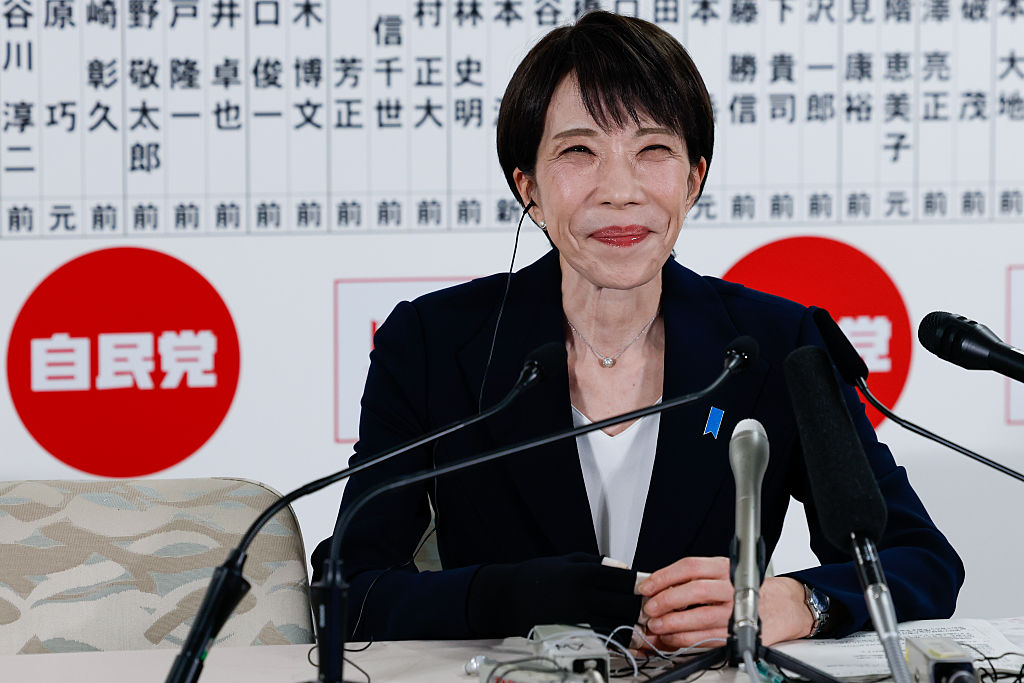
In another unmistakable sign of a brewing global conservative resurgence, Japanese voters have delivered a sweeping mandate to Prime Minister Sanae Takaichi, rewarding her “Japan First” platform with one of the most decisive election victories in the country’s postwar history. Like recent conservative breakthroughs elsewhere, the result reflects a renewed appetite for sovereignty, security, and national cohesion.
Takaichi’s ruling Liberal Democratic Party (LDP) and its coalition partner surged past the threshold needed for a supermajority in Japan’s 465-seat lower house on Sunday, ultimately securing roughly three-quarters of all seats. The landslide followed her bold decision to call a snap winter election – the first in 36 years – just months after becoming Japan’s first female prime minister. Critics called the move reckless. Voters clearly disagreed.
The scale of the victory gives Takaichi firm control of parliamentary committees and the authority to override resistance in the upper house, clearing the way for her long-promised “Japan First” agenda. That agenda centers on national defense, economic revitalization, and immigration reform, mirroring President Donald Trump’s “America First” agenda in the United States.
Takaichi’s campaign message was deliberately blunt. Breaking with years of technocratic ambiguity, she argued that Japan’s social stability, security, and cultural continuity were being strained by policies that had expanded foreign labor and residency without sufficient safeguards. As Dr. Winfried Schultz, a former German diplomat and Japan specialist, put it, “Immigration reform became the cornerstone of her platform, clearly signaling her political priorities to voters.”
Voters responded, even under extreme conditions. On election day, blizzard conditions blanketed much of the country. Tokyo streets were buried in snow, polling stations opened late, and travel was treacherous. Yet turnout held steady, with students and working voters braving the weather to cast ballots—an effort that reflected the determination behind Takaichi’s campaign.
Business leaders quickly recognized the message voters were sending. Masayoshi Matsumoto, chairman of the Kansai Economic Federation, observed that “Takaichi’s call for trust and unity galvanized voters, validating her claim to a Japan First mandate.” The results, he added, “demonstrate the public’s expectations for strong leadership.”
At the heart of that mandate is immigration. Japan’s foreign workforce reached a record 2.57 million last year, marking more than a decade of uninterrupted growth driven by labor shortages. Projections suggest foreign nationals could comprise over 10 percent of Japan’s population by 2070 – a dramatic shift for a historically homogenous society. Today, foreign nationals account for more than half of all non-Japanese workers, with Chinese nationals making up the largest share.
These trends have fueled growing public unease, sharpened by recent spy scandals, welfare abuse cases, and security concerns tied to sensitive industries. Immigration became a central issue during last year’s LDP leadership race, with all candidates adopting tougher rhetoric. Takaichi went further, pledging a comprehensive overhaul.
That posture has not been merely rhetorical. She has openly criticized misconduct by foreign tourists and warned against the exploitation of Japan’s asylum system, stating, “If you come to Japan for financial reasons and claim refugee status, I will have you go home. I will also make illegal immigrants obey the law.”
Conservative intellectual Naoki Hyakuta captured the broader anxiety driving voter support when he warned, “If society is transformed by immigration, we can’t go back to how things were.”
Since taking office, Takaichi has moved swiftly. Her government has advanced proposals requiring stronger Japanese-language proficiency for residency, mandatory cultural and historical knowledge benchmarks, and tighter rules governing deportations – specifically to prevent lawyers from exploiting advance notice to help clients evade enforcement. Within the LDP, lawmakers are also examining voting eligibility for naturalized citizens and enhanced oversight of foreign land ownership.
These reforms are paired with national security measures that directly intersect with immigration policy. The administration is laying the groundwork for a new counter-espionage framework – the Intelligence System Development Promotion Act – aimed at protecting universities, research institutions, and advanced manufacturing sectors. Professor Masato Kamikubo of Ritsumeikan University underscored the urgency, noting, “Universities and companies cannot judge whether someone is a spy or not.”
LDP official Yoshitaka Shindo framed the effort succinctly, calling the new policy “a national issue that supports an orderly local society in Japan.”
For the United States, Takaichi’s victory is unequivocally good news. She has paired immigration reform with a hawkish foreign policy, pledging a major military buildup, expanded defensive and offensive capabilities, and a tougher stance toward Beijing. She also has been explicit that an attack on Taiwan would pose a direct threat to Japan, a position that triggered Chinese economic retaliation but resonated powerfully with Japanese voters.
With her supermajority secured, Takaichi can now pursue reforms that allow Japan to shoulder more of the security burden in the Indo-Pacific. She has described the U.S.–Japan alliance as having “limitless” potential and is set to visit Washington in March, where deeper defense and intelligence cooperation are expected to be central topics.
At a time when the United States faces mounting pressure from China and strains on its global commitments, a stronger, more self-reliant Japan is a strategic asset. Japanese voters have chosen clarity over caution, sovereignty over drift, and national cohesion over managed decline. Their verdict reinforces a broader global trend and offers Washington a rare and welcome alignment with a partner moving decisively in the same direction.

About the author
Ben Solis
Contributing Writer
Expertise
- • International affairs
- • History
- • Foreign policy and national security
Credentials
- • International affairs journalist, historian, and researcher (writing under a pen name)


6 Comments