


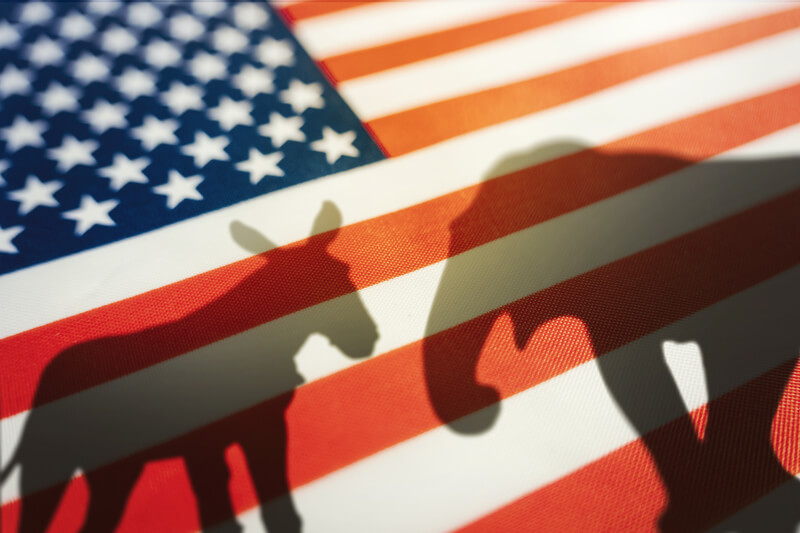
History and early polling suggest that Democrats are well-positioned for a strong showing in November’s midterm elections. But Republicans’ significant cash advantage could dash liberal dreams of a “blue wave.”
In a shift from previous cycles in which Democrats far outraised Republicans, the Republican National Committee (RNC) entered 2026 with a cash advantage over the Democratic National Committee (DNC) of nearly $100 million, according to Federal Election Commission (FEC) filings. Furthermore, as The New York Times reported, “the three leading arms of the national Republican Party and the two super PACs aligned with House and Senate Republicans” entered 2026 with a jaw-dropping $320 million. The corresponding Democrat groups, meanwhile, tallied just $137.2 million after accounting for debts.
As a massive cherry on top for Republicans, President Donald Trump’s super PAC – for which there is no Democrat counterweight – is also sitting atop a war chest of more than $300 million. With Trump term-limited, the PAC is expected to spend heavily to boost Republican candidates in the hopes of preserving GOP majorities. That money gives Republican strategists more flexibility to flood swing districts late in the cycle, define Democrat challengers before they build name recognition, and mobilize lower-propensity voters who powered Trump’s 2024 success.
In total, Republicans’ combined cash advantage over Democrats is nearly half a billion dollars. While Democrat fundraising in the months ahead is sure to cut into that edge, it still represents a stunning reversal from the situation just two years ago. In 2024, Democrats outraised Republicans by an astonishing $1 billion. House Speaker Mike Johnson put it plainly on X: “Republicans entered 2026 on offense with unprecedented resources.”
Outside money is also tilting toward Republicans, with Elon Musk re-engaging to support GOP candidates.
The Supreme Court could also soon give another advantage to Republicans when it revisits how party committees are allowed to use large donations. Under current law, candidates can purchase television advertising at discounted rates, while outside super PACs often pay significantly more. If those rules loosen, the party with deeper reserves would gain an additional edge. Republicans would be well positioned to benefit.
To be sure, money isn’t everything. Democrats lost in 2024, and Trump won a landslide victory despite being significantly outspent. The national political environment matters a great deal, as does the wise allocation of resources. (The Kamala Harris campaign infamously shelled out millions to A-list celebrities like Beyoncé, Cardi B, and Oprah Winfrey.)
Democrats are now hoping that 2026 will be their turn to be the financial underdog, but still secure major victories. DNC Chair Ken Martin has pointed to a string of recent special election wins as proof that his party’s standing remains strong despite financial woes. In an interview with Fox News Digital, Martin touted “win after win” at the ballot box and said Democrats are “winning up and down the ballot.”
His argument is that Democrats don’t need to match Republicans dollar for dollar. They just need enough to compete in a political environment that appears to be breaking their way.
On that front, Martin may have a point. In the latest RealClearPolitics polling average, Democrats have a 4.6-point advantage over Republicans on the generic congressional ballot. That edge has only grown over the past year, with Republicans holding a one-point edge last February.
For reference, Republicans held a 0.3-point edge in the 2024 generic congressional ballot just ahead of Election Day and finished with a 2.7-point advantage when all the votes were counted. In 2018, Trump’s last midterm cycle, Democrats held a 7.3-point edge ahead of Election Day and finished with an 8.4-point actual advantage, wiping out the GOP House majority.
But the RNC has pushed back on Martin’s optimism and discounted the importance of notoriously volatile special election results.
“Ken Martin is bragging about spending money the DNC doesn’t even have on deep-blue races and touting those easy wins as if they’re a serious national strategy,” RNC National Press Secretary Kiersten Pels told Fox. “They’re broke, divided, and without a coherent plan — and voters will send that message loud and clear at the midterms.”
Ultimately, the reality likely rests somewhere between Democrats’ supreme belief in the power of historical trends and the national environment on the one hand and Republicans’ confidence in their financial edge on the other.
Money does matter – and there is a difference between simply being outspent and being overwhelmed. Especially early in campaign cycles, cash on hand determines what campaigns can do before most voters are even paying attention. It locks in television reservations months in advance. It funds voter identification and turnout operations. It pays for mail programs, digital targeting, ballot-harvesting infrastructure, and opposition research. In tight battleground districts, those investments often prove decisive.
Still, Democrats are correct that no amount of hard-hitting advertising or get-out-the-vote messaging can overcome a certain level of voter frustration. Though inflation has cooled and Trump’s tax cuts are beginning to deliver real relief to families, Democrats are betting that economic improvement alone won’t determine the outcome. They are working to stoke opposition to immigration enforcement through aggressive media messaging while amplifying voter frustration over issues such as the cost of healthcare, hoping that discontent will be enough to carry them to victory.
Republicans have the money. Democrats are banking on the mood. The result will likely come down to which party does a better job of wielding its resources to actually get voters to the polls. Regardless, it appears that the country is headed for another nail-biter finish this November.

About the author
Sarah Katherine Sisk
Contributing Writer
@SKSisk76All articles by Sarah Katherine Sisk →
Expertise
- • Economics
Credentials
- • Hillsdale College alumna; pursuing a master’s in economics at George Mason University


38 Comments