


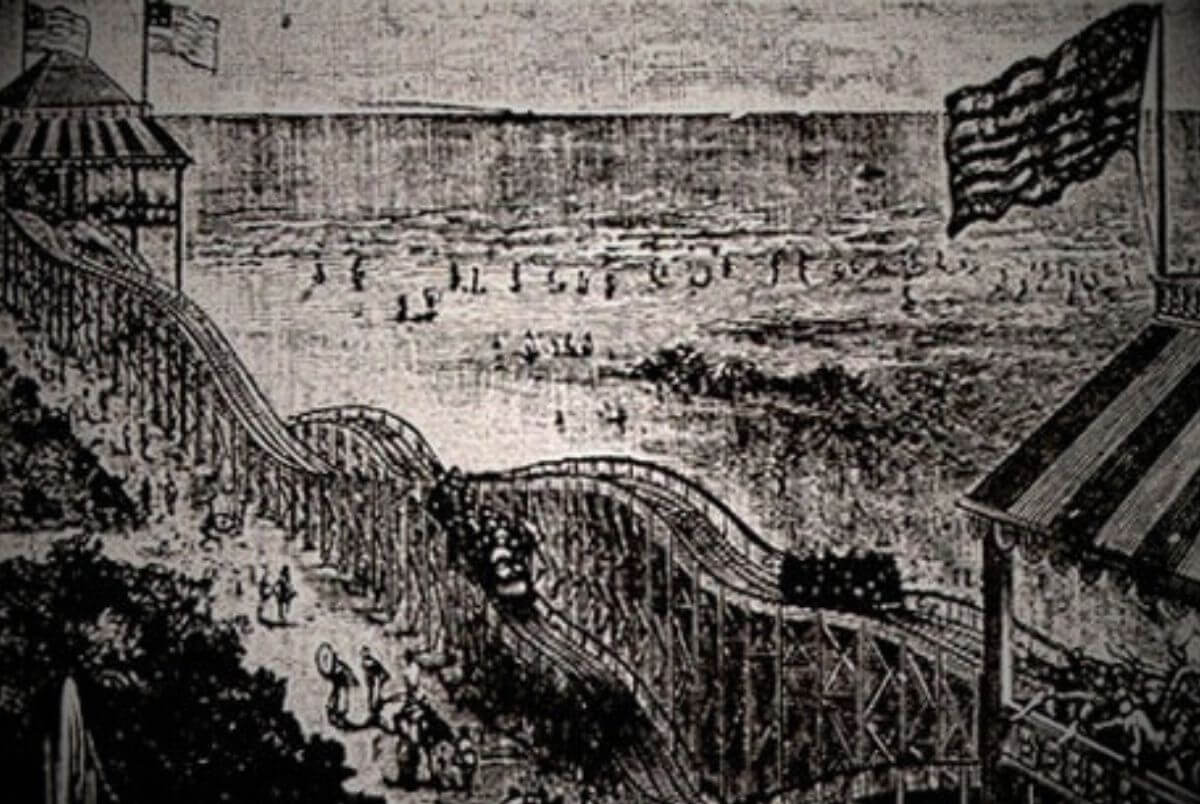
On June 16, 1884, a simple ride at New York’s Coney Island launched an American obsession that continues to captivate thrill-seekers more than a century later. On that day, the nation’s first purpose-built roller coaster opened to the public, marking the beginning of a new era in entertainment and amusement. Known as the Switchback Railway, the ride was the creation of inventor LaMarcus Adna Thompson, who would later earn the title “Father of the American Roller Coaster.”
By modern standards, the Switchback Railway was remarkably modest. Riders climbed a platform and boarded a bench-like car that coasted along a 600-foot wooden track powered solely by gravity. Traveling at approximately six miles per hour, the ride offered little in the way of speed or dramatic drops. At the end of the track, attendants manually moved the car to a parallel rail for the return trip, giving the attraction its “switchback” name. Despite its simplicity, the experience was unlike anything Americans had seen before. A ride cost just five cents, and visitors quickly lined up to experience the new sensation.
The timing was perfect. During the late 19th century, Coney Island was rapidly emerging as one of America’s premier seaside destinations. Located in Brooklyn along the Atlantic coast, the resort area attracted thousands of visitors seeking recreation, entertainment, and an escape from city life. Thompson’s roller coaster became an instant hit and helped transform Coney Island into the nation’s amusement capital. Within a few decades, amusement parks, carnival attractions, and increasingly elaborate roller coasters spread across the country.
Thompson’s invention was inspired in part by the Mauch Chunk Switchback Railway in Pennsylvania, a former coal-hauling rail line that had become a popular tourist attraction. He refined the concept into a ride designed purely for fun, creating a model that would influence generations of amusement engineers. Over the years, roller coasters evolved from gentle gravity-powered rides into towering steel structures capable of breathtaking speeds, inversions, and record-breaking heights.
The success of the Switchback Railway sparked an industry that remains a major part of American culture. Today, roller coasters are among the most popular attractions at amusement parks around the world, drawing millions of riders annually. Yet every looping, twisting, high-speed coaster can trace its roots back to that summer day in 1884 when a humble wooden railway at Coney Island introduced Americans to the thrill of the ride.


Comments