


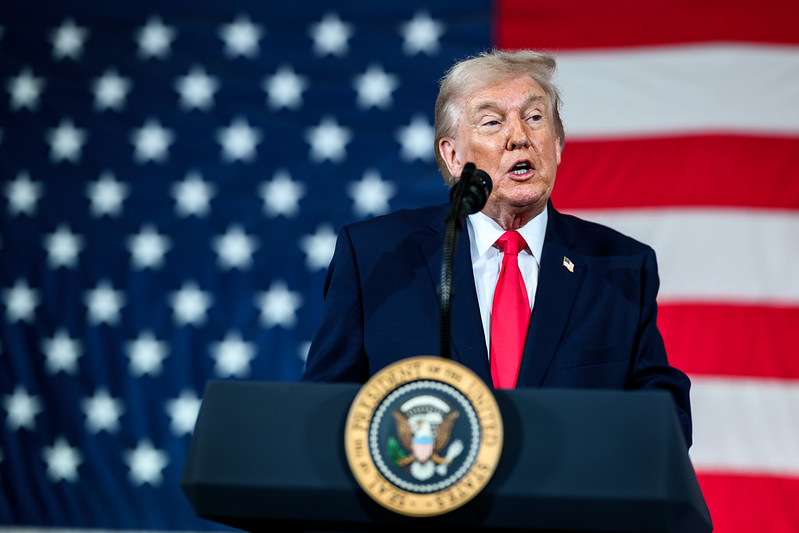
As President Donald Trump takes the podium for the State of the Union on February 24, he enters a political moment defined by both accomplishment and high stakes. Here’s a preview of what to expect next Tuesday.
With the 2026 midterm season about to kick into high gear, this address will serve not only as a review of the early portion of his second term but also as a strategic launchpad for the campaign battles ahead. After one of the most consequential opening years of any administration in modern American history, Trump will use this platform to spotlight a long list of policy wins, underline his policy vision, and frame the choice facing voters this November.
The political backdrop matters. Republicans have the slimmest of margins in the House, and polling suggests Democrats are in a strong position to take control of the chamber. The GOP is in a better position to hold the Senate, but Democrats believe they could compete for control here, too.
If Republicans hope to defy the “midterm” curse, keep control of Congress, and prevent the last two years of Trump’s time in the White House from being mired in Democrat obstructionism, Trump’s ability to set the narrative during next week’s speech is of vital importance. Policy wins are only as valuable as the ability to message them to the American people. The State of the Union is a rare opportunity to cut through liberal media narratives and speak directly to a large audience.
Central to Trump’s appeal remains his core refrain: “Promises Made, Promises Kept.” Over the past year, the President has enacted a sweeping agenda directed at restoring economic strength, securing the southern border, reining in federal bureaucracy, and reshaping U.S. global leadership. Coming out of a previous administration marked by high inflation, border chaos, rising crime, and foreign policy weakness, Trump’s tenure has been defined by reversal and restoration across these domains – themes he’s sure to emphasize.
Expect to hear plenty about how the Trump administration declared a national emergency at the southern border, reinstated strict immigration enforcement policies, ended the controversial “CBP One” parole app, designated major cartels as foreign terrorist organizations, and began mass deportations – starting with violent criminals.
Trump has plenty of success to point to on this front. Within weeks of taking office, illegal immigration was reduced to levels unseen in decades as enforcement replaced inaction. This dramatic transformation of border policy will almost certainly be a centerpiece of the president’s remarks, with Trump underscoring decisive action on a crisis that defined the 2024 campaign.
The economy, always front and center for voters, will also figure prominently in Trump’s speech. Recent government data show that January brought 172,000 new private-sector jobs, an increase in labor force participation, and a decline in the unemployment rate. These figures affirm the narrative of economic expansion and strengthen Trump’s claim that his policies are delivering measurable benefits to working Americans. Private-sector job growth remains robust, while federal employment has contracted to its lowest level in decades, a point the administration highlights as evidence of leaner, more efficient government operations.
Inflation, the dominant electoral issue in 2024, has also continued its descent toward normal levels, aided in part by Trump's regulatory rollback and energy policy shifts that encouraged domestic production and reduced costs at the pump. These developments will help reinforce a message of prosperity and confidence heading into the midterms.
Beyond economic and immigration achievements, expect Trump to call on lawmakers to pass his “Great Healthcare Plan.” Unveiled in January, this comprehensive framework seeks to lower prescription drug prices, reduce insurance premiums, increase transparency in the healthcare system, and shift more control and purchasing power to patients. It calls for codifying Most-Favored-Nation prescription drug pricing deals that aim to bring American drug costs in line with lower international benchmarks, expand the availability of verified drug therapies over the counter, and eliminate certain middleman kickbacks that inflate costs.
The plan also proposes to send healthcare subsidy dollars directly to eligible Americans so they can choose their own coverage, require plain-language disclosures from insurers, and mandate prominent posting of pricing by providers and insurers in Medicare and Medicaid programs. These proposals, while requiring congressional action, provide a bold blueprint for lowering costs and empowering consumers.
In crafting this plan, Trump has aimed at the heart of two major Democrat narratives – soaring healthcare costs and insurance company dominance. By framing his proposal as putting money and choice back in the hands of Americans, he positions Republicans as champions of market-driven reform and personal freedom, countering Democrat critiques while offering a positive alternative that resonates with voters who feel squeezed by rising medical expenses.
Strategically, healthcare will be a key arena of contrast in the weeks ahead. Democrats have signaled that they intend to define the midterm elections around healthcare affordability and opposition to strict immigration enforcement. Trump’s address allows him to center his own constructive agenda early, forcing Democrat challengers to respond rather than take control of the discussion.
Trump will look to weave these policy accomplishments and proposals into a cohesive narrative of national renewal. He will likely spotlight American energy dominance, regaining strength on the world stage, increased wages, and strengthening law enforcement efforts that have led to declines in crime. On foreign policy, Trump will have occasion to highlight diplomatic achievements, including negotiations to end long-running conflicts, elimination of nuclear threats abroad, and the safe return of hostages from conflict zones.
Yet the State of the Union is not just about policy wonks and data points; it is about connecting with the American people. Trump, ever the entertainer, has a long history of using such speeches to create made-for-TV moments. Few could ever forget scenes like a military family being reunited, a student receiving a scholarship, or legendary conservative commentator Rush Limbaugh receiving the Medal of Freedom – all scenes that took place during Trump’s State of the Union Addresses in his first term. Viewers should watch for moments where Trump personalizes his policy agenda with human faces.
Of course, the partisan environment in the House chamber may draw its own headlines. Last year’s joint address saw a high-profile disruption from a Democratic member of Congress, and while party leaders on both sides have expressed a desire to avoid a repeat spectacle, the charged political atmosphere makes it impossible to rule out dramatic moments.
As the president takes the stage on February 24, the address will mark more than a review of past accomplishments. It is a chance for Trump to shape the conversation, take control of the narrative, and give voters a clear choice between his vision of American renewal and the alternative offered by his opponents.
This State of the Union is about setting the stage for the midterms and beyond – and the American people will be watching closely for both what he says and the direction he sets for the remainder of the year.

About the author
Shane Harris
Editor in Chief
@ShaneHarris513All articles by Shane Harris →
Expertise
- • U.S. politics and elections
- • Public policy and conservative commentary
- • Issues affecting older Americans
Credentials
- • Editor-in-Chief, AMAC Newsline
- • Former Associate Director, White House Office of the Staff Secretary
- • Served in the White House Office of Presidential Correspondence
- • Special Projects Coordinator for Sen. Bill Hagerty (R-TN) (January-June 2021)


47 Comments