


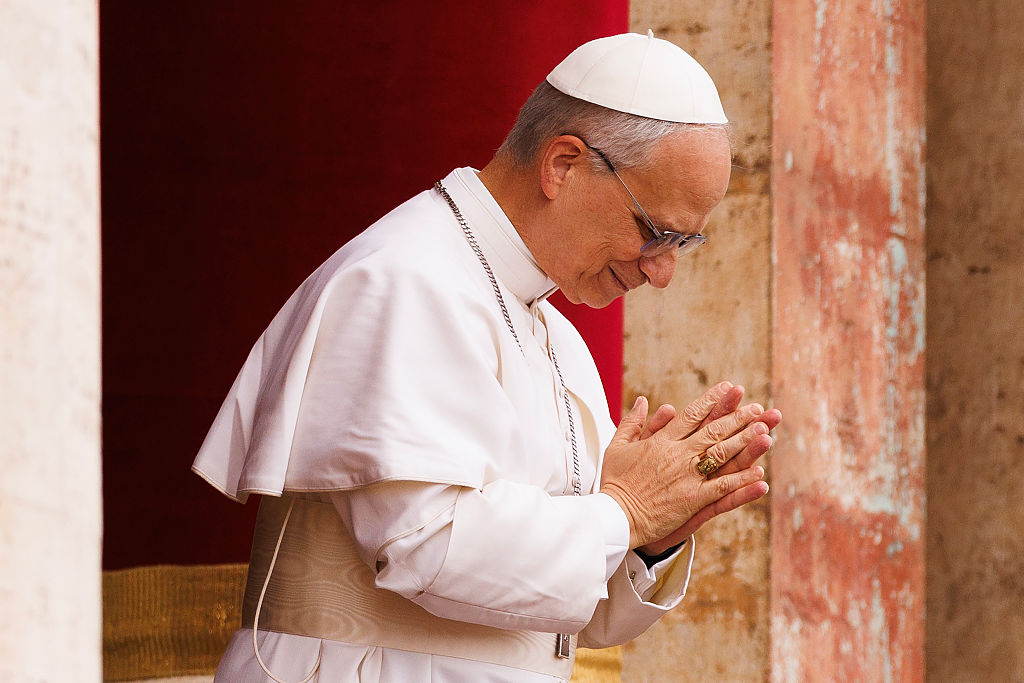
In a shot across the bow at Big Tech companies, Pope Leo XIV used his first major teaching letter, known as an encyclical, to call for protecting kids from “hypersexualized” and violent content on social media. He also addressed the consequences of the rapid proliferation of artificial intelligence (AI) in the sweeping 42,300-word document, arguing that the new technology can be used for good but also can wreak havoc on society if left unchecked.
From the moment then-Cardinal Robert Prevost took his new name as Leo XIV, it was widely expected that he would directly address AI. Pope Leo XIII, who served from 1878 to 1903, is remembered for his encyclical Rerum Novarum, which was released in response to the social, economic, and political upheaval of the Industrial Revolution. That groundbreaking letter addressed the benefits, harms, and solutions needed to protect workers and the human spirit during a period of rapid change.
With the world now facing similarly disruptive new technologies, Pope Leo XIV made clear that addressing those changes will be a major priority of his papacy. To drive that point home, he signed his first encyclical on May 15 – the 135th anniversary of Rerum Novarum.
Leo XIV’s encyclical is titled “Magnifica Humanitas (Magnificent Humanity): On Safeguarding the Human Person in the Time of Artificial Intelligence.” As Vatican News reports, the document is “divided into five chapters” and “has an underlying premise: technology is not ‘a force antagonistic to humanity,’ nor is it ‘inherently evil.’” Rather, because technology is a creation of Mankind, “it takes on the characteristics of those who devise, finance, regulate, and use it.”
In one of the more vivid sections of the document, Leo evokes the story of the Tower of Babel to caution against the pursuit of uniformity and standardization at the expense of humility and individualism. “With the heart of a shepherd and a father,” he writes, “I ask everyone to abandon the construction of yet another Tower of Babel and to join forces in building up the common good, so that humanity will never lose its beauty, and the world once again will come to recognize the human heart as the place where God desires to dwell.”
While AI may be a modern technology, this and other Biblical references are a reminder that the social and ethical challenges that AI poses have ancient roots – and are in fact deeply ingrained in the human condition.
Like most human inventions, AI can be used for good, such as faster processing of medical results. However, there are also serious concerns with the effects of massive data centers, necessary to power AI, on rural communities, as they can require heavy usage of water and electricity. There are also mounting concerns about the effects of AI on mental health and educational outcomes, as young people turn to the technology for everything from companionship to help writing papers.
In one tragic case, ChatGPT reportedly coached a teenager on how to kill himself, even offering to write a suicide note for him. Kids are also using AI to replace romantic intimacy, with a majority of Gen Z saying that they “can form a deep emotional bond with an AI-generated partner,” as one study found. The issue of social media and technology addiction has even attracted the attention of the Trump administration, which recently issued a health advisory about children and screen time.
It’s no wonder, then, that Pope Leo used part of his letter to call for policy solutions to put limits on children’s internet access in order to protect them from inappropriate and explicit content, as well as exploitation and addictive algorithms.
“Our first task is neither to demonize nor idolize technological tools, but to utilize them on the basis of a fundamental principle, namely that truth is a common good and not the property of those with power or influence,” he wrote, making clear that technology itself is not inherently good or evil.
Pope Leo also warned about how minors are being taken advantage of through AI and social media. Harms to “vulnerable” kids are “further aggravated,” he said, by “easy access to violent or degrading content that offends sensibility, to pornographic and hypersexualized material.”
Leo likewise warned of “nline phenomena such as grooming, blackmail and the sexual exploitation of minors” which he said are made easier by “AI tools capable of manipulating images and videos.”
Families play a role in protecting children from this content, the pope wrote. However, policymakers should support parents in protecting children from the dangers of the internet and AI.
The pope praised legislators for “setting age limits” on social media use, “holding service providers accountable rather than shifting the whole burden of control onto families” and “providing specific protections against all forms of online sexual exploitation and violence.” While parents have the ultimate authority over their children, Leo said, policymakers and internet companies also must work on behalf of the family to protect kids. “No man is an island,” as the saying goes.
As Pope Leo addressed later in his letter, business profits cannot be allowed to override the role of the family and the safeguarding of minors. “At the root of these problems lies a technocratic and post-humanist mentality that tends to regard the human person as an object to be manipulated or a resource to be optimized,” he warned. This mentality “remov all safeguards against the unchecked pursuit of profit.”
AI companies are benefiting from lucrative defense contracts at the federal level along with tax breaks and other incentives at the state and local level. That means taxpayers, and their elected officials, have the responsibility to ensure developments in AI benefit everyone – not just investors. Likewise, it is imperative that the financial interests of AI and internet companies do not supersede the broader societal interest in protecting children.
Pope Leo’s encyclical rightly throws weight behind this mission, ensuring that the same tools that can help society flourish and the economy grow are not leading to the spiritual destruction of the next generation of Americans.

About the author
Matt Lamb
Associate Editor, The College Fix
@mattlamb22Expertise
- • Higher education and campus issues
- • Free speech
- • Pro-life politics and policy
- • Conservative politics and culture
Credentials
- • Associate Editor, The College Fix
- • AMAC Newsline contributor
- • Formerly with Students for Life of America, Students for Life Action, and Turning Point USA
- • Former intern, Open the Books


42 Comments