


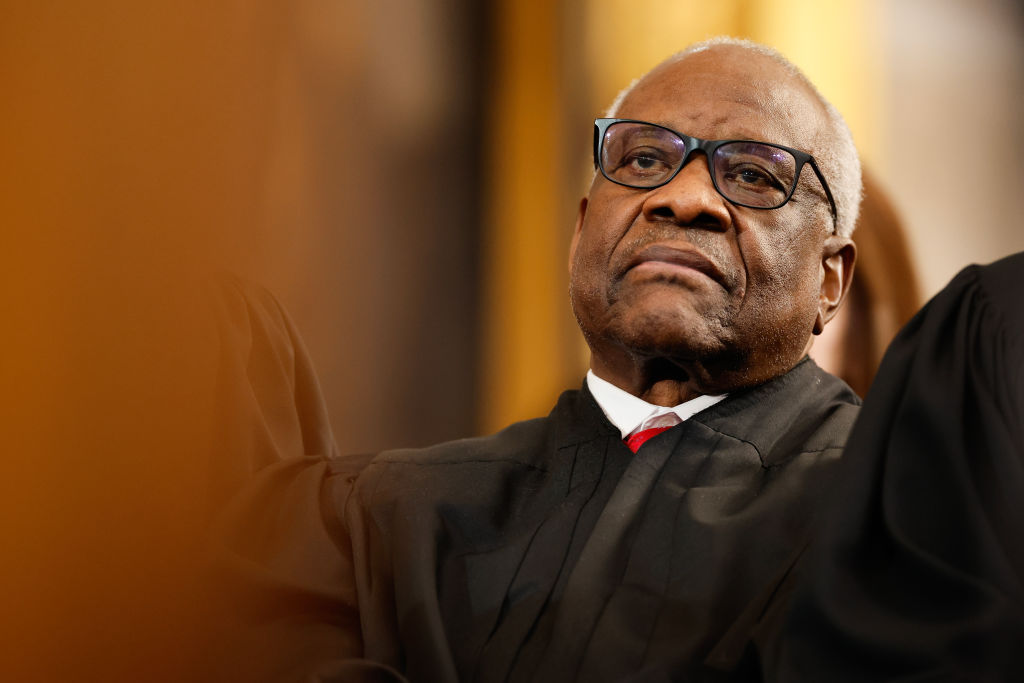
Years ago, I had sat quietly in Justice Clarence Thomas’ chambers and later watched him interact with students, with good cheer, clarity of thought, generosity of heart, and humility. The day never left me. Behind it was an earnest, honest, humble man – whose faith, like his bench presence, was often quiet.
Five years ago, Thomas spoke at Notre Dame about his faith. Justice Scalia had apparently encouraged him to speak more, knowing their shared faith and appreciating Thomas’ tendency to be quiet.
So, Justice Thomas accepted the invitation to speak and offered his views candidly and humbly. He spoke – if you go back to the speech at our Nation’s 250th anniversary – about the Declaration of Independence, what it means, and his own deep patriotism and personal faith – both of which he had once lost, then regained.
Five years ago, if you recall, half our Nation fought to preserve the Bill of Rights, while the other half was content to let it go for COVID. Thomas spoke plainly – and his words are powerful today.
He noted that the Declaration and Bill of Rights must not be vanquished for convenience, to accommodate fear or politics. “We have failed the Declaration of Independence, but it has not failed us. It endures because it articulates truth.”
Echoing our Founders, he talked about the timeless nature of the rights preserved in our Constitution, the inspiration that allowed people to govern themselves.
Fittingly, he uttered those words in 2021, delivering the “Tocqueville” lecture at Notre Dame’s Center for Citizenship and Constitutional Government.
De Tocqueville, a Frenchman writing on America in the 1830s, marveled at us, a people whose “exceptionalism” was rooted in love of God and individual rights.
Thomas explained that these sacred rights are distilled from God, from natural law, and thus are timeless and non-negotiable. They are not given by the government, so cannot be taken by the government, making our Constitution itself sacred – first of its kind. Thomas is also notably a Magna Carta scholar, which he teaches to law clerks.
The Declaration and Constitution, both to be honored this July 4th, are the foundation of civil society. Even in 2021, he noted they had “weathered every storm.” He said they are still as relevant as ever.
He then talked about “We the People,” celebrated in those documents. “There is something true, something transcendent, something solid, something that pulls us together rather than divides us,” even now found in everyday Americans.
Thomas said he was educated by his grandparents and nuns at St. Benedict the Moor School in Savannah, learned how to “navigate … and survive the negativity of the segregated world without negating the good that there was,” with love.
“I revere, admire, and love my nuns. They were devout, courageous, and principled women,” he said – talking about the Franciscan sisters. While the school is now closed, it laid the foundation under him that made him who he is today.
In the early years, after Martin Luther King was killed, Thomas said he lost his faith, became cynical, “thought my country and my God had abandoned me.” He found himself “consumed by negativity, cynicism, animus, and any other negative emotion that you could conjure up.”
In time, however, he rediscovered his faith, which allowed him to survive extreme adversity, including in politics. Five years ago, he bemoaned a national phenomenon paralleling his own life. “Sadly, the destructive disposition that I exhibited then…appears to be celebrated today.”
He was watching – even then – a national loss of moral compass, dismissing the deeply rooted, ultimately Christian values that built the nation as “old-fashioned.”
Not the only believer on the Highest Bench, Thomas clarified that the Supreme Court does not make policy, nor bend law to religious convictions, but applies law.
The vital understanding of this point, if lost, will “jeopardize faith in the judiciary.”
He closed, saying he has a prayer on his wall in the Court, his right under precedents back to our nation’s founding – just as children can pray in school if they wish.
That prayer is the Litany of Humility: “Having been humbled, I have every reason to be humble.” His last advice: “I think you start with that, and being true, being honest with yourself about what you know … what you don’t know. Also, do not lose sight of the good in people.”
Interesting, is it not, that so many wise people – those of varying faiths – come to that same conclusion. For that reason, if no other, it is a wonderful starting point. Justice Thomas, these five years on from our speech, thank you.
About the author
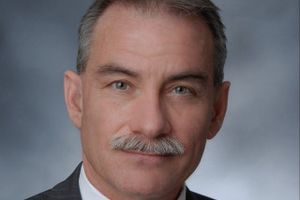
Robert B. Charles
National Spokesman, AMAC
@Bobby4MaineAll articles by Robert B. Charles →
Expertise
- • U.S. foreign policy and national security
- • Counter-narcotics and international law enforcement
- • American politics and government
- • Leadership, character, and American history
Credentials
- • Former U.S. Assistant Secretary of State, Bureau of International Narcotics and Law Enforcement Affairs (October 2003 - March 2005)
- • Reagan White House staffer (1981-1983)
- • Deputy Associate Director, Office of Domestic Policy, George H.W. Bush White House (1992-1993)
- • Staff Director and Chief Counsel, U.S. House Subcommittee on National Security, International Affairs, and Criminal Justice (1995-1999)


17 Comments