


-1200x630.jpg)
Interest in Social Security’s annual cost-of-living adjustment (COLA) is building, as it typically does around this time. Looking ahead to 2027, we’re seeing wild swings in media accounts of what the 2027 increase will be. Earlier this year, for example, the airwaves carried a post speculating on the possibility of a 4.7% bump, although a cooling inflation rate has tempered that in recent weeks. The most recent projections appear to hover around a 1% increase over the 2026 2.8% COLA.
While it’s very likely that the 2027 COLA will exceed this year’s adjustment, now’s a good time to reflect on how this process unfolds. Let’s start with some background…each year’s COLA results from comparing the third quarter average Consumer Price Index (currently CPI-W) each year to the same average from the preceding year. The result of dividing the current year’s average by the previous year’s average produces the COLA for the following year. For 2026’s adjustment, the 2024 third-quarter average CPI-W measurement was 308.187, and the comparable figure for 2025 was 317.265, producing the 2.8% benefit increase.
COLA, though customary, is not necessarily guaranteed
It’s not always the case that the year-to-year CPI calculation produces a positive result, as was the case three times so far this century. As recently as 2016, for example, the 2015 third-quarter average was 233.284, and the comparable figure for 2014 was 234.242, producing a negative change of 0.4. Fortunately for beneficiaries, Social Security law prohibits a negative COLA, so the negative result was ruled out, and the COLA for 2016 was zero.
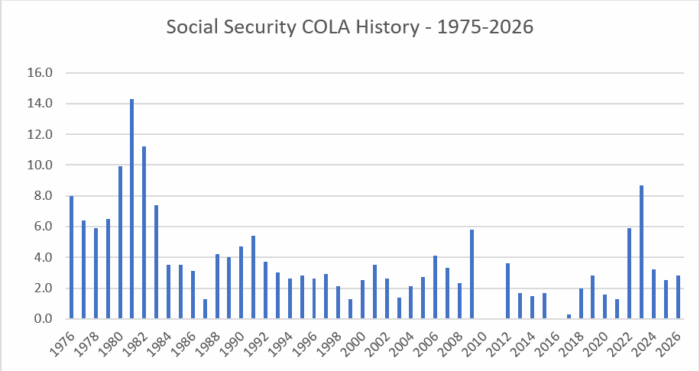
So, the rumor that there will always be a benefit increase in January is technically untrue, although having only three zero COLA years since the start of automated adjustments in 1974 leads folks to assume there will always be a boost in the new year. The size of the adjustment fluctuates with economic cycles, and has ranged from a high of 14.3 percent in 1980 to a low (excluding, of course, the zero years) of 0.3% in 2017 . Here’s a historical look-see at how the adjustments occurred since 1974, just to show you the cycles in action. The historical average for this 51-year period, incidentally, was 3.7 percent, so the 2026 adjustment of 2.8% was historically low, reflecting a downward trend in overall inflation.
Changes to the COLA calculation process may be in Social Security’s future
The current financial difficulties Social Security is facing will likely result in program changes in order to address the looming insolvency problem. It’s reasonable to expect that these changes may affect the COLA process, and the changes under discussion (at least so far) include capping the annual adjustment at a specified level, using a measurement other than CPI-W to gauge inflation, and adopting a flat-dollar adjustment rather than a percentage adjustment. These potential changes are described in AMAC’s recently updated Social Security Guarantee document, which is available for review on the AMAC website.


10 Comments