
MEET THE AUTHOR
C.S. Lewis
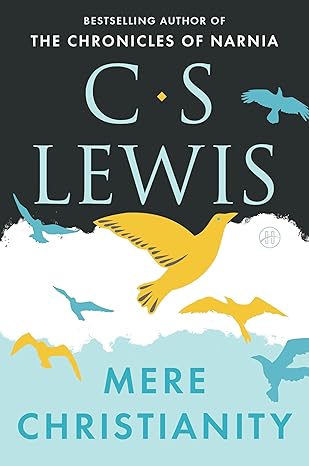
C.S. Lewis (1898-1963) was one of the intellectual giants of the twentieth century and arguably one of the most influential writers of his day. He was a Fellow and Tutor in English Literature at Oxford University until 1954, when he was unanimously elected to the Chair of Medieval and Renaissance Literature at Cambridge University, a position he held until his retirement. He wrote more than thirty books, allowing him to reach a vast audience, and his works continue to attract thousands of new readers every year. His most distinguished and popular accomplishments include Out of the Silent Planet, The Great Divorce, The Screwtape Letters, and the universally acknowledged classics The Chronicles of Narnia. To date, the Narnia books have sold over 100 million copies and have been transformed into three major motion pictures.
I have just started reading Mere Christianity. I have a book of collection of 7 Lewis’s books and Mere Christianity one of them. I have looked at the questions, and they are very interesting because it makes me get involved more in the book. Thank you for accepting into this group. I used to read a lot, but I got out of the habit and now I am going to start that reading again.
Glad to see this classic on the list!
Funny that I just last week finished reading this book. Excellently written and with great content. CSL lays out reasons for people to convert or return to Christianity that are still relevant. His prose is as impeccable as his reasoning. If I had to read this book again I would read chapter 9 first then the rest of it.
1. The “Moral Law” vs. Social Conditioning Lewis opens with the fascinating observation that when we argue, we aren’t just expressing personal distaste but appealing to a standard we expect the other person to know. While it is tempting to write this off as social conditioning or an evolutionary survival instinct, Lewis challenges us to look more deeply at the “third voice” within us. He points out that while we might have an instinct to help and an instinct to run, the Moral Law is the judge that tells us which instinct to follow, often favoring the weaker one. It’s a compelling argument because it suggests that if morality were just a biological drive, the strongest impulse would always win; instead, we often feel we ought to do the hard thing, pointing to a standard that exists outside of nature.
2. The Loving and Just God Lewis tries to move us away from the “Christianity-and-water” view of God as merely a benevolent grandfather who wants us to be happy. He reconciles love and justice by redefining love not as affectionate kindness, but as a relentless desire for the beloved’s ultimate good. It helps to think of it like an artist with a masterpiece or a parent with a child; true love doesn’t tolerate flaws that harm the beloved, which means God must be “just” and actively hostile to our evil to love us truly. While this can be a hard pill to swallow in a culture that values tolerance above all else, his explanation offers a deep comfort—it means God takes us too seriously to leave us as we are.
3. The Trilemma (Lord, Liar, or Lunatic) This is one of the most famous logical pivots in the book, where Lewis removes the “safe” option of calling Jesus merely a great moral teacher. He argues that a man who claimed to be God and forgive sins would not be a “good teacher”—he would either be the ultimate evil (a liar) or completely insane (a lunatic). While many find this logic inescapable, it often sparks lively debate about a fourth option: “Legend.” Some readers might wonder whether the biblical accounts are historically accurate enough to support the argument, suggesting that Jesus’ claims were later exaggerated by his followers, which adds a layer of historical complexity to Lewis’s philosophical puzzle.
4. Faith vs. Reason. It is refreshing how Lewis dismantles the idea that faith is about forcing yourself to believe something you know isn’t true. Instead, he defines faith as the art of holding onto things your reason has once accepted, despite your changing moods. We all know that our emotions shift—some days we feel brave, other days fearful—and Lewis argues that faith is the anchor that prevents these temporary emotions from washing away our intellectual convictions. This definition shifts the conversation from “blind belief” to “loyalty” and “steadfastness,” making faith sound more like a disciplined virtue than a wishful feeling.
5. The Virtues When Lewis walks through the virtues, he has a way of making ancient concepts feel strikingly modern, particularly when discussing Temperance or Charity. While the Cardinal virtues (Prudence, Temperance, Justice, Fortitude) are practical, many readers find themselves most challenged by his definition of Charity. He clarifies that Charity is not an emotion or a warm fuzzy feeling, but a state of the will—choosing to act for someone’s good even if you don’t like them. This takes the pressure off “feeling” loving and refocuses us on “acting” lovingly, which is a profound relief for anyone who struggles to like their difficult neighbors.
6. Pride: The Great Sin Lewis’s chapter on Pride is often cited as the most uncomfortable and convicting part of the book because he frames it as the “anti-God” state of mind. Unlike modern “pride,” which often means self-respect, Lewis defines it specifically as competitive—the pleasure of being above the rest. He argues that as long as you are looking down on others, you cannot see the God who is above you. This strikes a sharp contrast with modern self-help culture, as Lewis suggests that true humility isn’t thinking less of yourself, but thinking of yourself less—effectively forgetting the self entirely rather than trying to bolster it.
7. “Nice” vs. New Men This section tackles the confusing reality that some non-believers seem “nicer” than some Christians. Lewis explains that “niceness” is often just good digestion or a fortunate temperament, whereas Christianity is about transformation—turning a tin soldier into a real man. He argues that we shouldn’t judge the raw material (the personality) but the direction the soul is moving; a nasty person becoming slightly less nasty might be doing more spiritual work than a naturally friendly person remaining stagnant. In practical terms, this suggests that the goal of faith isn’t social conformity but a radical, internal renovation in which the “old self” is gradually replaced by the life of Christ.
8. The Trinity and Dimensions The doctrine of the Trinity is notoriously difficult to explain, but Lewis makes it accessible by bringing in geometry. He asks us to imagine dimensions: a line is one dimension, a square is two, and a cube is three. Just as a cube is a single body made of six squares, God is one Being made of three Persons. This analogy is beneficial because it shows how something can be logically consistent even if it contradicts the rules of a “lower” level of existence, such as simple arithmetic. It moves the Trinity from being a math problem (1+1+1=1) to being a description of a higher, more complex reality that we are invited to enter.
9. The Hall and the Rooms Lewis uses the metaphor of a house to describe the church: “Mere Christianity” is the grand hallway where all believers agree on the basics, but the hallway is only a waiting room. He insists that to live the faith truly, you must eventually go into a room—a specific denomination with its own fires, chairs, and meals. This approach is generally very successful in promoting unity because it validates the shared foundation of all believers without pretending that our differences don’t exist. It encourages us to treat those in other “rooms” as housemates and family, even if we disagree on how the furniture is arranged.
10. Timeliness vs. Datedness Reading Mere Christianity today is a mix of encountering timeless wisdom and stumbling over 1940s cultural artifacts. The sections on human nature, the psychological roots of sin, and the logic of the atonement feel incredibly relevant and sharp, proving that the human condition hasn’t changed much. However, modern readers often pause at his social examples, particularly his views on gender roles in marriage or his distinctively Freudian psychoanalysis references. Despite these dated moments, the core “mere” message—the logical case for Jesus and the call to a transformed life—remains a powerful challenge to the modern worldview.
Love the book. Could be a good discussion if enough participate. Interesting if more secular of AMAC conservatives give their two cents or should I say pence for CS Lewis , as well as more churchy types