
AMC BOOK

UNITED WE READ

BOOK OF THE MONTH
* September, 2025 *
Post Image

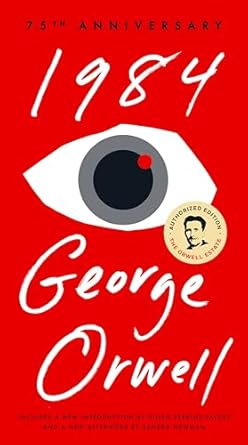
"1984"

By George Orwell | Published: June 8, 1949

AMAC'S ANALYSIS

Winston Smith, a member of the ruling Party in Oceania, grapples with constant surveillance and the Party's manipulation of truth and history. He rebels against Big Brother, the Party's omnipresent leader, by keeping a diary, engaging in a forbidden love affair with Julia, and eventually joining a resistance group, only to be betrayed and subjected to torture and mind control.

Buy 1984 Now!

MEET THE AUTHOR

George Orwell

George Orwell (1903–1950), born Eric Arthur Blair, was a British writer, journalist, and social critic best known for his novels 1984 and Animal Farm. A sharp critic of totalitarianism, authoritarianism, and political propaganda, Orwell’s work has had a profound influence on modern political thought and literature. His writing is marked by clarity, insight, and a deep commitment to truth and justice. Orwell also worked as a teacher, BBC broadcaster, and war correspondent, and his essays remain widely read for their commentary on politics, language, and society.

Author Image
AMC BOOK

Welcome
to the Club!

DISCUSSION QUESTIONS:
  • 1. What aspects of Orwell’s dystopian world felt most disturbing or realistic to you? Did any parts feel eerily relevant to today’s society?
  • 2. How does the concept of “Big Brother” reflect Orwell’s warning about government surveillance and control? Can you think of modern parallels?
  • 3. Discuss the role of language in the novel, especially Newspeak. How does the manipulation of language affect thought and freedom?
  • 4. What do Winston and Julia represent in the story? How do their actions reflect resistance—or complicity—in a totalitarian regime?
  • 5. Is the ending of 1984 inevitable? Do you believe Orwell intended to leave room for hope, or is it a warning of complete submission?
  • 6. How does the Party maintain its power beyond physical force? Consider propaganda, fear, and control of truth.
  • 7. What role does memory play in the novel? Why is controlling the past so important to the Party?
  • 8. How do you interpret the character of O'Brien? What does he represent in the context of totalitarian ideology?
  • 9. How does 1984 compare to other dystopian works you’ve read? What makes Orwell’s vision unique or especially chilling?
  • 10. What lessons do you think 1984 still offers readers today? How can we apply those lessons to protect freedom and truth?
Join the discussion below:
Subscribe
Notify of
guest
6 Comments
Most Voted
Newest Oldest
Inline Feedbacks
View all comments
Ed Daveski
Ed Daveski
8 months ago

With regards to Big Brother I believe a reasonable parallel would be the quick installation of control during COVID that was put in place for the good of the people and the “Cancel Culture” with common people reporting on others of their thoughts and speech along with surveillance of that speech.

We understand from this book that when a majority of people follow the direction of a tyrannical platform it is difficult to move the population back to truth after this type of leadership is established.

Dan
Dan
8 months ago
  • 1. What aspects of Orwell’s dystopian world felt most disturbing or realistic to you? Did any parts feel eerily relevant to today’s society?

The entire book seems like an operations order for today’s Woke-ist movement. One can’t help wondering if the entire movement toward Socialism is driven by this ‘will to power’ – the Nischean concept that is the underlying driving force behind Oceana.

  • 2. How does the concept of “Big Brother” reflect Orwell’s warning about government surveillance and control? Can you think of modern parallels?

It is almost a direct correlation to what China is doing now and promoting to all its client states.

  • 3. Discuss the role of language in the novel, especially Newspeak. How does the manipulation of language affect thought and freedom?

This is exactly what the Woke-ist movement is trying to do to Western civilization. The removal of the ability of people to have any conflicting thoughts with the state’s goals.

  • 4. What do Winston and Julia represent in the story? How do their actions reflect resistance—or complicity—in a totalitarian regime?

Love, emotions, passion, are things that the state has difficulty dealing with. Eventually, these biological drives would have resulted in them seeking to create a nuclear family. One of the things this authoritarian state decries.

  • 5. Is the ending of 1984 inevitable? Do you believe Orwell intended to leave room for hope, or is it a warning of complete submission?

I think that he drives his book in the direction of hope even though the characters end up in a hopeless state. He hints that even if it takes 1000’s of years eventually their state will be overthrown because it is unstable, and human beings have an innate biological need for stability.

  • 6. How does the Party maintain its power beyond physical force? Consider propaganda, fear, and control of truth.

Throughout the book there is a continuous explanation that by using all these tools and more to control reality, not just truth, that they can maintain the state far into the future.

  • 7. What role does memory play in the novel? Why is controlling the past so important to the Party?

As explained in the book, the past, present, and future are all interrelated. By controlling all aspects of these three pillars of reality, they feel invulnerable to change.

  • 8. How do you interpret the character of O’Brien? What does he represent in the context of totalitarian ideology?

He is the true believer. The ‘whip’ of the party. He would be similar to the inner circle of the Nazi or Communist Party. In a sense he has no individual existence. He is the localized face of the Party.

  • 9. How does 1984 compare to other dystopian works you’ve read? What makes Orwell’s vision unique or especially chilling?

Many of the dystopian works I have read provide an easy ‘out’, a hope for the future, that appeals to readers. This book does not do this. It points toward an evolution (or devolution) that is all too realistic. An nakedly non-positive.

  • 10. What lessons do you think 1984 still offers readers today? How can we apply those lessons to protect freedom and truth?

There are two levels of lessons that can be learned from the book. The first is the dangers of, and warning signs that indicate moving in this direction. However, there is an implied critique of Western Civilization’s current state that can give rise to the revolution this book predicts. Readers would well pay attention to the failures of the current system to make corrective action that would defuse the revolt the left could lead against the existing system.

Rich moyers
Rich moyers
8 months ago

From a book that was not intended to be a how-to guide but rather a warning, this book seems to predict the use of all instruments of surveillance, social pressure, legal warfare, and technology to quash a Free People. Furthermore, it demonstrates how easily corralled people are when fierce independence and courage falter.

Linda
Linda
8 months ago

Didn’t know there’s a book club.
Will have to check it out later when I don’t have so much other reading to do.

Barbara Bradshaw
Barbara Bradshaw
8 months ago

Read it in high school, reread it last year. Followed it up with Brave New World and Animal Farm.

Daniel S
Daniel S
8 months ago

The first time I have read this since High School (long ago). Can anyone doubt this is where we, as a nation, have been headed since the 1960’s?

6
0
Would love your thoughts, please comment.x
()
x