
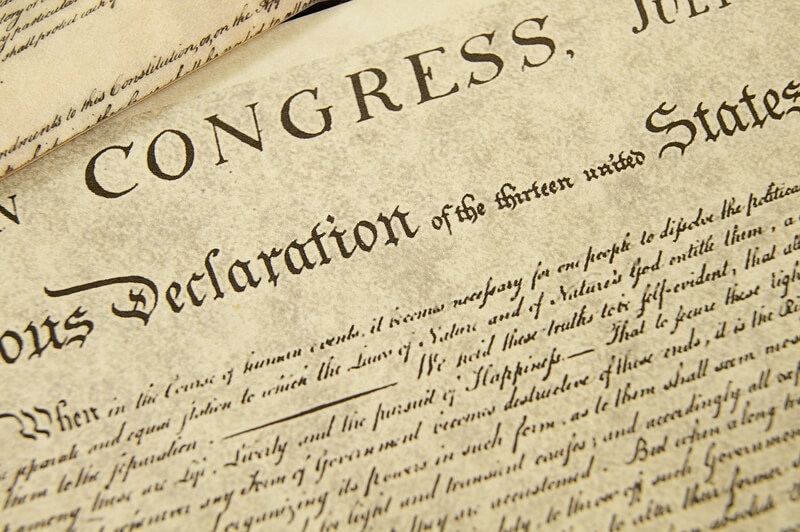
The following is a transcript of remarks delivered by law professor and former Kansas Attorney General Phill Kline on behalf of AMAC on the occasion of the 250th anniversary of the signing of the Declaration of Independence. The remarks were delivered on July 10, 2026, at the Great American State Fair in Washington, D.C.
One thousand and fifty-two yards northeast of where we now gather rest the founding documents of the United States — our Constitution and Declaration of Independence. They lie in a vault not just to prevent theft, but because the parchment itself is so fragile that oxygen would destroy it. Those documents will not stop a bullet. They will not, on their own, protect speech, secure worship, or preserve the right to assemble as we do now. Exposed to air, the parchment would crumble in our hands.
Yet the parchment bore that same fragility when it was first written. The parchment then, as now, derives its power when flesh and blood are attached to it.
The 56 men who signed the Declaration knew that in a broken world, the truths the parchment proclaimed would demand sacrifice. They knew that those truths would require, just as the parchment stated, the dedication of their lives, their fortunes, and their sacred honor — not sacred fortunes, not even sacred lives, but sacred honor.
For neither their fortunes nor even their lives were sacred, but sacredness rested in their fidelity to God. For sacredness is not attached to our tools, nor our institutions, but rather to the proper purposes for which they are created.
And so, government’s purpose, its design, must match that of the actions of our Savior; it must be willing to leave the ninety-nine to find the one. So, they proposed a new nation dedicated to the proposition that all men are created equal, and that government must constrain its power so as to cherish the intrinsic value of each person.
Our dignity and worth exist from our first moment of being, for it is gifted to us by our Creator. Our rights pre-exist America. They even pre-exist politics, for they rest on the proclamation of the eternal Author of eternal truths.
The United States was the first nation founded on these truths, and on this foundation American Exceptionalism rests — an exceptionalism that has been a blessing to the world.
But our founders also knew, as we must now always remember, that in a broken world humankind seeks to build its own Babels, worship its own creation, and use the individual as a means, rather than the end.
The story of humankind is not the story of the individual tyrannizing government, but rather is the story of government tyrannizing the individual.
Our founders knew that the parchment on which they wrote was fragile, that it could be trampled upon by boots and muskets. They knew it only held power if the parchment was attached to flesh and blood. And so, they affixed their own.
They did not whisper their treason, nor hide in anonymity. They lent the parchment their names, and to its cause pledged their lives, and their fortunes, and their sacred honor. Then they nailed that pledge to lampposts across the colonies, mailing a copy to the King.
The founders, in fidelity to the truths they proclaimed and in fidelity to the God who proclaimed them, announced their treason to the King, a ruler of the Kingdom of the world who commanded the world’s greatest military power. Our founders placed greater faith in the Author of truth than they placed fear in the powers of man.
They had properly placed their affections — not in their wealth, not even in their lives, but in their sacred honor. Their fidelity to those transcendent truths, written on parchment, defined their duty and animated their action.
These transcendent truths offered warmth on the frozen ground of Valley Forge. They lifted weary legs that left bloody footprints on the march to Trenton in the 18th century. The parchment — resounding from pulpits, passed from parents to children, and read and spoken in our communities — began forging a people, unleashing ingenuity, and lifting the lamp of liberty for a world residing in the darkness of tyranny.
These truths unmasked the hidden nature of unjust laws, revealing that procedural due process for an unjust law is nothing more than organized injustice; that to find justice we must measure the law’s application against its purpose and its purpose against the transcendent truths.
These transcendent truths march forward independent of our comings and our goings. They will dismantle what we build that rejects them, and our defiance of these truths creates great cost in the dismantling.
Our founders knew the parchment required great cost. And they were willing to pay that cost. And they did pay that cost.
But 13 years after the Declaration, and six years after the end of the war they initiated on parchment, those struggling to form the core procedural documents of our nation forgot the cost of defying those truths, and enshrined slavery in our Constitution.
Their compromise, thanks to God’s grace, did not defeat those truths. But just as Britain’s defiance of these truths cost it greatly, our nation’s defiance of our founding transcendent truths plunged the nation into division. The full bill came due in the fullness of time, 84 years after our founding. Homes and lives were devastated, communities destroyed, and 700,000 were left dead on the battlefield, in makeshift hospitals, and in their communities, caught between the warring armies in the American Civil War.
One point eight miles to the east of where we now stand, on the steps of the Capitol, on a raw and wet day on March 4, 1865, Abraham Lincoln tallied the enormous cost thus far paid in the Civil War, and he proclaimed “if God wills that [this mighty scourge of war] shall continue until all the wealth piled by the bondsman’s two hundred and fifty years of unrequited toil shall be sunk and until every drop of blood drawn from the lash shall be paid by another drawn with the sword as was said three thousand years ago still must be said ‘the judgments of the Lord are true and righteous altogether.’”
In our defiance, in our unwillingness to see the other as our neighbor, our willingness as a nation to treat other persons as a means to our wealth, as tools on our plantation, as creatures of God deserving of bondage — we defied the truths on that parchment.
But in the face of our defiance, the truths marched on and inspired the eventual abolition of slavery. But the parchment once again had to be embodied, it required flesh and it required blood; flesh and blood given in the sacrifice of merchants, farmers, abolitionists, and ordinary soldiers.
With them and in them, freedom advanced across Southern cotton fields in the 19th century. And in the face of further defiance by distant tyrants in the 20th century, these truths were carried in the bodies of American doughboys into the trenches of Europe in the First World War, and by GIs onto the sands of Omaha Beach — liberating concentration camps and the peoples of France, Belgium, the Netherlands, Luxembourg, Italy, French North Africa, the Philippines, and Burma — in the Second World War.
America and the truths on which she stands have shaped the world, and will continue to do so toward our blessing, if we measure ourselves against the ultimate source of the truth.
And so, we must remain vigilant, for these truths — and the voice they carry — can be silenced by our fears or by our false hopes.
On November 19, 1863, 68 miles to the north-northwest from where we now stand, on a battlefield where more than 7,000 Americans lost their lives, President Lincoln reminded the nation of that vigilance. Standing amid the graves of Gettysburg, he asked whether any nation conceived in liberty and dedicated to the proposition that all men are created equal can long endure. His question then remains our question today.
Lincoln recognized that we can celebrate those who have carried the burdens of liberty, those who have offered themselves for their posterity; but he also rightly noted that we cannot now dedicate nor consecrate the altar of liberty, for those who came before have already done so.
Yet, Lincoln said, it is right for us to have our parades, our gatherings, and our speeches — to celebrate the blessings of liberty in remembrance of those who sacrificed in the cause of liberty.
But true remembrance, true consecration, does not rise from such things. Rather, it is measured in how we lead our lives. As it was then, so it remains now, for as Lincoln proclaimed: “It is for us the living to be dedicated here to the unfinished work which they who fought here have thus far so nobly advanced. It is rather for us to be dedicated to the great task remaining before us [and to] take increased devotion to that cause for which they gave their last full measure of devotion.”
We do not live in a time exempt from liberty’s demand for sacrifice. It is, and always will be, true that while the eternal power of our Declaration remains, its temporal power is present only when the truths reflected in its words resonate in the hearts of a people — for the parchment must be attached to flesh and blood. We must give it our legs; our souls must breathe it in so we can breathe it out to others.
In this present moment — a time of relative peace and abundance — the cost of liberty is vigilance, contrasted with the ultimate sacrifice of those who came before. But if our indifference to these truths hardens into defiance, and the cries of those suffering under injustice reach into the heavens, the cost will be far greater than what is demanded now.
What shall we decide?
Two hundred twenty-five miles north-northeast of here stands an old stone house near what is now 3rd Street and 5th Avenue in Brooklyn. Today the area bustles with condos, townhouses, artists’ lofts, cafés, and bakeries. But 54 days after the Declaration was signed, on August 27, 1776, that ground was a fog-shrouded marsh, blood-stained and echoing with British cannon.
The world’s greatest military power had landed 20,000 soldiers on Long Island to crush the rebellion. George Washington’s army was divided. Roughly 3,261 men — 3,000 Continental regulars and 261 Maryland regulars under Captain Mordecai Gist — faced 10,000 British soldiers with their backs to the Gowanus marsh. Washington watched from a redoubt, certain he was witnessing the destruction of his army and the end of the cause on its fifty-fourth day.
Then, without prompting, Mordecai Gist stepped forward. He knew the British had flanked the position and that retreat across the marsh under fire would be slaughter. He said simply: “Sir, I and my Marylanders will hold the line while you retreat.”
Two hundred sixty-one Marylanders turned to face 10,000. They fixed bayonets and charged. The British were stunned.
The Americans were overwhelmed and fell back. Gist saw that more time was needed and he gathered his Marylanders again.
Two hundred sixty-one charged 10,000 again.
And they were thrown back. So, they charged again… and again… and again.
Five times 261 charged 10,000.
The rest of the army was saved. Sixty-one of the Marylanders made it back across the lines.
And George Washington wept, saying, “To lose such men on this day.”
Those men bought Washington one hour — one hour to escape across Gowanus Creek. One hour that saved the Continental Army. One hour that saved the Revolution.
Their bodies were found in heaps.
But their sacrifice purchased the future. Their sacrifice purchased the Republic. Their sacrifice purchased the chance for the parchment to become a people.



What an article, there are no words to describe the courage, character and magnificence of those men, the magnitude of what they’ve done, every one of them in all those years, the endurance and resolve, we should thank them daily on out knees for what they had courage to do .And done not for themselves but for those left behind and those who came after them. What men they were.
President Trump is trying to get us back to the Constitution and its values, but the Low-life, Constitution hating Democrats are fighting him every way they can.
We need to make sure that we do not lose the House and Senate this November, because if the Democrats gain control they will make all the Impeach President Trump, Pack the Supreme Court, outlaw ALL Guns, and that’s all they have to do, America will no longer exist as we know it!
God Bless America!
Save America —-Vote Republican! — Except RINO’s!
Phill Kline is a national treasure.