


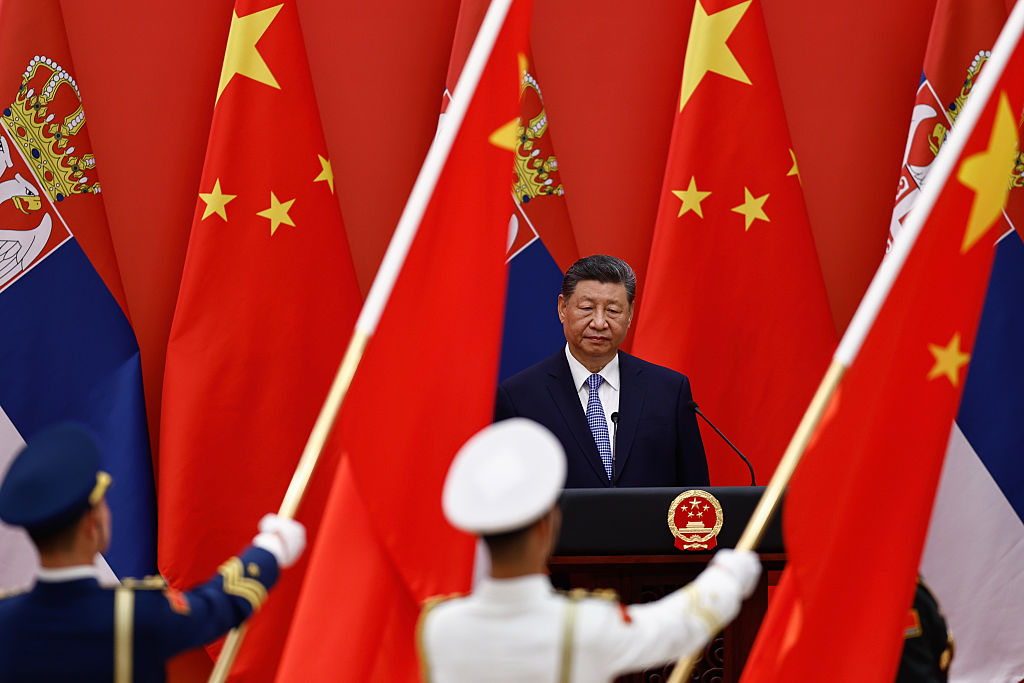
Earlier this month, Chinese leader Xi Jinping urged his nation to maintain “strategic resolve” with North Korea during a meeting with the Hermit Kingdom’s Premier Pak Thae Song marking the 65th anniversary of the neighbors’ friendship treaty. But more than just a diplomatic nicety, Xi’s remark reveals his growing inclination toward complete authoritarian control.
While China has remained authoritarian since the Communist Party seized power in 1949, the degree and style of repression have varied significantly. Under Mao Zedong, the country approached totalitarianism, with ideological purges, forced collectivization, pervasive state control, and unspeakable atrocities.
Deng Xiaoping, who took power in 1978, preserved one-party rule but reduced ideological intrusion into daily life, introduced market reforms, and promoted a more collective system of leadership – although the 1989 Tiananmen Square massacre showed the regime’s limits. Under Jiang Zemin and Hu Jintao, authoritarianism became more bureaucratic and predictable, with somewhat greater economic, academic, and personal freedom but no tolerance for organized political opposition.
Since Xi Jinping took power in 2012, however, China has moved back toward more centralized and personalistic rule, with expanded surveillance, censorship, party control, and repression. Xi’s recent actions indicate that he intends to push China toward a more radical form of communism rather than cede power. Like the former leaders of the Soviet Communist Party – which he views as the blueprint for the communist movement – Xi has surrounded himself with a phalanx of advisors who are loyal first and foremost to him rather than the CCP.
The first major barrier to Xi’s growing power fell in 2018, when the CCP abolished presidential term limits – thus clearing the way for him to lead indefinitely. He is expected to easily secure another five-year term at the CCP Congress next year, extending his rule to at least 20 years.
Xi has also quietly eroded retirement norms to remain in power. As one former high-ranking CCP official who defected to the West explained to me, “Mao believed age brought wisdom and that he alone should lead indefinitely.” After Mao’s death, interim leader Hua Guofeng “quietly directed the Central Discipline Inspection Commission to retire Politburo members at 68,” concerned by the aging Soviet leadership and watching a generation of Kremlin elders die in the 1980s.
By the early 2000s, 68 had become the de facto retirement age for almost all senior party officials. But Xi just marked his 73rd birthday last month – a milestone that was almost entirely ignored by the state-controlled media. Many of Xi’s closest allies are also flouting the retirement age.
The most significant of these is Cai Qi, who turned 70 this year. Cai is a constant presence at Xi’s side, and the pair have been working closely together since the 1990s. This month, Xi appointed Cai as the next president of the Central Party School, which trains rising CCP officials. Historically, ambitious younger leaders have posed the greatest threat to dictators and authoritarians. From his post at the school, Cai will be able to ensure that the next generation of CCP officials is strictly loyal to Xi.
Xi has also tasked Cai with overseeing a new campaign to establish Xi’s ideas about discipline and loyalty, known as “Xi Jinping Thought on Party Building,” as the official doctrine of the CCP. That doctrine emphasizes complete and total loyalty to CCP leadership – with Xi at the top.
Professor Suen Yong, another CCP defector, said that Xi now views the Party’s organizational strength as central to his own power, much like Lenin, Stalin, and Mao. Xi seeks the same total control Lenin and Stalin held – over politics, culture, and even people’s thoughts, tastes, and feelings. “Like Soviet leaders, Xi hides behind the ‘dictatorship of the proletariat,’ Suen said. “But in practice, it’s a ‘dictatorship over the proletariat.’”
Xi’s ambitions are no longer visible only through personnel decisions and opaque struggles inside the CCP. On July 2, the Xinhua Research Institute, part of China’s official state news agency, published a lengthy report extolling “Xi Jinping Thought on Party Building.” The report declared Communist Party leadership to be the “most essential feature” of China’s political system and called for Party control to reach across government, the courts, the military, businesses, social organizations, and even nominally autonomous grassroots institutions. It further insisted that the entire Party’s thoughts and actions must be brought into alignment with the Central Committee – which Xi now dominates.
Even more revealingly, the report celebrated political indoctrination as the foundation of Party unity. It noted that Xi Jinping Thought is required instruction at more than 3,000 party schools and praised a form of loyalty that is “unique, thorough, unconditional” and free of any impurity or reservation. The goal is not simply obedience to government policy, but the remolding of officials’ judgment, beliefs, and internal loyalties to be directed at Xi himself.
China is not yet North Korea. Its economy is far more connected to the outside world, and its society remains less isolated and comprehensively controlled. But under Xi, the boundaries separating the Party, the state, civil society, and the supreme leader are steadily disappearing.
What began with the elimination of term limits and the erosion of retirement conventions is now hardening into an ideological system built around one party, one approved political doctrine, one center of authority – and, increasingly, one man.

About the author
Ben Solis
Contributing Writer
Expertise
- • International affairs
- • History
- • Foreign policy and national security
Credentials
- • International affairs journalist, historian, and researcher (writing under a pen name)


29 Comments