


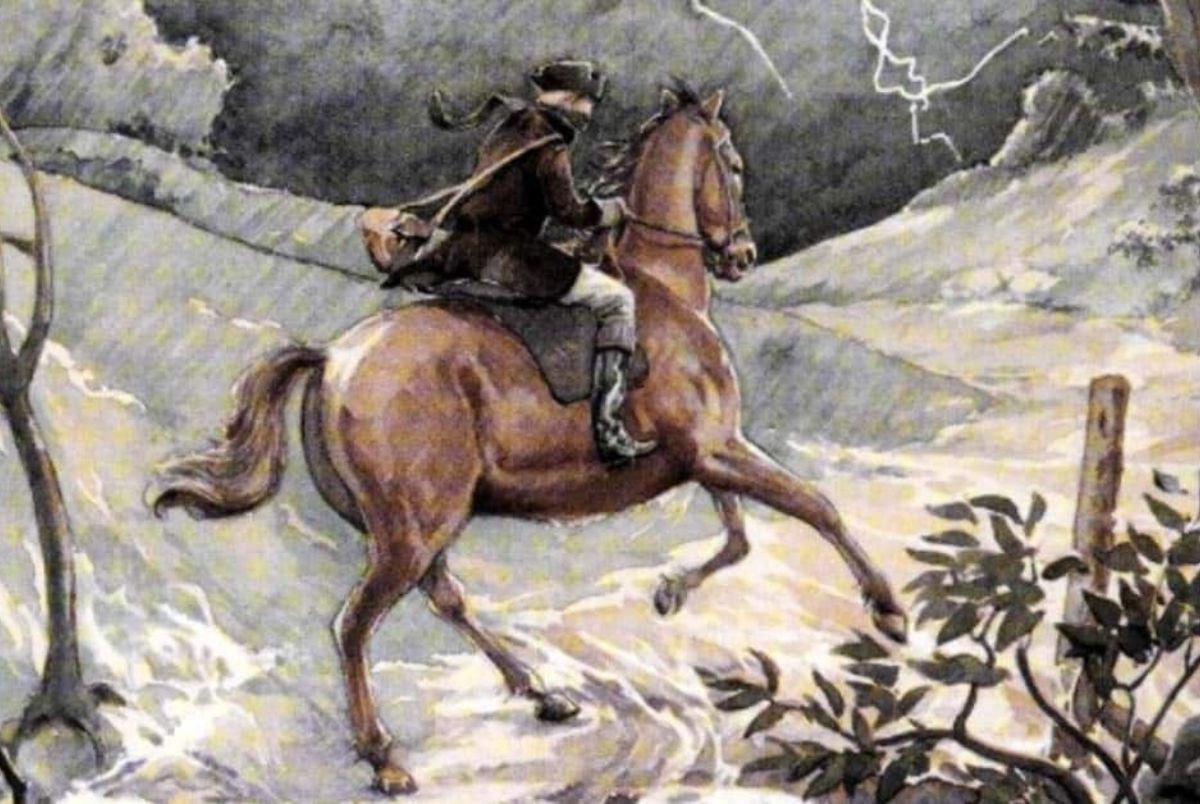
The storm clouds gathering over Delaware mirrored the darker storm spreading across the colonies. America stood on the edge of independence. Gunfire had already cracked across the fields of Lexington and Concord, Redcoats crowded the harbors and wharfs, and the fate of independence—if it was to come at all—rested in the hands of a 47-year-old cancer-stricken Delaware planter Caesar Rodney.
The hour was approaching midnight when an urgent pounding rattled Rodney’s door—loud enough to cut through the thunder rolling across the fields. He rose slowly, the familiar ache in his face pulsing with each heartbeat, and opened the door to find a soaked messenger, rainwater streaming from his hat and cloak.
Rodney took the folded note, its ink already running from the storm. He held it close to the lantern, smoothing the damp paper with trembling hands. He read the words once, then again, letting their meaning settle in his stomach.
He knew exactly what the message required of him. Ahead lay seventy miles of darkness, mud, and violent storm—a brutal ride for a healthy man. But Rodney was not healthy. Every breath burned, every movement sent pain radiating through his jaw, and he would have to make the journey alone, through a night that seemed determined to break him before dawn.
It was July 1, 1776. The Second Continental Congress was considering independence. But Delaware’s delegation was deadlocked. The Congress had first convened on May 10, 1775, and Rodney as one of three delegates from Delaware was present. But illness had forced him home. Rodney was dying from cancer.
As the storm raged, so did Rodney’s pain. His cancer had eaten deep into his cheek and jaw, leaving his skin raw and tender. He wore a green silk cloth over the disfigured side of his face, but it did little to ease the agony. Breathing was difficult. Speaking was harder. Some days he could barely rise from bed.
But the cause of independence required his presence. The Continental Congress was ready to vote on independence, but the Delaware delegation was split. The failure of any colony to support the decision could defeat the cause entirely. The vote was imminent. Likely the next day.
He was no longer a strong rider. But he was still Caesar Rodney.
He stuffed the note in his pocket and put on his boots.
Born in 1728, Caesar Rodney had been shaped by life on a quiet Delaware farm working in the fields. His father died when he was 17, leaving him with responsibilities far heavier than most boys his age. Duty was not a matter of convenience, but of character.
He served in the militia during the French and Indian War, rising to the rank of captain. He became Sheriff of Kent County, then a member of the colonial assembly, later a judge, and then a delegate to the Stamp Act Congress. He was not a man who sought the spotlight. He was a man who stepped forward as others stepped back.
By 1776, the conflict with King George III had become something far darker than political disagreement. Parliament’s taxes, the closing of Boston Harbor, the quartering of troops, and the bloodshed at Lexington and Concord had convinced many colonists that the Crown no longer saw them as citizens, but merely subjects.
The King’s declaration that the colonies were in “open rebellion” sealed the matter. British troops poured into America. Warships lined the coast. And the King made clear that those who defied his authority would face a horrible fate.
In the face of such might, the colonies had to be united.
Rodney rode out into the night as the storm broke open above him. Rain hammered the ground, turning the roads to rivers of mud. The wind tore at his cloak. Water soaked through his boots. Every hoofbeat of the 70 miles from Dover to Philadelphia was a battle.
His breathing grew ragged. The cloth on his face chafed against the raw skin. Pain pulsed with every movement of his horse.
He pressed on.
Rodney changed horses at least once, maybe twice—accounts differ—but his urgency never wavered. By dawn, the storm had passed, leaving behind a heavy silence. Rodney, soaked, feverish, and exhausted, reached the outskirts of Philadelphia as the first delegates began to gather in what is now known as Independence Hall.
As the voting began, Rodney entered the chamber still wearing his riding boots, mud splattered up his legs, his cloak damp and heavy. His face was gaunt, his eyes sunken, his breathing strained.
Delaware’s vote was called.
“George Read? No.”
“Thomas McKean? Yes.”
“Caesar Rodney?”
Rodney raised himself to his full length, turned his cancer eaten face towards John Hancock, the presiding officer. In a quiet but firm voice, he replied, “I believe the voice of my constituents and of all sensible and honest men is in favor of Independence.”
The vote cleared the way for Congress to move forward. On July 4, they adopted Thomas Jefferson’s draft of the Declaration of Independence.
We remember Paul Revere’s ride because Henry Wadsworth Longfellow immortalized it in poetry. Rodney’s ride received no such gift—although that is now beginning to change thanks to President Donald Trump, who honored Rodney with a proclamation in 2020 and earlier this year moved his statue from a dusty storage room to a place of honor in the nation’s capital.
Revere rode to warn of an approaching enemy. Rodney rode, already marked by a mortal enemy within his own body, to ensure that a new nation would be born with a united voice.
His ride did not echo through taverns or ballads. It echoed through the character of a people who believed that liberty was worth suffering for—worth everything. Rodney did not ride because he was strong. He rode because the moment demanded someone who understood that duty is not postponed until the weather clears or the pain subsides.
And that is the heart of American exceptionalism.
It is not found in invincible armies or perfect leaders. It is found in ordinary citizens who choose courage when comfort would be easier, who rise when rising hurts, who understand that the republic survives only when individuals decide that the cost is worth paying.
On that storm-soaked night in July 1776, a dying man rode 70 miles through darkness and mud so that 13 colonies could speak with one voice. He arrived trembling, soaked, and exhausted—and cast a vote that helped birth a nation and gave the chance for a piece of parchment to become a people.
Rodney’s ride reminds us that America’s greatness has never depended on the absence of storms. It has depended on citizens who ride through them.


11 Comments