


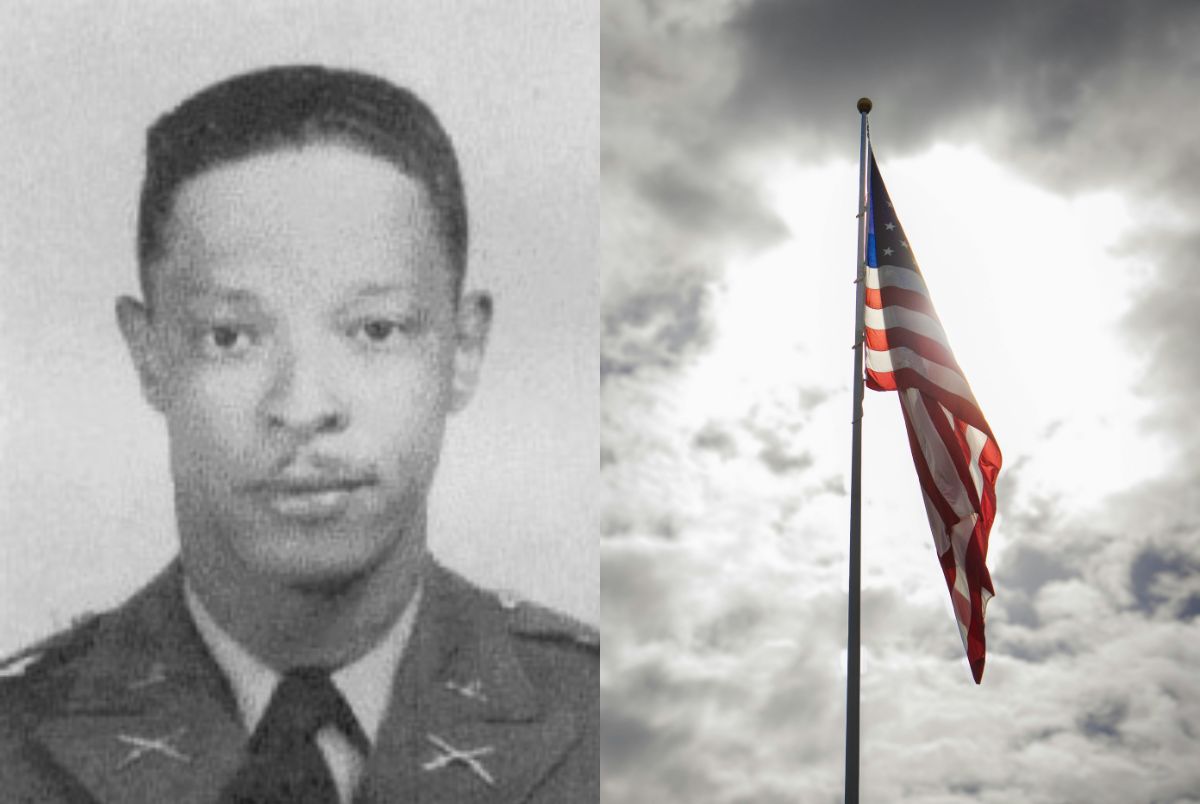
On Memorial Day, we often speak in abstractions — sacrifice, service, freedom. But a free people cannot survive on abstractions alone. A republic survives only when it remembers the names, the faces, and the stories of those who gave everything so the rest of us could live in peace.
Few stories capture the moral weight of this day more than that of Lt. John Robert Fox, a 29-year-old artillery officer who made a decision so courageous, so selfless, that it still echoes across the generations.
Fox was a member of the 92nd Infantry Division, the famed “Buffalo Soldiers,” one of the segregated African American units that fought in World War II. On the morning of December 26, 1944, his unit was defending the small Italian mountain village of Sommocolonia against a massive German assault that formed part of Operation Wintergewitter (Winter Storm) – the enemy’s surprise Christmas offensive.
The bitter cold had settled over the snow-dusted Apennine hills, with biting winds and low clouds that grounded Allied aircraft and turned the narrow stone streets into a frozen kill zone. On Christmas night, German and Italian troops had quietly infiltrated the town under cover of darkness, many slipping in dressed in civilian clothes to avoid detection. By early morning, the village was largely overrun.
At approximately 4:00 a.m., a thunderous artillery barrage – “everything the Germans had” – erupted, pounding American positions. Uniformed enemy forces then poured into the streets in overwhelming numbers. The fighting turned fierce and chaotic. Gunfire echoed off ancient stone buildings as civilians who had not yet fled cowered in their homes or tried desperately to escape through the alleys.
Many Buffalo Soldiers fell that brutal morning; dozens from the 92nd Infantry Division lost their lives in the defense of Sommocolonia and the surrounding valley. Greatly outnumbered, most American forces were forced to withdraw under heavy fire.
Fox and a small observation party volunteered to stay behind as forward observers – a role that required them to remain in the village, directing artillery fire as the Germans advanced.
From the second floor of a house, Fox radioed coordinates back to his artillery battery. He called in fire closer and closer to his own position as the Germans flooded the streets. The men on the other end of the radio grew uneasy. The shells were landing dangerously near him. Then Fox gave the order that would define his life – and his death:
“Fire it! There’s more of them than there are of us. Give them hell!”
The artillery officer on the other end protested. The coordinates Fox had given would land the barrage directly on top of him and his observation party. Fox repeated the order. He knew exactly what he was asking. He knew what it would cost. And he knew that if the Germans broke through, his unit – and the civilians who had not escaped – would be overrun.
The battery fired.
When Allied forces retook the village, they found Fox’s body among nearly one hundred dead German soldiers. One man, with his small team, had delayed an entire enemy advance long enough for the Allies to regroup. One man had given his life so that others might live. One man had made a decision that required the rarest kind of courage.
Because Fox was a Black officer serving in a segregated Army, his heroism was not fully recognized for decades. It was not until 1997 – more than 50 years after his death – that he was finally awarded the Medal of Honor. The citation reads, in part, that his “gallant and courageous actions… were in keeping with the highest traditions of military service.” That is true. But it is also incomplete. Fox’s actions were in keeping with the highest traditions of the American story itself.
And that is why we tell these stories on Memorial Day.
We tell them because they remind us that freedom is not an inheritance – it is a bequest. It is handed down from men like Fox, who never came home, to generations who will never know their names unless we choose to make them known. We tell their stories because they close the distance between a military that serves and a civilian population that benefits. We tell them because a nation that forgets its dead forgets what it owes the living.
We live in a time when cynicism is cheap and gratitude is rare. But Memorial Day calls us to something higher. It calls us to remember that the blessings we enjoy – the right to worship, to speak, to raise our children in peace – were purchased by men who believed that some things are worth dying for. Men who believed that duty is not a slogan but a summons. Men who believed that the measure of a life is not how long it lasts, but what it is lived for.
Lt. John Robert Fox understood that. He understood it in the cold streets of an Italian village, with the enemy closing in, with the radio in his hand, with the knowledge that the next order he gave would be his last. And he gave it anyway.
This Memorial Day, don’t let the day pass in silence. Don’t let it become just another long weekend. Tell a story. Tell Fox’s story. Read his Medal of Honor Citation below, out loud. Tell the story of one American who gave everything so that the rest of us could live in freedom.
A nation that remembers its dead is a nation that still deserves the freedom they bought.
Medal of Honor Citation For conspicuous gallantry and intrepidity at the risk of his life above and beyond the call of duty: First Lieutenant John R. Fox distinguished himself by extraordinary heroism at the risk of his own life on 26 December 1944 in the Serchio River Valley Sector, in the vicinity of Sommocolonia, Italy. Lieutenant Fox was a member of Cannon Company, 366th Infantry, 92d Infantry Division, acting as a forward observer, while attached to the 598th Field Artillery Battalion. Christmas Day in the Serchio Valley was spent in positions which had been occupied for some weeks. During Christmas night, there was a gradual influx of enemy soldiers in civilian clothes and by early morning the town was largely in enemy hands. Reports were received that the area was being heavily shelled by everything the Germans had, and although most of the U.S. infantry forces withdrew from the town, Lieutenant Fox and members of his observer party remained behind on the second floor of a house, directing defensive fires. Lieutenant Fox reported at 0800 hours that the Germans were in the streets and attacking in strength. He called for artillery fire increasingly close to his own position. He told his battalion commander, “That was just where I wanted it. Bring it in 60 yards!” His commander protested that there was a heavy barrage in the area and the bombardment would be too close. Lieutenant Fox gave his adjustment, requesting that the barrage be fired. The distance was cut in half. The Germans continued to press forward in large numbers, surrounding the position. Lieutenant Fox again called for artillery fire with the commander protesting again, stating, “Fox, that will be on you!” The last communication from Lieutenant Fox was, “Fire It! There’s more of them than there are of us. Give them hell!” The bodies of Lieutenant Fox and his party were found in the vicinity of his position when his position was taken. This action, by Lieutenant Fox, at the cost of his own life, inflicted heavy casualties, causing the deaths of approximately 100 German soldiers, thereby delaying the advance of the enemy until infantry and artillery units could be reorganized to meet the attack. Lieutenant Fox’s extraordinarily valorous actions exemplify the highest traditions of the military service.


25 Comments