
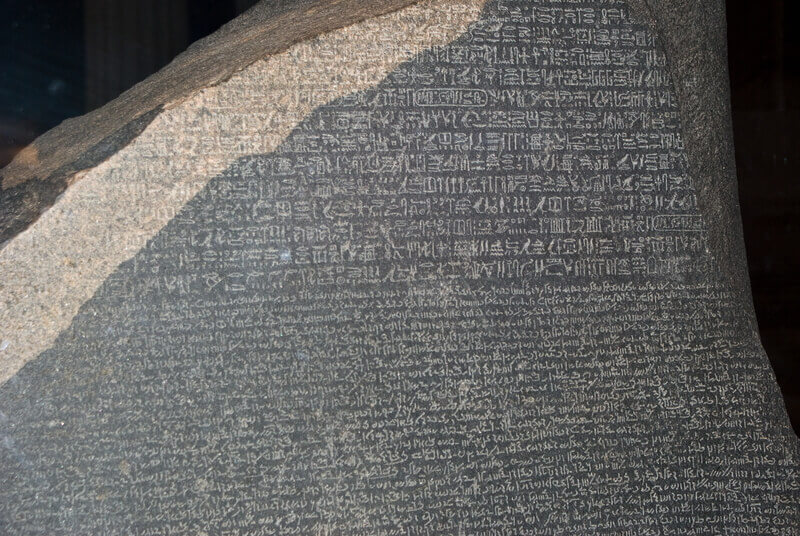
On July 15, 1799, French soldiers serving under Napoleon Bonaparte made one of the most important archaeological discoveries in history when they uncovered the Rosetta Stone near the town of Rosetta (modern-day Rashid) in Egypt. What initially appeared to be an ordinary slab of dark granodiorite would ultimately unlock the secrets of ancient Egyptian civilization, allowing scholars to decipher hieroglyphics for the first time in nearly 1,500 years. The Rosetta Stone remains one of the most significant artifacts ever discovered and is often credited with transforming the study of ancient Egypt.
The discovery occurred during Napoleon’s Egyptian campaign, which sought not only military conquest but also scientific exploration. Along with thousands of soldiers, Napoleon brought engineers, artists, scientists, and scholars to document Egypt’s ancient monuments and culture. While strengthening the defenses of Fort Julien near Rosetta, French engineer Pierre-François Bouchard noticed a carved stone built into an old wall. Recognizing that the inscriptions might be important, he preserved the artifact and sent it to scholars for examination.
The Rosetta Stone measured about four feet tall and contained the same official decree written in three different scripts. The top portion featured ancient Egyptian hieroglyphics, the middle was written in Demotic, the everyday script used in Egypt at the time, and the bottom contained Ancient Greek, a language scholars could still read. The decree itself, issued in 196 B.C., honored King Ptolemy V for his service to Egypt and ordered that the proclamation be displayed in temples throughout the kingdom.
Although scholars immediately recognized the importance of the trilingual inscription, deciphering the hieroglyphics proved to be an enormous challenge. For centuries, many believed hieroglyphics were purely symbolic rather than representing spoken language. Early researchers made gradual progress, but the breakthrough came in 1822 when French linguist Jean-François Champollion demonstrated that hieroglyphics combined phonetic symbols with pictorial signs. By comparing the Greek text with the Egyptian inscriptions, Champollion unlocked the ancient writing system and forever changed the field of Egyptology.
The Rosetta Stone itself changed hands after Britain’s victory over France in Egypt. Under the terms of the Treaty of Alexandria in 1801, the artifact was surrendered to the British and transported to London. Since 1802, it has been displayed at the British Museum, where it remains one of the institution’s most visited and recognizable exhibits. In recent years, Egypt has repeatedly called for its return, making the stone part of an ongoing international conversation about cultural heritage and museum collections.
The discovery of the Rosetta Stone opened a window into a civilization that had long been shrouded in mystery. Thanks to its inscriptions, historians can now read ancient Egyptian literature, religious texts, government records, and monumental inscriptions that were once indecipherable. More than two centuries after its discovery, the Rosetta Stone continues to symbolize the power of knowledge, scholarship, and perseverance, reminding us that a single archaeological find can forever transform humanity’s understanding of the past.







Interesting.