

The greatest threat to democracy isn’t fascism, white supremacy, or the left’s much-feared “bad orange man.” It’s the unelected and powerful federal bureaucracy that operates outside of the will of the people.
This bureaucracy can (and has) investigated and harassed peaceful citizens. It can (and has) directed taxpayer money to decidedly anti-American programs and blatantly political ends. It can (and has) tried to smear, slander, persecute, and imprison anyone who gets in its way.
Whether you call it the Deep State, the administrative state, or the swamp, it’s all part of the same problem: A large part of the federal government is uncontrolled and even outright antagonistic toward the people it is supposed to serve.
This terrifying reality helps explain many of President Donald Trump’s most significant actions in his first months—including nominating Tulsi Gabbard and Kash Patel to root out corruption in the intelligence and law enforcement apparatuses, respectively, and throwing USAID in the woodchipper.
I’ve argued before that the Department of Government Efficiency (DOGE) isn’t just about increasing government efficiency or cutting waste. Even more importantly, it’s about challenging the corrupt power systems that have effectively usurped the democratic will of the voters.
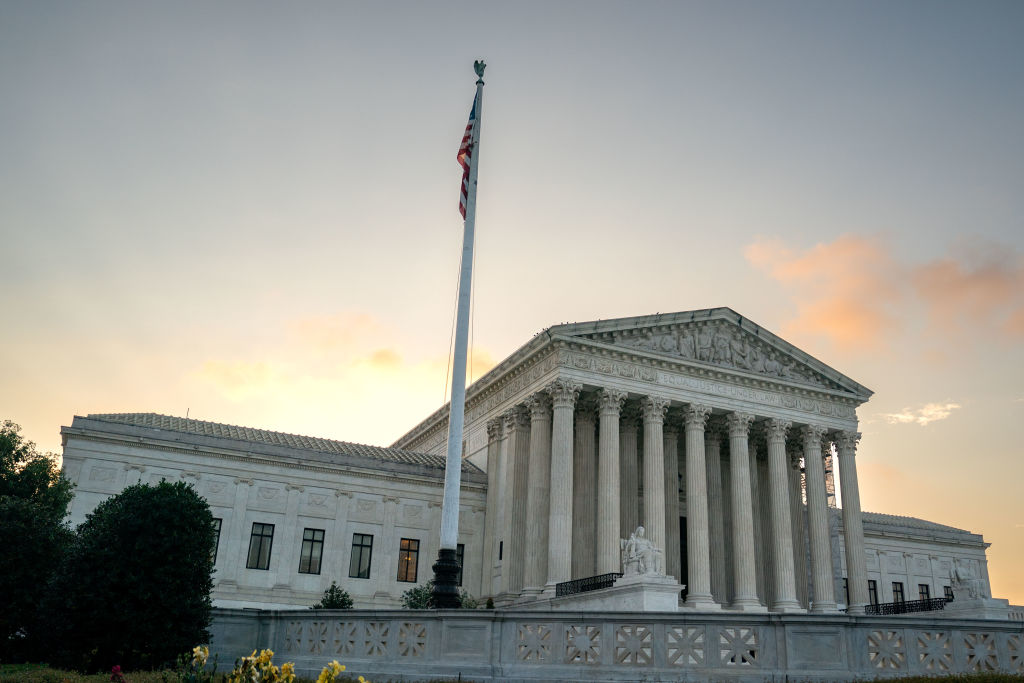
Now, it looks like the Supreme Court has a chance to get in on the government reform game with the so far little-noticed case FCC v. Consumers’ Research. Oral arguments are set for Wednesday, and if the Court rules based on constitutional principles instead of according to some legal technicality, the Deep State as we know it could see its foundation start to crack.
The issue is something called the Universal Service Fund (USF) under the Federal Communications Commission (FCC). The FCC is supposed to tax consumers to fund the USF in order to increase internet access, but it is as wasteful as government waste gets. One company funded by USF committed $100 million in fraud. Another person allegedly used money from the USF to buy a jet, a yacht club membership, and a Ferrari. Your tax dollars at work.
The fraud is bad enough, and any positive ruling by the Court will mean savings for taxpayers. But at its core, this case isn’t about waste. It’s about how the whole USF scheme works in the first place—and how a similar corrupt playbook has been deployed throughout the rest of the federal bureaucracy for decades.
According to the Texas Public Policy Foundation and the law firm Boyden Gray PLLC—the two organizations arguing against the government at the Supreme Court—the USF raises money through a private group of telecom insiders. In other words, the very companies that benefit from the tax the USF levies decide how much you will pay. The only reason this cabal even has the power to raise taxes is because the FCC gave them that power.
But wait, how does the FCC have the power to raise taxes in the first place? It doesn’t take a legal scholar to understand the first line of Article I, Section 8 of the Constitution: “The Congress shall have Power To lay and collect Taxes.”
That’s where this case gets interesting. Lawyers are arguing that the Court should crack down on the USF’s tax scheme not just because it’s wasteful, but because it violates something called the nondelegation doctrine, meaning that no branch of government can exercise the powers of another branch.
As Trent McCotter, a partner at Boyden Gray and one of the top lawyers on the case, said, “The Universal Service Fund statute represents the first time in American history that Congress gave an agency the power to raise domestic taxes, without any kind of objective limitations on the amount raised… Congress – and only Congress – must determine the taxes that Americans pay.”
Put simply, the nondelegation doctrine means the executive can’t let the judiciary take executive actions like directing foreign policy. The judiciary can’t let Congress take judicial actions like making rulings on legal cases (outside of impeachments). And Congress can’t let the executive take congressional actions like laying and collecting taxes.
If you remember your American government course, you’ll recognize that the nondelegation doctrine is really just a way to preserve the separation of powers, which was the primary safeguard our Founders instituted to prevent tyranny.
For generations, the federal bureaucracy has bypassed that safeguard by collecting executive, legislative, and judicial powers all into the singular body of the administrative state. If the Supreme Court rules that the USF is unconstitutional according to the nondelegation doctrine, it will be a shot across the bow for the entire federal bureaucracy.
This could be a chance for the Supreme Court to out-DOGE DOGE.
For example, the very concept of an “administrative law court” is a contradiction of terms. Courts are a tool of the judiciary, not the administrative state.
For years, Americans have been subject to insane, nation-altering “regulations” like electric vehicle mandates and bans on incandescent lightbulbs. Every reasonable observer knows such “regulations” are just another word for “laws.” Again, the Constitution is clear on such matters: “All legislative Powers herein granted shall be vested in a Congress of the United States” (Article I, Section 1).
The administrative state has been slowly eroding the separation of powers, and FCC v. Consumers’ Research could finally begin to restore a proper balance.
Every department, office, bureau, agency, commission, or board in the permanent bureaucracy that exercises an authority from another branch can be targeted and sued with renewed vigor if the Court rules against the legality of the USF.
Indeed, the president himself, as a constitutional actor, could declare that he has no authority to operate the parts of his administration that clearly violate the nondelegation doctrine. That could be a major boon for President Trump’s mission to dismantle large parts of the federal bureaucracy without having to surmount the Senate’s 60-vote threshold.
We’ll see what happens—it will be a few months before the Court issues its final decision. But a robust ruling on this case could be another hammer blow to the administrative state already reeling from the Trump administration’s program of constitutional restoration.
Horatius is the pen name of a writer who served in the first Trump White House and on Capitol Hill.



Corruption has always been hiding in plain sight and no one bothered to look until now. It would appear that every bureaucratic controlled entity has its sinister side. But how deep does this go and how long will they expect to get away with it? Exposing truth and revealing who’s behind it is just the beginning. Is it any wonder the corrupted and those who that defend them might be how they got away with it for so long?
Ok, so we Americans can research people during an election in order to make an informed decision on the candidate of our choice. But, please explain to me how this USF has been going on for generations and we know nothing about it. The Deep State is living high on our tax dollars and sit back and allow it to happen. Praise God for a businessman like President Trump who has the knowledge and foresight to look into these things. Simply stated, I am appalled.
I have little faith in the Supreme Court, and the “Swamp” could easily be renamed the “Cesspool.”
Interesting how our Constitution, when followed, has the right answers to many questions. Congress is suppose to be the only body that can levy and collect taxes from The People. The writers of the Constitution knew what they were doing and if we would just look to the Constitution which is our ruling document, we would find out just how to handle most issues that crop up. Anyone who does not want our DC government to follow the Constitution needs to either try to legally amend it or keep their mouths shut.
I’m not holding my breath. I’m afraid this country is on a non-stoppable downward spiral. Just make sure you have accepted Christ Jesus as your savior. Everything is going to change soon. The Judgment of the Lord is eternal. And no George Soros cannot buy his way out
Will USSC aid DOGE or NOT or be the DC Swamp
This is ridiculous all Doge is reducing spending in Federal government to keep a balance budget! Which is primary function of President to make sure that we stay with our budget! President is like father figure that represent the American people!
Hopefully our Supreme Court will unanimously show us how they interpret the “NONDELEGATION DOCTINE.” SOON WE WILL SEE THOSE WHO SERVES THEIR PARTY AND NOT THE COUNTRY.
Perhaps like a compost heap Congress should be turned upside down. Drive that pitchfork really deep and shake it..
I concur. and if you notice they might have been in power since they killed Republican presidents: Pres. Abraham Lincoln, Pres. James Abraham Garfield, Pres. William McKinley, Pres. John F. Kennedy & all from assassin’s bullets, and they attempted to kill Pres. Ronald Reagan & Pres. Donald J. Trump. Why? Maybe because they were all for the people & could not be manipulated. This pattern is scary for any Republican President and I still fear for Pres. Donald J. Trump. May God protect him always and punish those who do him harm.
We The People sure do hope so. Reversing the integration of powers between Congress and the Administration is long overdue. Executive Orders having the weight of laws and Admin depts ability to enforce them is not Constitutionally legal.
Our Constitution has been ignored by Congress (mostly Democrats) for decades to grow the bureaucracy and their power. But SCOTUS can only ‘fix’ it IF those issues are brought before them, as has been this case.
Thank you, Horatious, for this highly informative article.
If only Congress is permitted to Lay and COLLECT taxes, under which branch is the IRS controlled? For example, was POTUS able to hire 80,000 IRS workers without Congressional approval of funding? Or, who has the authority to fire them?
Known for a long time that Roberts is worthless but I suspect that the Leftist Dogs have threatened the safety of Amy’s family. She did a quick turnaround from how she was in the court to begin with. Amy should ask Trump to intervene in this or she and her family will be under the thumb of these thugs forever. Nothing would be worth that!
Some degree of bureaucratic rule making is necessary. Take the FCC, among other things, they manage radio communication/spectrum allocation. It takes a good understanding of the science and technology to manage that well. That is beyond the pervue of the average citizen-legislator. (nevermind politician) I can’t imagine any good outcomes from having the likes of AOC vote on the majority of the FCC’s rules.
So, we’ve attempted to delegate some of Congress’s legislative powers to these agencies, where it makes sense. That means drawing a line, But, as with all such things, the line has been pushed — a lot. Given human nature, the line will *always* be pushed. I think we need a different approach for these situations.
Also arguing for a different approach is that all of these agencies are bundled under the President. That means we get one vote for one of two people every four years to have our say on how these agencies are run. That’s insane.
I think we need to get these agencies out from under the President and have them more directly answerable to the people, or the States.
Fortunately, the Constitution provides a mechanism to do this — compacts between the States. Congess would write up a compact covering the responsibilities of an agency such as the FCC. The compact would lay out how the executive, legislative and judicial functions are to be handled (possibly including national elections). Funding could be through Congessional allotment, State contributions and/or fines/fees/other assessments. Then Congress would authorize removing any State who signs on to the compact from the authority of the federal agency.
Using this approach we could have national elections for the head of the EPA and it’s board members. Smaller/less impactful agencies might be selected by State legislatures. Agencies wouldn’t have to be national either, they could be regional or even competing versions (e.g. different labor relations boards for right-to-work States vs. union favoring States). Agencies could be optional, those States who want a Department of Education could sign up while others can opt out.
If we do this right, we could completely change Presidential elections. They would become more about selecting a commander-in-chief and foreign policy, and less about domestic policy — as it should be.
I was born in 1944 and when we were taught CIVICS in school many of these entities didn’t even exist. I appreciate these articles as a way to update my education.
Please make this so!
Makes me feel like a “rented mule”.
“Rented mule” is an idiom that refers to treating someone or something harshly or without care, similar to how a rented animal might be overworked since it is not owned. It implies a lack of concern for the well-being of the person or object being treated this way.
Damned disgusting.