
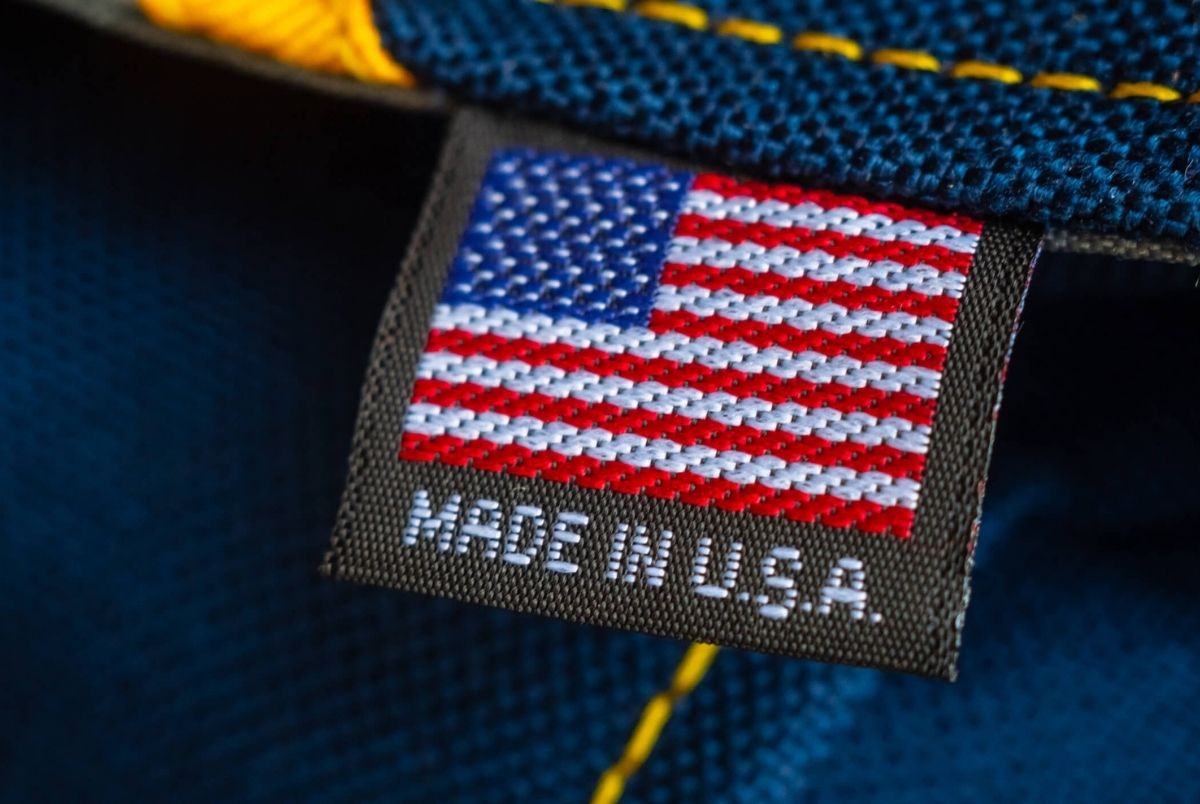
For decades, American politicians from both parties have pledged to prioritize American-made products to protect U.S. industry and crack down on deceptive labeling practices. But President Donald Trump has gone beyond campaign promises to make real progress toward those goals while in office.
Trump’s recent executive order, “Ensuring Truthful Advertising of Products Claiming to be Made in America,” is a reflection of the President’s commitment to the “Made in America” mission. The order specifically grants the Federal Trade Commission expanded authority to address false labeling, directs the Department of Justice to pursue violations under the False Claims Act, and instructs Customs and Border Protection to more closely inspect import declarations. It also requires federal agencies to ensure contractors comply with Buy American standards.
Even U.S. Customs and Border Protection and the National Highway Traffic Safety Administration now have greater authority to monitor fake “Made in America” labeling. Shipments with false origin claims can be seized, while the businesses attempting to sell the misleading products can be criminally prosecuted.
The order also seeks to close loopholes that have allowed businesses to exploit vague labeling rules. It calls for clearer, stricter definitions of domestic content and directs federal agencies to coordinate enforcement efforts across sectors, including online marketplaces where misleading claims have become more prevalent.
In its most recent report, the FTC identified three companies that misused the “Made in America.” label. The investigation revealed that key components in some products, such as microchips and leather, were sourced from abroad. Each company was fined between $167,000 and $625,000, and its brands were publicly associated with false advertising.
By targeting deceptive practices in e-commerce and global supply chains, President Trump is aiming to ensure that foreign goods cannot be easily repackaged or relabeled to appear American-made.
Beyond just consumer protection, the order helps preserve economic and national security. By restoring integrity to “Made in America” labeling, President Trump will strengthen domestic manufacturing, support American workers, and reduce reliance on foreign supply chains. The policy aligns with broader efforts from the White House to promote U.S. industry and encourage companies to bring production back home.
This order is particularly important for Americans – and even foreign visitors – who prioritize buying American-made products. Even some products that are today listed as “Made in America” are not actually produced in the United States. I recall one incident from 2001 when I purchased gift-wrapped “American memories boxes” in San Francisco, only to discover that the products in them, including a copy of the U.S. Constitution, had “Made in China” labels.
Specialists I spoke with for this article offered up the European Union as a warning of what could befall the United States if it does not guard “Made in America” labeling with pride. The E.U. now produces almost nothing and relies largely on imports. As a result, its economy has stagnated.
José de Ruiz, a retired Professor of Commercial Law, played a pivotal role in crafting industry norms for both the Spanish government and the European Community during the transformative decades of the 1980s and 1990s. He warned how false labeling can damage the economy as deeply as inflation, eroding trust and weakening the connection between business and the community.
Professor de Ruiz recounted how, in the late 1980s, European workers rallied to persuade politicians to halt the flood of unfairly priced Chinese goods. At the time, European manufacturers were already feeling the squeeze, as Chinese competition found new ways in and increased exports to Soviet-aligned countries. Many Eastern European firms exported Chinese-made pencils, glue, and other school supplies, repackaging them to export to Western Europe.
Boxes printed in English, French, or Spanish increasingly concealed their true origin, making products appear local. “The bright colors and cheerful packaging drew children in, while bargain prices won over parents,” de Ruiz said. As imports surged, Western producers faced strong competition. Labor unions appealed to political leaders and, for a time, the threat was contained. However, the challenge later returned “in subtler, harder-to-fight forms,” and ultimately, “European workers lost much of the battle.”
Dr. Francoise de Bérulle, a French sociologist and theologian who advised the mayor of Paris on labor relations in the late 1990s, argued that requiring the accurate labeling of product origins strengthens “the rights of both workers and consumers.”
“By delegating authority, these laws foster a sense of responsibility,” Dr. de Bérulle emphasized, drawing on his expertise in Catholic Social Teaching. He called it “a step toward strengthening a healthy society.”
“The benefits for U.S. firms and all operating in U.S. markets are clear,” Professor de Ruiz said. “Increased investment in domestic industry and fair wages for American workers will strengthen the brand, as companies will be able to use the ‘Buy American’ label.” Dr. de Bérulle added, “This process builds trust between markets and consumers.”
Ultimately, that’s what Trump’s executive order is about – restoring trust between businesses and consumers, and between the American people and the products they choose to buy. By enforcing clear, honest standards for what qualifies as “Made in America,” the Trump administration is not only protecting consumers from deception, but also reaffirming the value of American labor, craftsmanship, and industry in a global economy that too often prioritizes profit over integrity.
Ben Solis is the pen name of an international affairs journalist, historian, and researcher.





I will pay more for a while for Made in the USA goods. The thought of buying flags, Bibles, and even light bulbs from China make me ill. We need all pharmaceutical and medical supplies back!!!!!!
Its almost impossible to buy Made in America. We need to get back to making products here in the USA. I TRY very hard not to buy things made in China. I really miss Smithfield ham..but stopped buying it once China bought the company. We need legislation making it illegal for non-citizens to own farmland and real estate. Especially the RE surrounding our military installations. I’m worried that is Republicans lose control of the House after November, that everything Trump is doing to increase American manufacturing will ground to a halt.
The U.S. should have trademarked, copyrighted, labels for “Made in USA” and “Assembled in USA” that are restricted to those items that meet the required categories.
This should also apply to food and pharmaceuticals which at present never reveal their origins.
Made in America sounds good, but people must realize that these goods will cost more because wages are higher in USA. Also, Trump has signed numerous Orders to get rid of regulations on business, but one of the biggest costs in USA are being ignored & that is the need for Tort reform to stop the high cost of liability insurance and the Million dollar frivolous lawsuits.
If only we could buy clothing, made in America. Bring back the clothing manufacturing of the fifties, sixties, and seventies. Clothing that fits Americans. Now we need to deal largely with Chinese imports, which are horribly made and with inferior materials.
NAFTA, passed by both Republicans and Democrats in the nineties was the beginning of jobs leaving our shores. If only we could bring back these industries that left. One can only hope, and be thankful that “vintage” clothing can be chic in some areas where dress code is honored or encouraged. I still have some real classics, which I will not part with.
If we want to increase the value of American labor, why are we allowing corporations to pursue AI automation so they can fire hundreds of thousands, if not millions of workers and tank our economy? There is a policy incongruency here that makes you go, hmm… AI is neither effective, nor the pie in the sky solution to everything as it is touted to be, it poses a threat of surveillance and control that is very real and can turn our constitutional republic into a totalitarian left-wing banana republic in no time flat under another democrat Marxist administration with a little help from their Deep State friends as we already were shown under the Biden polit bureau autopen committee and the burn bag Arctic Frost conspiracy against President Trump. AI is not our friend, but a clear and present danger to the American public and should be banned, not pursued on all boilers! A little more skepticism than blind enthusiasm would be well appreciated for a technology that is just as potentially dangerous as the invention of atomic weapons which led to the threat of nuclear annihilation against our country during the cold war.
Have you looked at labels recently? For the most part, NOTHING is made here any longer. Decades ago, the ‘coin counters’ noticed that stuff made overseas can be made “less-expensively” (read CHEAPER), yet be sold here for the same price! Dollar pinchers, looking at the ‘bottom line’ instead of American JOBS, FAMILIES and American wellbeing, replaced “Made in America!”
Beware the “money-changers”….
You have to look closely at the label! Some of them say PRINTED IN AMERICA.
Does this mean GMC means General Motors of China?
It looks like we finally have a president for this country.
I like the idea. Let us see what it does.
Made in America what a joke I don’t see electronics,tools etc. made in America when will that begin? Like craftsman’s they used to be made here in the USA that’s why I say what a joke.
In Buffalo, and Niagara Falls, NY, there are made in America Stores. They sell only made in America products, from companies they know make their products in the USA. I purchased one of their Made in America Tee shirts about ten years ago. Of course it cost more than other brands, but it still has no holes, the logo is still intact today, and I have worn it about once a week since the day I purchased it. They sell tools, decor, and other stuff. Made in America is much better quality. Sorry if this sounds like an ad for the store, but I hope it makes my point about buying made in America.
All labels should have country of orgin. Distributed by is misleading. These should be in large eanough print so you can read them. Some candy items are also imported. Some are made in one country and packaged in China. It is time to stop buying from China and get corporations to invest in America.
As an ardent beef eater I’m especially concerned that foreign beef be labeled with the country of origin.
I buy products only made in the U.S. If I can’t find what I want from America, I don’t buy. I don’t rely on AI and go to the specific vendor that claim their goods are made in the USA. Recently, I wanted to buy a pair of shoes. The vendor’s advertising stated Made in the USA. I confirmed that it wasn’t the case. They are manufactured in Portugal and sold from California. I recommend contacting the vendor itself and if one doesn’t get a response within 1 business day, look elsewhere.
I still remember a small flute I bought in a gift shop in NYC’s Chinatown when I was a kid in the 1960s. Got it home only to find when I unwrapped it was the marking “Made In Japan”!