
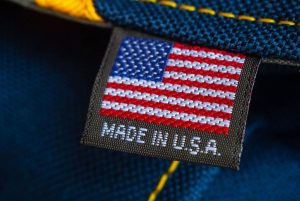
For decades, American politicians from both parties have pledged to prioritize American-made products to protect U.S. industry and crack down on deceptive labeling practices. But President Donald Trump has gone beyond campaign promises to make real progress toward those goals while in office.
Trump’s recent executive order, “Ensuring Truthful Advertising of Products Claiming to be Made in America,” is a reflection of the President’s commitment to the “Made in America” mission. The order specifically grants the Federal Trade Commission expanded authority to address false labeling, directs the Department of Justice to pursue violations under the False Claims Act, and instructs Customs and Border Protection to more closely inspect import declarations. It also requires federal agencies to ensure contractors comply with Buy American standards.
Even U.S. Customs and Border Protection and the National Highway Traffic Safety Administration now have greater authority to monitor fake “Made in America” labeling. Shipments with false origin claims can be seized, while the businesses attempting to sell the misleading products can be criminally prosecuted.
The order also seeks to close loopholes that have allowed businesses to exploit vague labeling rules. It calls for clearer, stricter definitions of domestic content and directs federal agencies to coordinate enforcement efforts across sectors, including online marketplaces where misleading claims have become more prevalent.
In its most recent report, the FTC identified three companies that misused the “Made in America.” label. The investigation revealed that key components in some products, such as microchips and leather, were sourced from abroad. Each company was fined between $167,000 and $625,000, and its brands were publicly associated with false advertising.
By targeting deceptive practices in e-commerce and global supply chains, President Trump is aiming to ensure that foreign goods cannot be easily repackaged or relabeled to appear American-made.
Beyond just consumer protection, the order helps preserve economic and national security. By restoring integrity to “Made in America” labeling, President Trump will strengthen domestic manufacturing, support American workers, and reduce reliance on foreign supply chains. The policy aligns with broader efforts from the White House to promote U.S. industry and encourage companies to bring production back home.
This order is particularly important for Americans – and even foreign visitors – who prioritize buying American-made products. Even some products that are today listed as “Made in America” are not actually produced in the United States. I recall one incident from 2001 when I purchased gift-wrapped “American memories boxes” in San Francisco, only to discover that the products in them, including a copy of the U.S. Constitution, had “Made in China” labels.
Specialists I spoke with for this article offered up the European Union as a warning of what could befall the United States if it does not guard “Made in America” labeling with pride. The E.U. now produces almost nothing and relies largely on imports. As a result, its economy has stagnated.
José de Ruiz, a retired Professor of Commercial Law, played a pivotal role in crafting industry norms for both the Spanish government and the European Community during the transformative decades of the 1980s and 1990s. He warned how false labeling can damage the economy as deeply as inflation, eroding trust and weakening the connection between business and the community.
Professor de Ruiz recounted how, in the late 1980s, European workers rallied to persuade politicians to halt the flood of unfairly priced Chinese goods. At the time, European manufacturers were already feeling the squeeze, as Chinese competition found new ways in and increased exports to Soviet-aligned countries. Many Eastern European firms exported Chinese-made pencils, glue, and other school supplies, repackaging them to export to Western Europe.
Boxes printed in English, French, or Spanish increasingly concealed their true origin, making products appear local. “The bright colors and cheerful packaging drew children in, while bargain prices won over parents,” de Ruiz said. As imports surged, Western producers faced strong competition. Labor unions appealed to political leaders and, for a time, the threat was contained. However, the challenge later returned “in subtler, harder-to-fight forms,” and ultimately, “European workers lost much of the battle.”
Dr. Francoise de Bérulle, a French sociologist and theologian who advised the mayor of Paris on labor relations in the late 1990s, argued that requiring the accurate labeling of product origins strengthens “the rights of both workers and consumers.”
“By delegating authority, these laws foster a sense of responsibility,” Dr. de Bérulle emphasized, drawing on his expertise in Catholic Social Teaching. He called it “a step toward strengthening a healthy society.”
“The benefits for U.S. firms and all operating in U.S. markets are clear,” Professor de Ruiz said. “Increased investment in domestic industry and fair wages for American workers will strengthen the brand, as companies will be able to use the ‘Buy American’ label.” Dr. de Bérulle added, “This process builds trust between markets and consumers.”
Ultimately, that’s what Trump’s executive order is about – restoring trust between businesses and consumers, and between the American people and the products they choose to buy. By enforcing clear, honest standards for what qualifies as “Made in America,” the Trump administration is not only protecting consumers from deception, but also reaffirming the value of American labor, craftsmanship, and industry in a global economy that too often prioritizes profit over integrity.
Ben Solis is the pen name of an international affairs journalist, historian, and researcher.
