


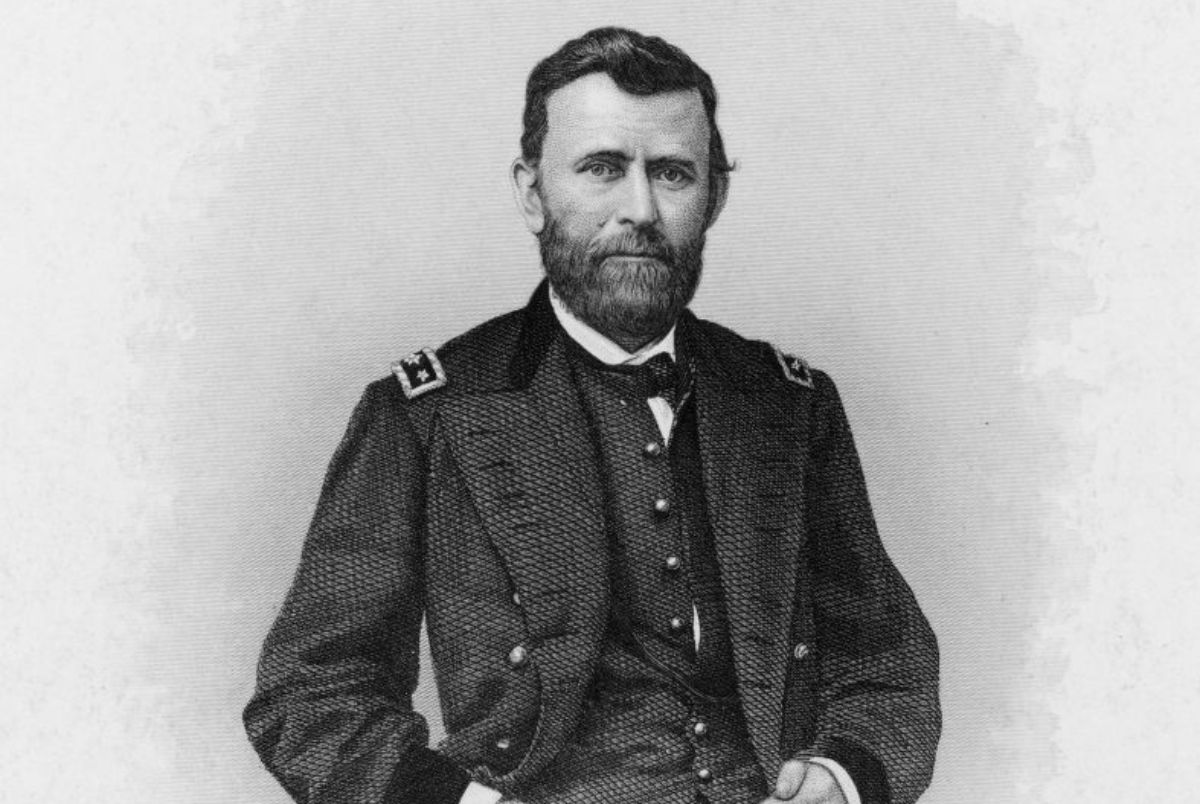
Grant died this week, July 23, 1885, after winning the Civil War in the West and East, being named by Lincoln to Commanding General in March 1865, a month before Lincoln’s assassination.
Ulysses S. Grant was one of the greatest presidents in our nation’s history, not just for winning the Civil War as the Union’s unrivaled general, but also for winning the peace after the War, crushing the Ku Klux Klan (KK), and saving the Union again.
In time, Grant would serve as head of the National Rifle Association (NRA), Secretary of War, and finally President (1869 to 1877), forcing the nation to abide by the 13th, 14th, and 15th Amendments, working on “Reconstruction,” modeling resolve in a time of chaos, resentment, grief, and discord unlike any since.
Grant’s example of incisive, unbending, principled leadership on the battlefield and in high office is often overlooked; historians somehow imagine our nation would have healed without him, categorically untrue.
In decision after decision, navigating the ship of state through a ledge-heavy channel, he resolved insurrections with proportionality and a clear-eyed view to preserving the peace for which so many had died.
Almost 40 years later, which seems long but no longer than the end of the Cold War for us, a future president – Theodore Roosevelt (TR) – delivered a speech entitled “Grant.”
Too long to recite in full, choice sections make vital points. Said TR: “Grant and his fellow soldiers who fought through the war… not only left us a heritage of a reunited country and of a land from which slavery had been banished, but left us what was quite as important, the great memory of their great deeds – to serve forever as an example and an inspiration …”
TR called Grant “a man of mighty days … equal to the days,” noting “The days are less mighty now … all the more reason why we should show ourselves equal to them,” noting Grant should “stir us” with his unbending commitment, humbly understood. “I shall ask attention not to Grant’s life, but to lessons taught by that life, as we of today should learn them.”
“Foremost … is the lesson of tenacity, of stubborn fixity of purpose,” which TR says Grant had at war and as President. “It is this element of unshakeable strength” which commends him not just as a genius general and president, but “as a man.”
As if speaking to us yet to his own time, TR says: “It is the one quality that we can least afford to lose. It is the only quality that lacks which is as unpardonable in the nation … as in the man.”
This resolve to do right, an unbending commitment to it, strikes TR as essential to our survival. “It is the antithesis of levity, fickleness, volatility, of undue exaltation, of undue depression, of hysteria and neuroticism in all their myriad forms.”
In short, Grant was unwilling at war or peace to give up his convictions – vital to holding the nation together. TR notes that the same conviction is needed always.
Declares TR in 1900: “A nation that has not the power of endurance, the power of dogged insistence on a determined policy, come weal or woe, has lost one chief element of greatness.”
TR explains the power Grant brought to everything he felt worthy, from West Point and horsemanship to completing his autobiography two weeks before dying.
Grant was “a plain, quiet man, not seeking glory, but a man who, when aroused, was always in deadly earnest, and who never shrank from duty. He was slow to strike, but he never struck softly… His promise squared with his performance. His deeds made good his words,” and “unsparing in battle, he was very merciful in victory.”
At war and peace, “No stronger foe of anarchy in every form ever lived within our borders,” yet he knew “the all-important thing to keep in mind is that if we have not both strength and virtue we shall fail.”
The speech by TR about Grant is a master work, worth reading, one great celebration of another. It ends with this note, worthy also of our time as in TR’s and Grant’s: “To do our duty – that is the sum and substance of the whole matter.”
About the author
Robert B. Charles
National Spokesman, AMAC
@Bobby4MaineAll articles by Robert B. Charles →
Expertise
- • U.S. foreign policy and national security
- • Counter-narcotics and international law enforcement
- • American politics and government
- • Leadership, character, and American history
Credentials
- • Former U.S. Assistant Secretary of State, Bureau of International Narcotics and Law Enforcement Affairs (October 2003 - March 2005)
- • Reagan White House staffer (1981-1983)
- • Deputy Associate Director, Office of Domestic Policy, George H.W. Bush White House (1992-1993)
- • Staff Director and Chief Counsel, U.S. House Subcommittee on National Security, International Affairs, and Criminal Justice (1995-1999)


16 Comments