
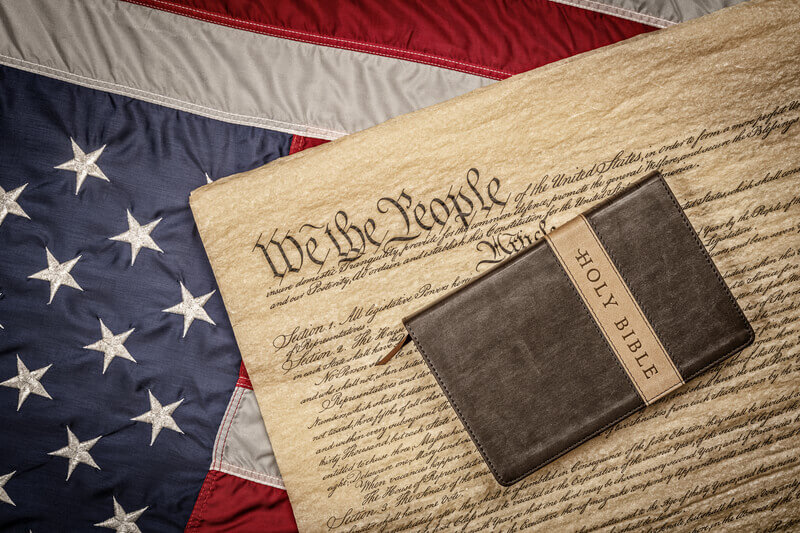
America’s Founders set in motion what we now enjoy, a nation of divided powers, checks and balances – federal and state levels – focused on protecting individual liberties against government abuse, in turn allowing us to use God’s gifts for our own best purposes (happiness) and taken together, the betterment of our Republic.
In this 250th year of our Republic, three questions come to mind. First, where did the Founding Fathers get their ideas? Second, if we have lost a full understanding, how do we recover it? Third, can we use those same direct sources to steer the way now?
In short, our Founding Fathers – Washington, Adams, Jefferson, and Madison, to Franklin, Hamilton, and all who fought for freedom, were familiar with the Greeks and Romans, British and French, Aristotle and Cicero, to Burke, Locke, and Montesquieu.
That said, they relied most heavily – day-to-day and in writing our Constitution – on two sources: The Bible and Montesquieu, a brilliant French-born thinker whose real name was Charles Louis de Secondat, Baron de La Brede et de Montesquieu.
Transporting ourselves back to the mid-1700s, we would not only be without modern conveniences, distractions, medicines, travel, and communications, but would have been influenced by very big forces: survival, self-reliance, and Christianity.
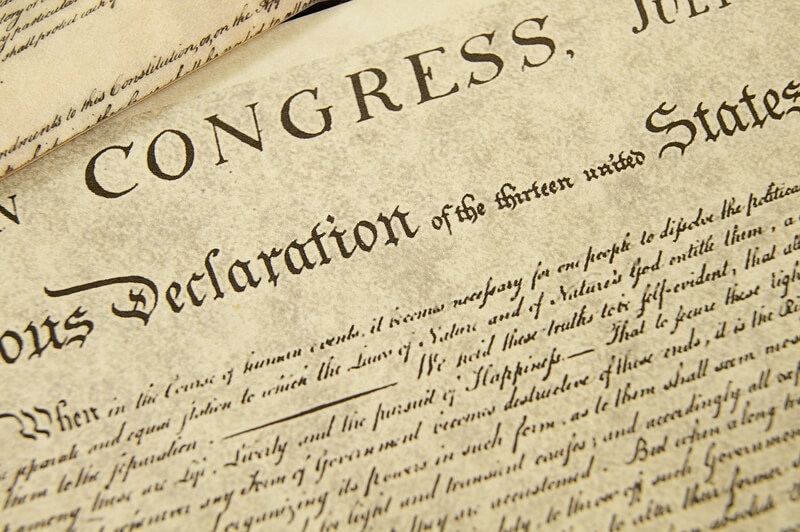
The Sons of Liberty sprang to life in 1765. Our Declaration was written 11 years later, the Revolutionary War ended seven years after that, and our US Constitution and Bill of Rights were finally ratified in 1788 by nine of the 13 states, with the others soon following.
Yet in the mid-1700s, beyond survival, revivals, and the Bible, we would be influenced by the nearness of life to the land, British tyranny – deeply unfair – and current thinking.
Current thinking on politics was of a unifying nature, the hundred-year-old “Fundamental Orders of Connecticut of 1639,” “Massachusetts Body of Liberties of 1641,” multiple colonial constitutions, Thomas Paine, and the evangelical “Great Awakening.”
But overwhelmingly, the Founder’s leading ideas came from the Bible – trying to institutionalize a moral government, moral law, moral future – and the works of Montesquieu. So, who was this guy? He was a brilliant lawyer who died in 1775.
His basic idea, expressed in his book The Spirit of the Laws, was that a modern Republic, a self-determining government accountable to the “People” and acting for them, would only survive if its institutions were always kept accountable.
He divided government actions into three general groups: legislative (law-making), executive (law-enforcing), and judicial (or dispute judging) groups. He said that these three should not – could not – be claimed by one person, group, or party.
He described in hundreds of pages how to set these three up to be constructive checks on each other, a cross-checking, balanced, and mutually limiting system. His ideas were revolutionary and were recognized as such in his lifetime.
By the time Jefferson penned our Declaration, and the Founders shaped our Constitution’s articles and Bill of Rights, Montesquieu was epic. His Spirit of the Laws lay behind much of what was done at our Constitutional Convention, where his ideas were made practical with a three-branch, cross-checking, and balanced republic.
So, that is where the ideas came from, the Bible and Montesquieu, but how do we recover what we have obviously lost – an understanding of our history, moral actions by citizens, deliberately limited government, state and federal branches in balance?
We must teach it, act on it, and remove those from power who do not want balance, who do not honor history, morality, limited government, and balance at the state and federal levels. That is what elections are for, and we need to lean into their purpose.
Finally, can we still go back, use the Bible and Montesquieu to guide us? Yes, we must. As Adams wrote: “Our Constitution was made only for a moral and religious people.” Absent wheat, there is no bread, absent clay, no statue, absent morality, no law.
So, here we are. We have managed to claw back some respect for history at the federal level, a beginning of remembering. That is good. Many states, however, remain captured by a party with no respect for the Bible or for Montesquieu and balance.
Put succinctly, if this Republic is to survive – as we look back 250 years and then forward – we must remember, respect, and apply these principles. Absent the Bible’s moral lessons and Montesquieu’s “checks and balances,” we will not remain a republic.
Robert Charles is a former Assistant Secretary of State under Colin Powell, former Reagan and Bush 41 White House staffer, Maine attorney, ten-year naval intelligence officer (USNR), and 25-year businessman. He wrote “Narcotics and Terrorism” (2003), “Eagles and Evergreens” (North Country Press, 2018), and “Cherish America: Stories of Courage, Character, and Kindness” (Tower Publishing, 2024). He is the National Spokesman for AMAC. Today, he is running to be Maine’s next Governor (please visit BobbyforMaine.com to learn more)!





THIS ARTICLE REMINDS ME THAT WHEN THE GOVERNMENT CALLS OUR RULE OF LAWS IS A DEMOCRACY, I GET A LITTLE TICKED OFF!! WE ARE NOT A DEMOCRACY!!! WE ARE A CONSTITUTIONAL REPUBLIC!!! ALTHOUGH A DEMOCRACY AND A REPUBLIC ARE VERY SIMILAR, THEY ARE NOT EQUAL!!! AS BEN FRANKLIN WAS QUOTED AS SAYING, “WE’RE A CONSTITUTIONAL REPUBLIC FOR AS LONG AS YOU CAN KEEP IT”!!! I SEE THE SOCIALIST DEMOCRATS CONSTANTLY USING THE TERM DEMOCRACY, AND IT IS FALSE!!!
If RBC were to ever run for POTUS, I’d vote for him. He understands the common, everyday problems we Common Trash here face daily, and can address those problems in detail. Thank you, sir, for bringing these details and explanations to our attention.
Need Strong Defense
Industrial base
Educated public or lose ALL
There is much to consider in Protecting the American Republic – at the foundation the lessons of the Bible and the teaching of Montesquieu especially what he wrote in ” The Spirit of the Laws ” . Finding something that gets lost, turns up missing , that can involve different procedures depending on the circumstances – respect for history will help for whatever is lost to avoid being lost to begin with . Considering the ways that Patriots like Paul Revere helped to establish an intelligence network prior to and during the American revolution, how police detectives solve crimes,how fire inspectors determine the cause of a fire, how Epidemiology ( including legal Epidemiology) is used to find out what endangers public health . Losing something like a pair of gloves and thinking right away where and when that pair of gloves was last seen will help in finding them So, keeping history in mind for finding principles that have been lost it would be good to go back to when there is an example of that taking place. Who was involved, at what level, could be something all three branches of government or one or two gave indications of in various ways. — one thing for certain is that it will be time well spent.
Thanks, Robert
“Democracy is two wolves and a lamb voting on what to have for lunch. Liberty is a well armed lamb contesting the vote. Ben Franklin. Also in a Democracy the majority rules. In a Republic the individual is protected from the majority.
Forget the Statue Of Liberty, that guy was the best thing we ever got from France!