
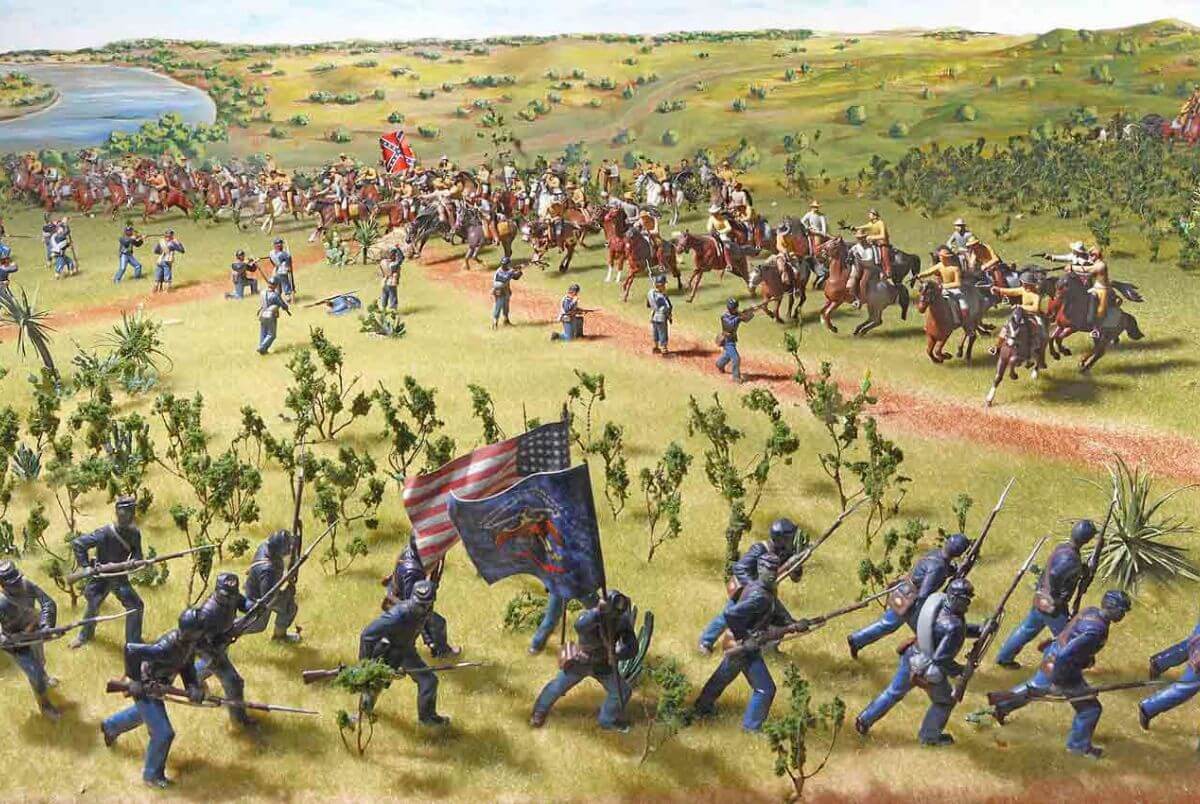
On May 12, 1865—more than a month after Confederate General Robert E. Lee had surrendered at Appomattox—Union and Confederate forces clashed along the Rio Grande in South Texas in what would become known as the final battle of the American Civil War. At Palmito Ranch, near present-day Brownsville, two relatively small forces engaged in a conflict that, by all accounts, should never have happened. The war was effectively over, news of surrender had already spread, and yet gunfire erupted once more on the windswept coastal plains.
The Battle of Palmito Ranch unfolded over May 12 and 13, 1865, in a region largely isolated from the main theaters of war. For months, Union and Confederate troops in the area had observed an informal truce, aware that the Confederacy was collapsing. Still, Union Colonel Theodore H. Barrett ordered an advance from Brazos Santiago, leading a force that included U.S. Colored Troops toward Confederate positions near Fort Brown. Historians continue to debate his motives—ranging from a desire for battlefield distinction to economic interests tied to cotton in the region.
As Union troops pushed inland on May 12, they initially encountered light resistance and achieved minor successes. But the following day, Confederate forces under Colonel John “Rip” Ford regrouped and launched a counterattack. Using cavalry and artillery, Ford’s men overwhelmed the Union line, forcing Barrett’s troops into a retreat. By the afternoon of May 13, the brief but consequential engagement had ended in a Confederate victory.
What makes the battle so striking is its timing. By mid-May 1865, the Confederacy was already in its final collapse. Lee’s surrender had taken place on April 9, and other Confederate forces were following suit across the country. Yet in the Trans-Mississippi region—far removed from the East—Confederate General Edmund Kirby Smith had not yet formally surrendered, and communication delays, combined with local motivations, allowed fighting to continue.
The human cost, while smaller than earlier battles, was still real. Dozens of soldiers were killed, wounded, or captured, and one Union soldier—Private John J. Williams—is often considered the last combat casualty of the Civil War. The fact that lives were lost after the war’s outcome had effectively been decided adds a poignant and tragic dimension to the story.
In many ways, the Battle of Palmito Ranch reflects the chaotic and fragmented end of the Civil War. It underscores how vast geography, delayed communication, and personal motivations could prolong conflict even after national decisions had been made.
Today, the battle is remembered not for its scale, but for its symbolism. It stands as a final, paradoxical chapter in America’s bloodiest conflict—a reminder that wars do not always end cleanly, and that even in moments of resolution, echoes of violence can still linger.






This battle is no different like the Battle of New Orleans of 1814, where a peace treaty had been signed and in effect before this battle. Communication was slow and the battle took place before the peace treaty was known.