
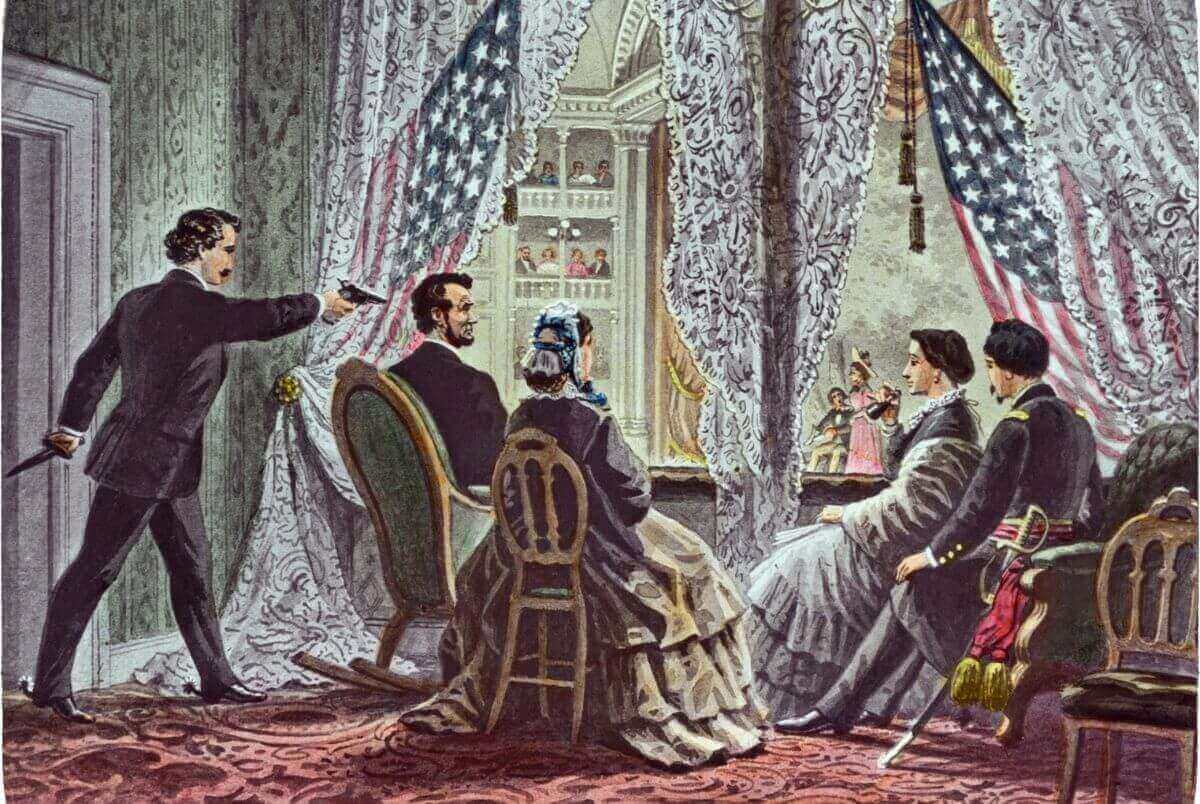
On April 14, 1865, just days after the Civil War had effectively ended, President Abraham Lincoln attended a performance of Our American Cousin at Ford’s Theatre in Washington, D.C.—an outing meant to offer a moment of relief after years of national conflict. Instead, the night would become one of the most tragic turning points in American history. Around 10:15 p.m., actor and Confederate sympathizer John Wilkes Booth slipped into the presidential box and shot Lincoln in the back of the head at point-blank range.
Booth was no ordinary assassin. A well-known stage actor from a prominent theatrical family, he had remained in the North during the war but harbored deep loyalty to the Confederate cause. As the South’s defeat became inevitable, Booth grew increasingly desperate and radicalized. Initially, he and a group of conspirators had plotted to kidnap Lincoln and use him as leverage to aid the Confederacy. When that plan failed—and as Union victory loomed—Booth escalated his efforts to a coordinated assassination plot aimed at destabilizing the U.S. government.
The attack on Lincoln was intended to be just one part of a broader conspiracy. Booth and his associates planned simultaneous strikes against Vice President Andrew Johnson and Secretary of State William H. Seward. While Seward was seriously wounded in a separate assault, Johnson’s attacker lost his nerve and never carried out the mission. Only Booth succeeded in his objective, dealing a devastating blow to the nation at a moment when it was poised for reconstruction and healing.
After firing the fatal shot, Booth leapt from the presidential box onto the stage, reportedly shouting “Sic semper tyrannis!”—Latin for “thus always to tyrants”—before fleeing the theater. Despite breaking his leg in the jump, he escaped on horseback into the night, setting off one of the largest manhunts in American history.
Lincoln was carried across the street to the Petersen House, where doctors worked through the night to save him. However, the wound proved fatal, and he died the following morning on April 15, 1865. His death marked the first assassination of a U.S. president and plunged the country into profound grief.
The assassination came at a pivotal moment. General Robert E. Lee had surrendered just days earlier, signaling the collapse of the Confederacy and the end of the Civil War. Lincoln had begun outlining plans for Reconstruction, emphasizing reconciliation and unity. His sudden death not only shocked the nation but also altered the course of its future, leaving unresolved questions about how the fractured country would rebuild.
Ultimately, Booth’s actions did not revive the Confederate cause as he had hoped. Instead, they immortalized Abraham Lincoln as a martyr for unity and freedom, and cemented April 14, 1865, as one of the most consequential—and tragic—dates in American history.






This is a well written article ,it shows the value of history in understanding the Who,What, Where , When,How and Why of President Abraham Lincoln’s assassination. Those of us who were around when President John F.Kennedy was assassinated will probably have that feeling associated with that day in November 1963 at least partially revived in giving thought to the events connected with the Lincoln assassination. I was 13 and started reading JFK’s book “Profiles in Courage a few months earlier. Watched the funeral on television and remember.the cadence of the drums and how that sound carried. a spirit of Reverence with it. How the Country needed to heal and how events pertaining to the place of importance this Nation had to face became apparent in a very unexpected way . The thought of God bless America,land of the free and the home of the brave has a significance at all times
A great presentation of the facts. Thank you AMAC.