
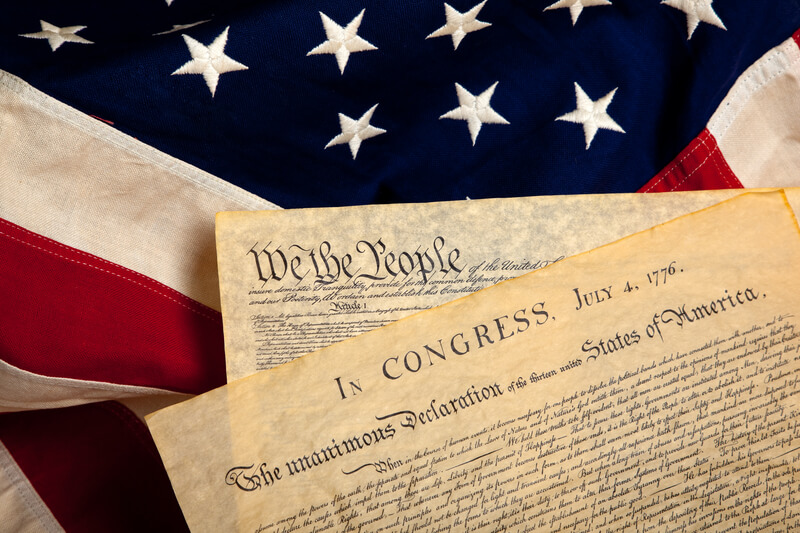
As we celebrate our country’s 250th birthday, we have an opportunity to reflect on the extraordinary documents that gave birth to the United States. These founding texts established the nation’s enduring ideals, created its framework of government, and continue to guide American law and civic life nearly two and a half centuries later.
Significant Documents of the United States
Some of the most important documents in United States history include the Declaration of Independence, the U.S. Constitution, and the Bill of Rights. Together, these documents helped form the nation’s government, laws, rights, responsibilities, and way of life. This overview explores why they matter, what challenges surrounded their creation, and why they remain important today.
The Declaration of Independence
What Is the Declaration of Independence?
The Declaration of Independence is the founding document that announced the thirteen American colonies’ decision to separate from Great Britain. Approved by the Continental Congress on July 4, 1776, it explained why the colonies believed independence was necessary and presented their claim that governments should protect the rights of the people.
Creation and Key Contributors
The Declaration was drafted during the Second Continental Congress in Philadelphia. A Committee of Five was appointed to prepare the document: Thomas Jefferson, John Adams, Benjamin Franklin, Robert R. Livingston, and Roger Sherman. Jefferson wrote the first draft, while Adams, Franklin, and Congress made revisions before the document was adopted.
Why It Matters
The Declaration of Independence is significant because it formally marked the colonies’ break from British rule and helped launch the United States as an independent nation. It also expressed powerful ideas about equality, natural rights, and government by consent that have influenced democratic movements in the U.S. and around the world.
Main Ideas and Purpose
The Declaration was written to justify independence and explain the colonies’ position to the world. Its main ideas include:
- All people have basic rights, including life, liberty, and the pursuit of happiness.
- Governments receive their power from “the consent of the governed.”
- People have the right to change or replace a government that violates their rights.
- King George III had failed to respect the rights and interests of the colonies.
Important Facts
- The Continental Congress approved the Declaration on July 4, 1776.
- Congress had voted for independence two days earlier, on July 2, 1776.
- Most delegates signed the engrossed parchment copy on August 2, 1776.
- Fifty-six delegates eventually signed the document.
- The original parchment is preserved at the National Archives in Washington, D.C.
Why It Still Matters Today
The Declaration of Independence remains important because it states ideals that continue to shape American identity and civic debate. Its words about equality, liberty, and the purpose of government are still used to discuss rights, citizenship, justice, and the responsibilities of a free society.
The U.S. Constitution
What Is the U.S. Constitution?
The U.S. Constitution is the nation’s fundamental law. It explains how the federal government is organized, what powers each branch has, and how the government is expected to operate. It replaced the Articles of Confederation, which had created a national government that many leaders believed was too weak to manage the country effectively.
Creation and Key Contributors
The Constitution was written during the Constitutional Convention in Philadelphia in 1787. Delegates debated major questions about representation, federal power, state authority, and the future of the nation. Important figures connected to the Convention included George Washington, who presided over it, and James Madison, who played a major role in shaping the document’s ideas and structure.
Why It Matters
The Constitution is significant because it created a stronger national government while also limiting government power. It established a system of checks and balances so that no single branch could control the country. This balance helped create a framework for democracy that has lasted for more than two centuries.
How It Organizes Government
The Constitution divides the federal government into three branches:
- Legislative Branch: Congress makes laws.
- Executive Branch: The President carries out and enforces laws.
- Judicial Branch: The courts interpret laws and decide whether they follow the Constitution.
It also explains the relationship between the federal government and the states, identifies the Constitution as the “supreme Law of the Land,” and provides a process for adding amendments.
Important Facts
- The Constitution was signed on September 17, 1787.
- It contains a preamble and seven original articles.
- It has been amended 27 times.
- The first ten amendments are known as the Bill of Rights.
- It is one of the oldest written national constitutions still in use.
Why It Still Matters Today
The Constitution continues to guide American government, law, and civic life. It protects the structure of democracy, allows for change through amendments, and provides a shared foundation for debates about rights, responsibilities, and the role of government.
The Bill of Rights
What Is the Bill of Rights?
The Bill of Rights is the name given to the first ten amendments to the U.S. Constitution. These amendments were added to protect individual freedoms and place clear limits on the power of the federal government.
Creation and Key Contributors
The Bill of Rights grew out of debates over whether the Constitution did enough to protect personal liberties. James Madison introduced proposed amendments in Congress in 1789, drawing on ideas from earlier rights documents and concerns raised during the ratification debates. Congress approved twelve proposed amendments, and ten were ratified by the states on December 15, 1791.
Why It Matters
The Bill of Rights is significant because it protects core freedoms that are central to American democracy. It limits government power and helps ensure that people can speak, worship, gather, and seek justice without unreasonable interference.
Rights It Protects
The Bill of Rights includes protections related to:
- Freedom of speech, religion, press, assembly, and petition.
- The right to keep and bear arms.
- Protection from unreasonable searches and seizures.
- Rights for people accused of crimes, including due process and trial protections.
- Protection from cruel and unusual punishment.
- Recognition that people and states retain rights and powers not specifically given to the federal government.
Important Facts
- The Bill of Rights became part of the Constitution in 1791.
- It was created partly to address concerns from people who feared the new federal government might become too powerful.
- James Madison played a major role in drafting and introducing the amendments.
- Originally, the amendments mainly limited the federal government, but many protections were later applied to the states through constitutional interpretation.
Why It Still Matters Today
The Bill of Rights remains important because it continues to protect basic liberties and guides major legal debates. Courts, lawmakers, and citizens still look to these amendments when discussing (or wholeheartedly debating) freedom of expression, religious liberty, privacy, criminal justice, and the proper limits of government authority.
Let Freedom Ring
Together, the Declaration of Independence, the U.S. Constitution, and the Bill of Rights explain what freedom means in the American tradition. The Declaration announced the nation’s belief that people have natural rights and that government should rest on the consent of the governed. The Constitution created a practical system for self-government, dividing power among branches and establishing rules for national leadership. The Bill of Rights added specific protections for individual liberties, making clear that freedom depends on limits to government power.
Supporting Core Responsibilities
These documents support several core principles:
- Individual rights: They affirm that people have freedoms that government must respect and protect.
- Patriotism: They encourage citizens to value the nation’s ideals and take responsibility for preserving them.
- Freedom: They establish protections for speech, religion, due process, and participation in civic life.
- Independence: They show that the American people claimed the right to govern themselves rather than be ruled without representation.
Supporting Core Responsibilities
When these documents were written, they gave people a bold vision of a new nation built on liberty and self-government. For many Americans, they represented hope, courage, and the possibility of creating a government based on shared principles rather than inherited power such as that of a ruling king. At the same time, the nation has had to keep working to apply those ideals more fully and fairly over time.
A Lasting Vision: July 4th and Documents that Define Freedom
As America approaches its 250th anniversary, July 4th offers a meaningful opportunity to reflect on the nation’s founding and on the strength, courage, and vision of those who helped build it. The Declaration of Independence, the U.S. Constitution, and the Bill of Rights continue to guide the United States and inspire pride in the nation’s growth and transformation – as one nation under God (as in our Pledge of Allegiance). These founding documents took bravery, strength, and wisdom to create. Today, they continue to shape laws, protect rights, encourage civic responsibility, and remind citizens that freedom requires commitment, participation, and, at times, sacrifice. These documents have helped America grow into an influential nation and remain a lasting standard for measuring justice, liberty, and democracy for its great citizens.
Disclosure: This article is for informational purposes. Happy Independence Day!





This article is appreciated D.J. , it puts in perspective the what, who, when ,why and how Independence was established in the 1700’s .And it should bring about a sense of responsibility to continue to have the freedoms function as planned by the founders. Those events that provided the foundation of this Nation are described in a way that makes remembering developments related to the Declaration ,the Bill of Rights, the Constitution understandable ,
Too bad none of the kids educated in public schools the last 50 years will not be reading this. Many of were taught nothing about our government and how it works…and why!! The radical liberals taught them to hate the U.S. and what it stands for. We are now seeing the results of this evil brain washing. That is why our country is slowly turning to Socialism and Communism….they also never were taught the dangers of these ideas either. It is sickening how the liberals have ruined our once-great country and hate Trump so much they want him killed!!!
too bad the scotus ruled today the way they did on the birthright citizenship. the constitution & America just lost some of what makes it the best country in the world.
The Pledge of Allegiance was not a founding document. It was not written until 1885. “under God” was not in the allegiance until 1954.
This explanation is extremely Well done and its meaningful words are so important to support our American Freedoms. We MUST join in and support the written documents in total to maintain the Liberties and.Rights by the accumulation of Patriotic Union. Building these documents so many years ago has proven to the rest of the world we are doing it right under these guideposts. American Citizens First.
This article reflects a sterile, and I believe willful description of these documents divorced from the foundation of the source of our liberties: we are endowed by our creator with these inalienable rights, not by natural forces, but by a personal God to whom even governments are accountable.