
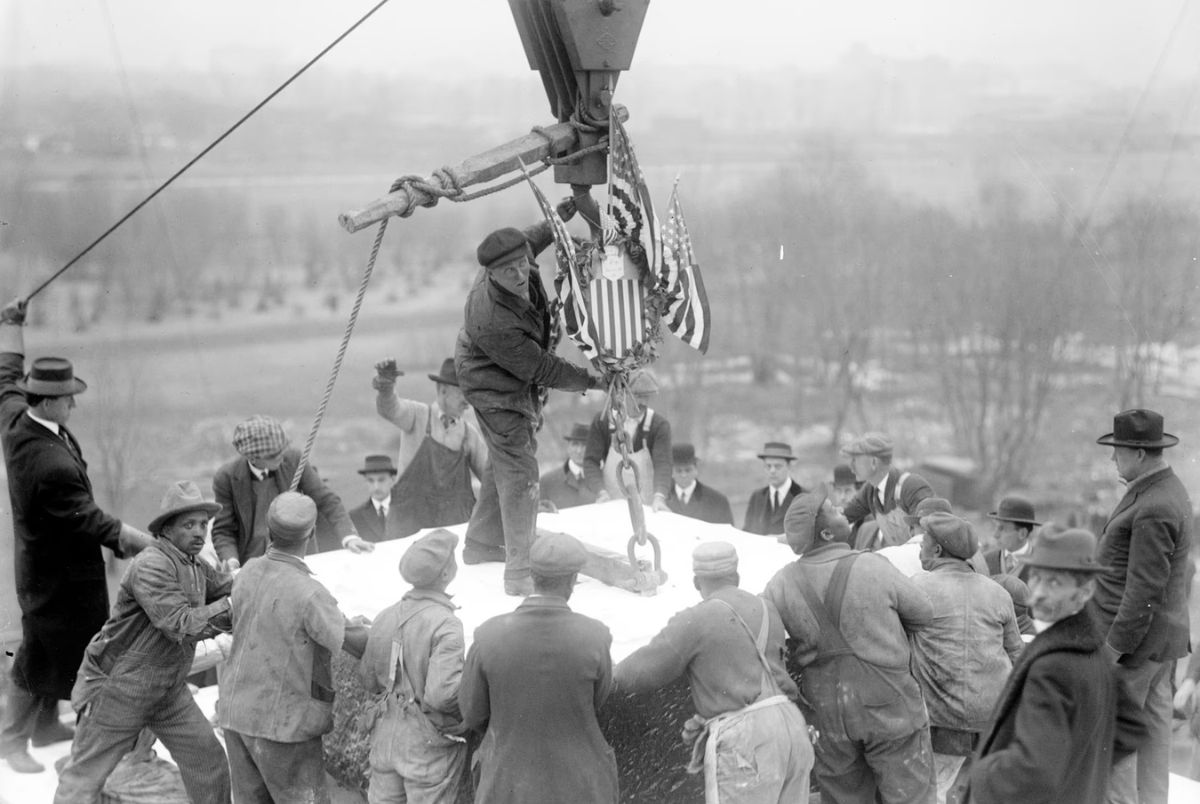
On February 12, 1914, construction of the Lincoln Memorial officially began, marking the culmination of decades of debate over how best to honor President Abraham Lincoln. The chosen site, on reclaimed marshland at the western end of the National Mall, presented immediate engineering challenges. Beneath the surface lay soft, waterlogged soil incapable of supporting the immense weight of a marble monument. To solve this, engineers designed an ambitious foundation system of 122 concrete piers, reinforced with steel and driven deep into the earth until they reached solid bedrock. This unseen structure would become the literal backbone of one of the nation’s most enduring symbols.
With the foundation secure, construction moved upward according to the vision of architect Henry Bacon, whose design was inspired by the Parthenon of ancient Greece. Bacon believed the classical form best conveyed Lincoln’s legacy as a defender of democracy and unity. The memorial was designed as a Greek Doric temple, featuring 36 fluted columns, each representing one of the states in the Union at the time of Lincoln’s death in 1865. The names of those states were carved into the frieze above the columns, reinforcing the memorial’s theme of national unity.
Materials for the structure were deliberately sourced from across the United States, underscoring Lincoln’s role in preserving the Union. Colorado Yule marble was used for the exterior, Indiana limestone formed the core walls, Tennessee marble paved the floors, and Alabama marble was selected for the ceiling tiles. Granite from Massachusetts was used in the foundation. This nationwide collaboration turned the memorial itself into a physical expression of reconciliation after the Civil War.
As construction progressed, plans for the interior evolved. In 1918, it was decided that the statue of Lincoln should be significantly larger and more imposing than originally envisioned. Sculptor Daniel Chester French designed a seated figure standing 19 feet tall, carved from 28 blocks of white Georgia marble by the Piccirilli Brothers. The statue was assembled inside the memorial in 1919 and 1920, requiring additional structural reinforcement to support its massive weight.
Despite delays caused by World War I, work continued steadily. By the early 1920s, the memorial’s structure, sculpture, and surrounding landscape were largely complete. On May 30, 1922, the Lincoln Memorial was formally dedicated in a ceremony attended by thousands, including Robert Todd Lincoln, the president’s only surviving son.
From its completion onward, the Lincoln Memorial became more than a tribute—it emerged as a stage for American history. Its steps have hosted defining moments in the ongoing struggle for civil rights and equality, transforming the monument into a living symbol of the ideals Lincoln championed. Today, the memorial stands not only as a feat of engineering and artistry but as a powerful reminder of unity, sacrifice, and the unfinished work of democracy.
[adrotate banner=”1184″]






Just wondering when the Left will begin destroying our National Monuments?
Building it on marshland the technique is similar to building Venice Italy.