
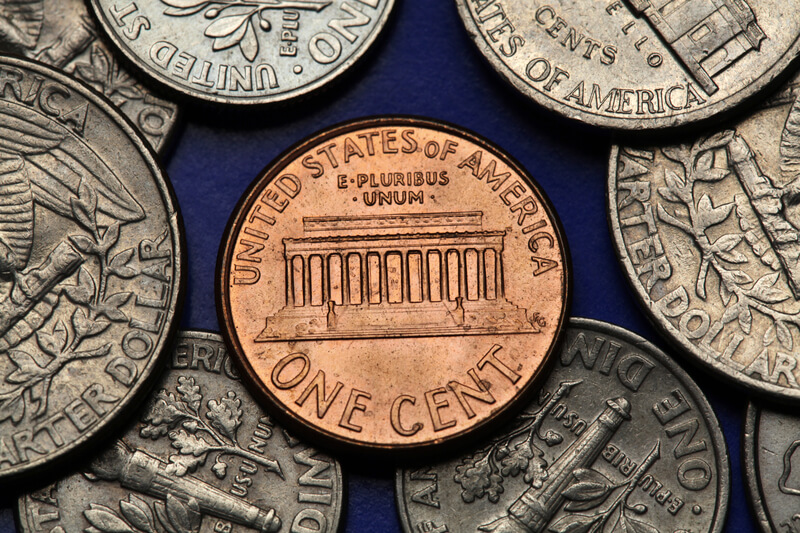
Recently, an article titled “No longer making cents” ran in the Houston Chronicle that lacked some extremely important context. The same article ran in the Beaumont Enterprise and a similar article in the Wall Street Journal.
Most notably, all articles lacked transparency about who the “penny advocate” and Executive Director of the American for Common Cents group really is. Americans for Common Cents is run by one person – Washington-based lobbyist Mark Weller, according to a New York Times article, and he is funded by a major beneficiary of taxpayer money.
Artazn is that company. It funds the Americans for Common Cents group to defend the penny and divert attention to the nickel. At the same time, it is a government contractor receiving hundreds of millions of dollars to supply zinc to the U.S. Mint.
Tom Jurkowsky, a retired Navy Rear Admiral, who became the director of Corporate Communications for the U.S. Mint from 2009-2017, stated: “How silly it is how much money it costs to produce pennies.” Jurkowsky also noted that Artazn, the company the Treasury has contracted to manufacture zinc blanks for over 40 years, lobbies against efforts for penny reform.
In 2023, Artazn is reported to have received over $51 million from its U.S. Department of Treasury contract.
In January, when I interviewed U.S. Mint Director Ventris Gibson, she told me it costs over 4 cents to make a penny, a loss of 3 cents for each one made.
Previous Mint Directors, like Democrat Philip Diehl and Republican Ed Moy, agree with ending the penny. Moy said, “I went to Congress saying I’m losing $90 million a year on pennies. You guys need to pass a law forcing me to change it.”
In 2013, President Barack Obama suggested retiring the penny but wasn’t able to. “It’s very hard to get rid of things that don’t work,” he commented at the time.
Canada successfully stopped making the penny in 2012 and their people adjusted well to elementary math rounding rules, as did Finland, the Netherlands, Sweden, Australia and New Zealand.
As far as the biased Mark Weller red herring comments about additional losses the country may incur by needing to make more nickels if it eliminated pennies, it has been easily addressed by coin experts, like myself, who have consulted for the U.S. Mint and the Royal Canadian Mint.
The simple answer is that we need to reduce the size and weight of the circulating nickel, as other countries have done over the years with their coinage, and as America did previously, in 1857, with the penny. As you can see, this is not a precedent-setting idea.
The current U.S. nickel weighs 5 grams and is composed of 75% copper and 25% nickel.
The Mint could reduce the weight of the nickel from 5 grams to about 4 grams by using an alternative and less expensive base metal. Canada, Spain and Finland all have nickels that weigh 4 grams. I also argue that there would be little way to confuse a 4-gram nickel for a 2.7-gram dime.
One idea is that the U.S. Mint could change the composition to 94.5% steel with a 2.5% nickel plating, like Canada does. Currently, copper costs about $5 per pound and nickel costs about $7 per pound but steel is only 47 cents per pound. This results in over 10 times the savings in material costs.
Both options have been successfully implemented in other countries.
Yes, the nickel costs about 13.8 cents to make today, resulting in a loss of roughly 8.8 cents for each one and an overall loss of $18 million a year. That is far less than the $60 million to $100 million the country has lost for producing pennies each year for the past five years.
Even if nickel production increases by eliminating the penny the losses on making them can be mitigated if Congress and the Mint take one or both of the actions I previously noted.
This should not be a partisan issue. It currently has and has had in the past bipartisan support to save taxpayers money. The zinc lobby influencing Congress should no longer cost taxpayers tens of millions of dollars each year while enriching its benefactors and a lobbyist by any other name, like the Common Cents group, is still a lobbyist.





Points well taken but I still disagree. The penny is an icon in our culture for a reason. Because it’s needed with all today’s technology in cash machines and the public likes pennies. Unfortunately with our dumbed down educational system in this country kids graduating from high school can’t make change without help which these cash register machines do for you to the cent.
if you buy a car, clothes, shoes or any other consumer item could you expect it to remain in use for up to hundreds of years like you can a penny. What is the real cost to make a penny when still used millions of times a year by millions of people? At some point the true cost becomes close to nothing. I’m all for Doge and what Elon Musk has attempted to do with great push back from all those who benefit but this is nickels and dimes as to to the real problem. Leave the pennies alone and go where the real trillions are wasted by our evil, greedy self serving politicians.
I wasn’t aware that the Treasury Department, specifically the U.S. Mint, was ever a “profit or loss” operation. The mint produces the coinage used in our daily consumer transactions and is not itself a commodity in those transactions. From the first ever U.S. struck coin until 1965, ( with the exception of the steel Pennies struck during WW II ) ALL of our coinage was made of silver, copper, nickel, and yes, GOLD – the stable value of which was set by Congress before Congress became corrupt. The cheap clad coinage started coming out in 1965 and was due to the accelerating devaluation of the U.S. Dollar. The production of coinage is and always as been a non-profit service of the government. With the recent outcry of the costs of producing coins, does it mean we will soon have to BUY any coinage we wish to use for transactions? I think the outcry over cost of production is aimed at conditioning us to accept the end of all coinage, and even the worthless fiat federal reserve note paper money, going to crypto currency exclusively. Monetary devaluation disguised as inflation ( that is usually blamed on businesses ) is an old political tool to spend more without directly raising taxes. Something that cost a dollar in 1950 and now cost you about ten dollars can basically be traced to devaluation or inflation CAUSED BY devaluation. Devaluation is caused by the government INFLATING the money supply. I’ve already written a long post, so before losing your attention, I’ll let you think about this and maybe do a little research on your own.
Coinage should be eliminated altogether and the U. S. mint closed. It’s nothing but junk metal of no value. Congress has allowed the vale of our money to be reduced to the equivalent to the Continental dollar of the Revolutionary War period, something of almost no value. The value of the dollar is set by the Federal Reserve bank, a private bank, and not the United States government. This, according to the Constitution, is illegal, but that doesn’t bother the government at all. We have 535 oath breakers in Congress and somehow they keep getting elected and re-elected. Something’s rotten in D. C.
Business that sell products ending in .99 will go crazy. Having to sell at 1.00 will stop customers from buying items as they believe consumers are too dumb to mentally add a penny. They won’t lower 5 cent to .95 for sure.
How are we to save anything wasting,as we are doing, billions of dollars. We are still running full speed off the cliff. How can congress be so stupid to continue this distruction of our country through their deception!
Does anyone remember the plastic mills? These were produced to pay the tax on purchased items and the total due was less than a penny. When mills were no longer used the amount was rounded up to equal one cent. This was in the mid 1940’s. Now the same process is being discussed to eliminate the penny/one cent coin.
Just a piece of nostalgia as a kid buying penny candy. I liked the mills, different colors for each value.
The penny cost has been talked about for years & it is time that the penny is no longer minted. How will this impact the zinc mines & how many pounds of zinc are used for making penny in year 2024. Will this savings count as found by DOGE or will this be recognized as some savings that should have been done years ago (and that is on shoulders of both Demos & Repubs).
Sailing, concern about the penny, is true it would cost 3 cents to make 1 cents, is grounds to not make them any more!
Why are people still calling the Cent a penny. The United States has never had a penny minted. I have collecting U.S. climate for well over 65 years. I have very many different cents in my collection
I would like to see the Cent go away. The waste to the U.S. tax payer is enormous.
Rounding either up or down the charge for an item in the long run will even out in the long run.
Because of fixed cost accounting, Mark Weller has a point. Because we eliminated the penny but not the nickel, the cost of many nickels will continue costing our country even more money. The fixed costs once allocated to the penny will be redirected to the nickel due to accounting rules.
We should have eliminated both the penny and the nickel simultaneously, but there is not enough momentum to eliminate nickels, in due part because eliminating the nickel is bad for the quarter, which is America’s most useful coin in active circulation.
Americans complained about pennies all over the media for 20 years before Trump and the US Treasury took action. The media even released an article in 2013 about Joe Henry removing copper pre 1982 pennies from circulation on an industrial scale, and nothing was done to eliminate the penny.
Elimínate the nickel too. How many things can you find that cost 5 cents?
If only there were a way to convince people not to accumulate or hoard coins, especially pennies; there are surely billions of coins already produced that are NOT being circulated. I make it a point to SPEND pennies at places that can readily use them again (in combination with bills and/or other coins.) I see the anti-penny scheme as a step to eliminating cash so that all transactions can be traced. “They” want to know everything about everybody.
1) Part of the cost of penny is due to the increased price for commodities Zinc & Copper. 2) Article says that Obama told Congress to stop penny, so how did Trump do this…..was a bill passed by Congress to stop the minting of penny or what happened this year?
Has the Mint explored changing the composition of the metals in the penny to reduce the cost to produce it? I imagine it might anger that company just as much as eliminating the penny altogether, but if it is a solution then who else would care? Also, I have read that the cost of producing dimes and quarters is less than their face value. So another question I have is, what is the total production cost of all circulating coins produced for a year compared to the total face value of all those coins? Maybe it will come out very close, or maybe even below the total face value if the composition of the nickel and penny are changed, and then there wouldn’t be any need to eliminate the penny at all.
I’m having trouble with the “rounding up” issue: paying more to whoever I’ll be buying from, to the tune estimated at approx. $150/per merchant/per year. Really?