
AMAC Magazine Exclusive – By Alexa Astuto
Tim first set eyes on his wife through the light of a projected 8mm home movie. His friends had filmed a drag race—something they’d done often in Georgia—and when he went over to view the excitement, a girl walked by in the pits. “I asked my friends, ‘Who is that girl?’” Tim told me. “My buddy said it was his cousin. And I’d been friends with him my whole life. Been to every family reunion and BBQ. How could I have never seen this girl before? I knew I had to have her number.”
Tim got her number. The first date didn’t go too well. “We were driving around in my Ford F-250, and she pointed to the sign and told me this was her exit. She wanted to get away from me so badly,” he laughed. “But I knew I needed her to give me a second chance.”
She gave him a second chance, and they got married three months after that second date—and spent every waking second together for fifty-eight strong years.
Tim (who will be eighty in September) and I stood on the Gulf Shores pier, taking in the Alabama coast. As Tim, a stranger, told me this story, I kept glancing at the wedding band hanging by a thin gold chain around his neck. When he shifted his grip on his beach-hiking stick, the light caught the band on his finger, too. One ring anchored to him. One ring carried like a heartbeat. He’d come to the pier about three times a week to be closer to his wife. “I don’t have a tombstone for her,” he said. “Just the ocean I scattered her ashes in eighteen months ago.”
If it hadn’t been for that 8mm film, Tim would’ve never met his loving wife. Home movies have been connecting us since their conception. Today, we carry cameras in our pockets. We capture everything. But before the ease of clicking a button and sending a moment into the digital world, we filmed life on 8mm reels—and watched it together, projected onto a wall at home. Not from the privacy of our beds with tiny pixels lighting up our faces. No. Home movies were a reason to gather. A shared experience. Proof of a life, playing in real time.
So where did 8mm film come from—and how did it become such a delicate, lasting memory for so many Americans?
It all started with the founder of Kodak, George Eastman (1854–1932), who changed the way the general public views photography. In 1878, Eastman, a bank clerk from Rochester, New York, sought to take pictures on a vacation. However, the camera he invested in was the size of a toaster oven, the chemicals required to develop photos were more temperamental than those in a research lab, and it took too much patience to set everything up. Eastman, fueled by a picture-less vacation, was determined to find an easier way.
Flash forward to 1888, and George Eastman was granted a patent for his box camera, and by 1892, the Eastman Kodak Company was born. The first Kodak camera’s simple box design took everything that made photography a hassle and condensed it into a single process. Before this, photographers used glass plates coated with light-sensitive emulsion that formed an image when exposed in-camera. But now, the inconvenience of swapping out a new glass plate for each capture was eliminated by paper film rolls that could hold a staggering 100 exposures. Photography no longer had to revolve around swapping plates; now, it could be as simple as pressing a button. That convenience took another leap in 1948, when the first Polaroid camera eliminated the need for a darkroom.
Edwin Herbert Land (1909–1991), a native of Bridgeport, Connecticut, was fascinated by light and optics from a young age. He founded the Polaroid Corporation in 1937, first producing polarizing sunglasses and later colored filters and optical devices for the U.S. military during World War II. But it was a question from his young daughter—why she couldn’t immediately see a photograph after it was taken—that inspired him to transform the industry. The result was the Polaroid Land Camera Model 95, which brought instant photography to American consumers.
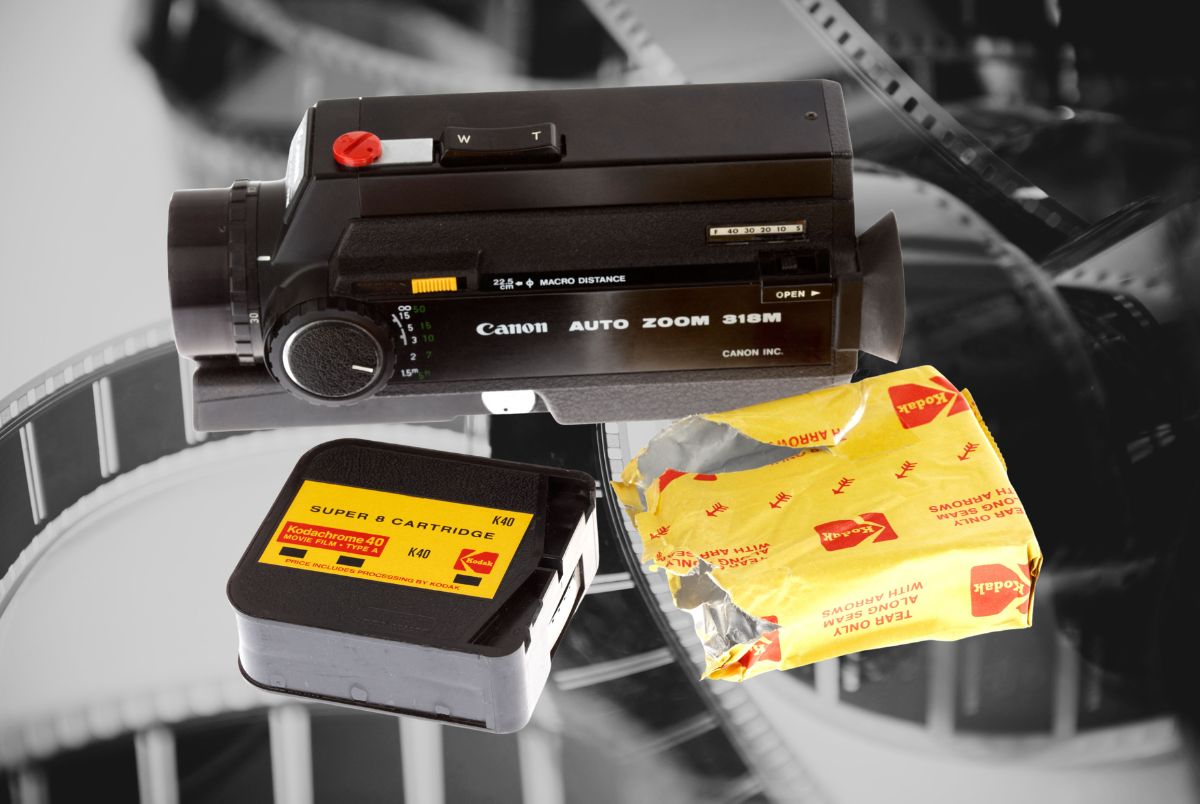
While still photography had become increasingly accessible to the public, filmmaking remained largely in professional hands. That changed when Kodak introduced a more consumer-friendly format: 8mm film.
Later improved into Super 8, the format made home moviemaking easier with smaller, more compact cartridges than the large reels required for 16mm film. Home recording quickly took off across America. At first, the films were silent, but in 1973, Kodak introduced magnetic sound striping, allowing sound to be recorded separately and played back alongside the finished film. It was another major leap in making visual storytelling more accessible at home.
And maybe that is what Americans have always been chasing—not just invention for invention’s sake, but a way to hold on to what would otherwise slip away. Photography and film gave ordinary people the power to preserve the faces, voices, and fleeting moments that make up a life.
Back on the pier, I looked again at Tim’s veteran hat, at the quiet pride stitched into its brim. “Thank you for your service,” I said, “and for sharing your story.” Tim smiled. “I served proudly,” he said. Then, after a pause, “And, my dear, thank you for listening.”
FILM TRIVIA CHALLENGE
Test your knowledge and take the film quiz below!
- Kodak helped popularize photography for everyday Americans with a famous slogan that promised simplicity. What was it?
- Before digital cameras, photographers had to manually advance the film after each photo. What small lever or knob did you turn to move the film to the next shot?
- For much of the 20th century, families often brought their rolls of film to what everyday store to be developed and printed?
Visit amac.us/filmtrivia to check your answers!







Worked there for 42 years…Kodak. Not in film though. I was in the Copy Products division. Those were the days !