


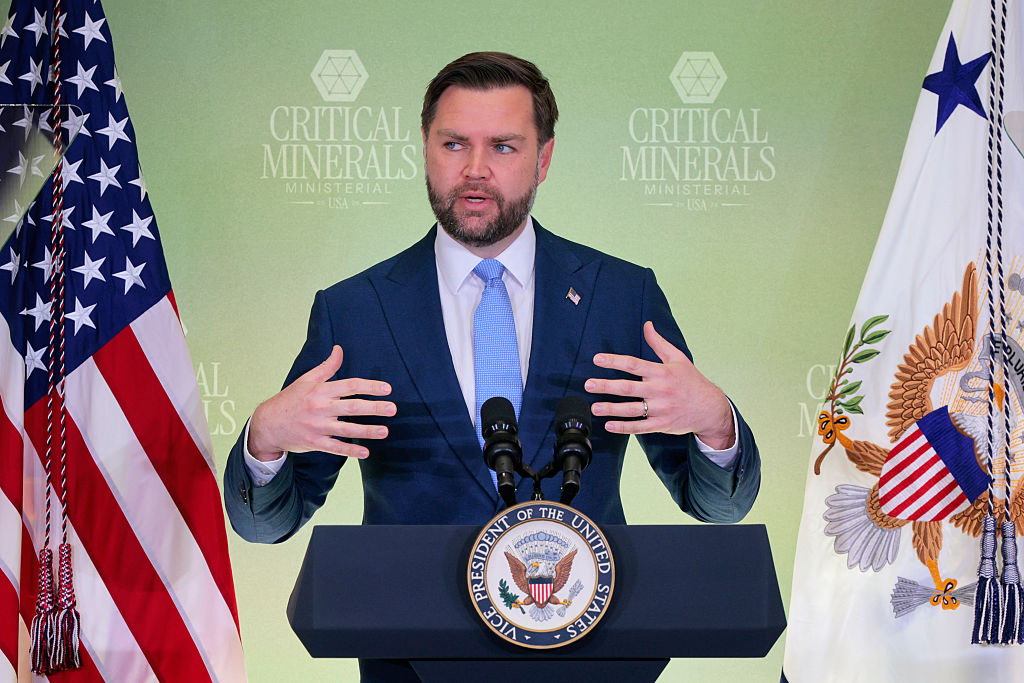
While the world remains fixated on the high cost of oil and gasoline as a result of the conflict in Iran, it is the skyrocketing cost of rare earth minerals that could ultimately have an even more dire effect on the global economy – and perhaps imperil U.S. national security.
For decades, communist China has had a stranglehold over the rare earths market, controlling up to 90 percent of the refining capacity for some of these minerals that are critical in the production of everything from cell phones to modern jet fighter planes. However, under President Trump the United States may finally be on the path to supply chain independence from its chief geopolitical rival.
Economic experts have referred to rare earth minerals, or rare earth elements, as the “vitamins of modern industry” and the “silent engine” behind the modern global economy. Beijing has sought to use its control of these materials as an economic weapon against the United States.
“The CCP’s actions in the metal market are far more damaging than high oil prices,” said Jiao-long Lùlǐ, a professor of economics and Chinese dissident. “But since these metals are less visible, the CCP avoids scrutiny.”
China is aiming to stall U.S. technological progress by starving it of the rare earth elements necessary to power innovation. A newly released European Union Chamber of Commerce report finds that Beijing’s rare earth export controls have “pushed global supply chains to a breaking point.” Some minerals that are vital to the electronics and defense industries, such as yttrium, have increased in price by a factor of 140 over the past year as a result of Chinese export restrictions.
“If these restrictions remain in place, tight market conditions are likely to persist,” said Luke Adriaans, a manager at commodities consultancy Project Blue, based in Tokyo. China produces more than 85 percent of the world’s yttrium.
In response to this and similar shortages of other rare earth minerals, the Trump Administration has ramped up its pushback against China’s efforts to undermine American innovation and disrupt global supply chains by forming alliances with mineral-rich nations.
Last month, for instance, the U.S. revamped its deal with Australia to accelerate mining and processing of tungsten, yttrium, and other key minerals like vanadium, aluminum, and graphite. The investments outlined in the deal now top $3.5 billion – almost double the previous arrangement.
“Australia and the U.S. are delivering on the commitments made in the White House, with priority projects in Australia that support production of rare earths and critical minerals,” Australia’s Resources Minister Madeleine King said in a statement. “Australia is taking a global lead to diversify crucial supply chains for critical minerals and rare earths, which are vital to support economic and national security for Australia and our trading partners.”
Late last month, USA Rare Earth also announced that it would buy Brazilian rare earth miner Serra Verde in a $2.8 billion deal. “The world has become too dependent on a single source and it’s high time to break that dependency,” USA Rare Earth CEO Barbara Humpton told CNBC’s “Squawk Box.”
Brazil has emerged as a key player in the rare earths space. Geological surveys show that Brazil holds the second-largest known reserves of these vital elements of any country in the world, which are mostly untapped. Until now, Chinese business ventures have largely dominated rare earths mining in Brazil.
Professor Lùlǐ, formerly a senior CCP official, said losing Brazil could weaken or deprive the CCP of control over rare earth prices. He said Brazil supplies about one-third of China’s total for at least two rare earth metals.
On the diplomatic front, the Trump administration has also pressured global institutions like the IMF and the World Bank to focus more on breaking China’s stranglehold on rare earths, rather than its obsession with climate change. The United States and the European Union also recently announced plans to deepen their cooperation with an eye toward countering China.
Newly discovered deposits of rare earths could also change the equation and put China on the defensive. Chile, Peru, and Argentina have deposits with global importance. In March, the Pentagon announced a $96 million deal to purchase the rarest of rare earth minerals from a new supplier in Malaysia.
The next challenge will be building refining capacity – the area where China really dominates. While China only controls about 50 percent of the world’s known reserves within its borders, it has about 90 percent of global refining capacity.
The Trump administration is tackling that challenge as well, including through a $400 million investment in MP Materials, an American company that has built refining capacity from scratch. MP says that it could refine enough rare earths to meet America’s needs by 2028.
During his first term, President Trump secured American energy independence, heralding a new era in economic and national security. Now, in his second term, he could do the same for rare earth elements – perhaps an even more consequential achievement.

About the author
Ben Solis
Contributing Writer
Expertise
- • International affairs
- • History
- • Foreign policy and national security
Credentials
- • International affairs journalist, historian, and researcher (writing under a pen name)


28 Comments