
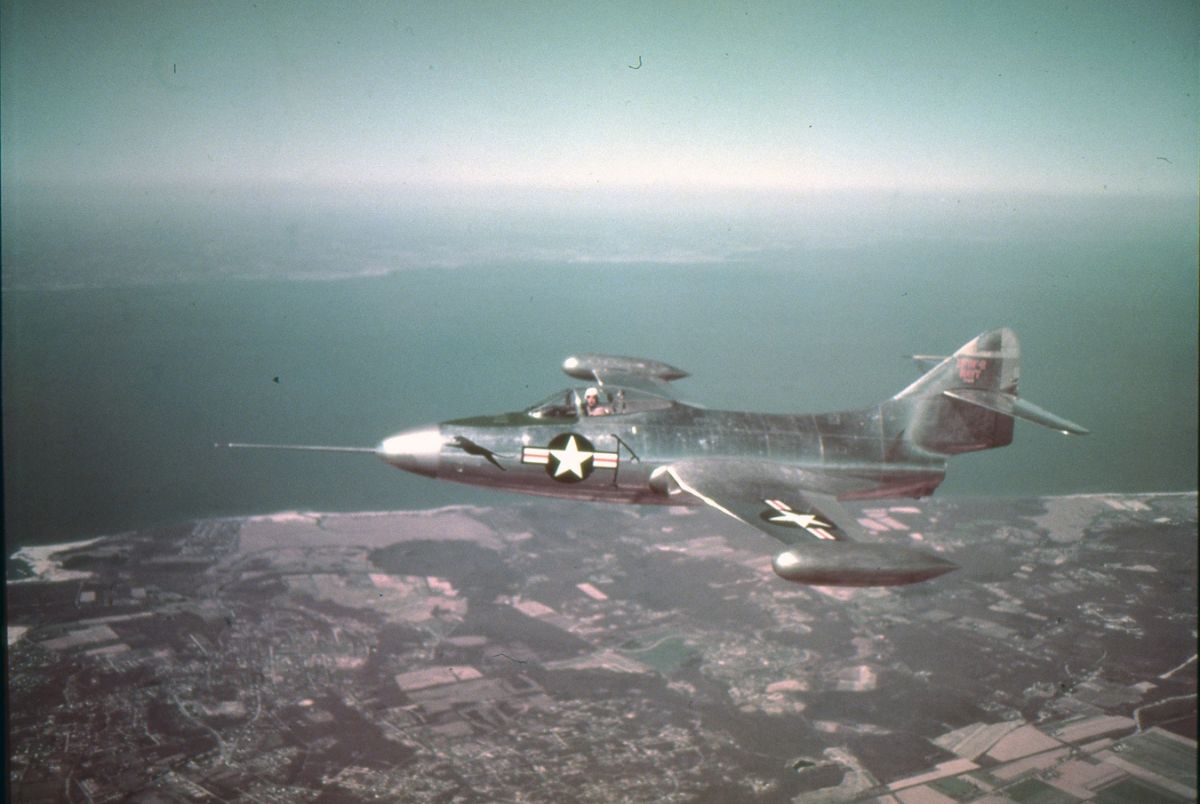
On November 21, 1947, aviation history took a significant leap forward when test-pilot Corwin Henry “Meyer” (known as “Corky” Meyer) of Grumman Aircraft Engineering Corporation lifted off from the company’s plant at Bethpage, Long Island, New York, in the prototype XF9F‑2 Panther (Bu. No. 122475) — marking Grumman’s first flight of a jet-powered carrier-based fighter.
The XF9F-2 Panther represented a major milestone: it was the first jet aircraft produced by Grumman, the famed “Iron Works” of carrier-borne fighters. The Panther was designed as a single‐seat, single‐engine day fighter for the U.S. Navy, intended for deployment aboard aircraft carriers, and its development signalled the Navy’s and Grumman’s transition into the jet era.
Meyer’s first flight was no casual hop: the runway at Bethpage was just 5,000 feet (1,524 meters) long — unusually short for a jet prototype of that size and power. After take-off, Meyer flew the aircraft and then landed at Idlewild Airport (now JFK), which provided a longer runway for the evaluation. The weather conditions, as Meyer later recalled, were “the foulest of any first flight in my experience.” He described the new jet’s handling as “like a J-3 Cub” — an ironic comparison given the leap in technology from a light trainer to a high-performance jet.
Powered by the British‐designed Rolls‑Royce RB.41 Nene centrifugal-flow turbojet (licensed in the U.S. as the Taylor/Taylor J42-TT-2), the Panther demonstrated advanced propulsion capability for its era. The Nene/J42 engine delivered 5,000 lb of thrust, a powerful figure at the time, enabling performance levels that matched the emerging generation of jets.
The importance of this first flight cannot be overstated: it marked Grumman’s entry into the jet-fighter domain, positioning the company for future success in the Korean War with the production Panther (F9F-2) and subsequent versions. The Panther would go on to serve with distinction, both as a fighter and in ground-attack roles.
This was a turning point in naval aviation and the broader evolution of carrier-based jet fighters. With the XF9F-2’s first flight, Grumman and the U.S. Navy embraced the jet age, setting the stage for decades of aerial innovation.



Comments