
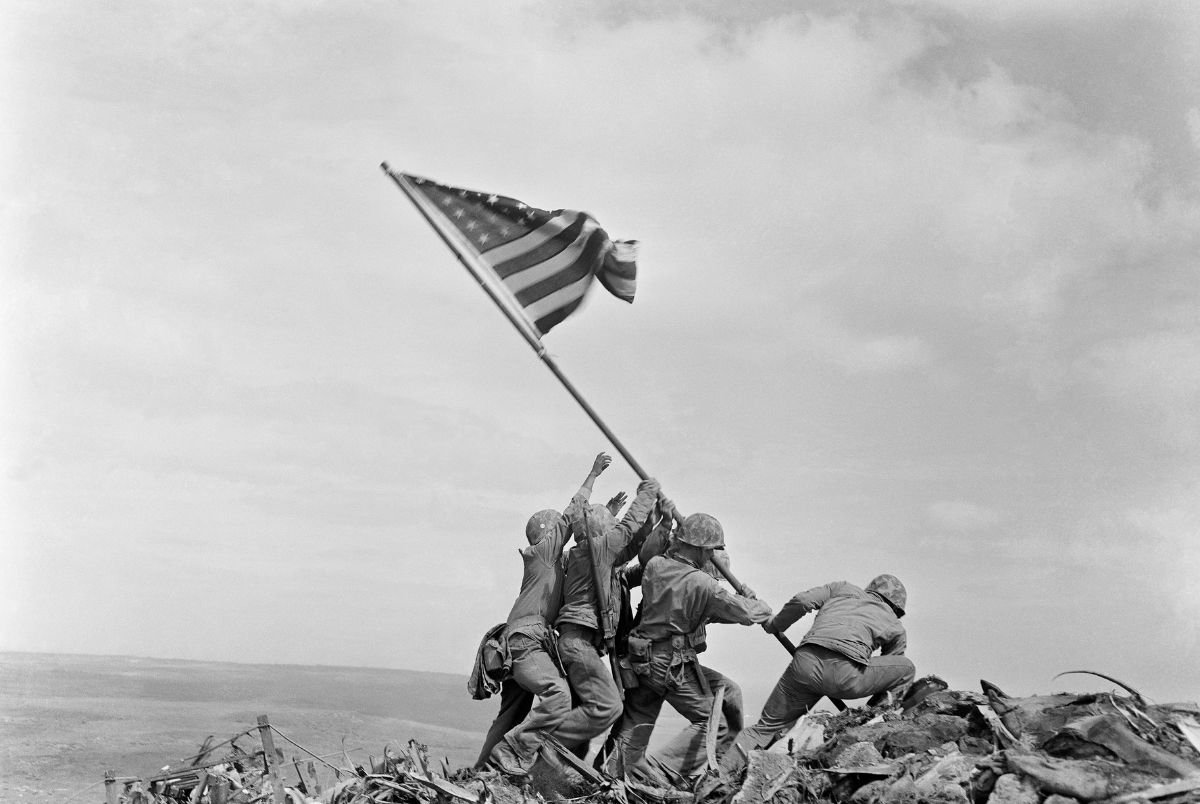

On February 23, 1945, one of the most enduring images of World War II was created atop volcanic rock in the Pacific Ocean: the U.S. flag was raised on Iwo Jima, marking both a tactical victory in a brutal campaign and a symbolic moment of courage and resilience for the United States.
The Battle of Iwo Jima had begun four days earlier, on February 19, 1945, when nearly 70,000 U.S. Marines and Navy personnel landed on the small Japanese island as part of America’s island-hopping strategy to secure bases critical for air operations against the Japanese home islands. Japanese defenders under General Tadamichi Kuribayashi were heavily entrenched in fortified positions and tunnels, making the struggle for control extraordinarily costly and ferocious.
Mount Suribachi, a 550-foot extinct volcano at the southern end of the island, was a strategic high ground. On the morning of February 23, Marines from the 3rd Platoon, E Company, 2nd Battalion, 28th Regiment, 5th Marine Division reached the summit and raised a small American flag, signaling that they had taken the peak. Cheers from troops below echoed across the battlefield.
But the moment that would become immortalized around the world came later that afternoon. A second, larger flag was brought up to replace the first for better visibility. Associated Press photographer Joe Rosenthal, who happened upon the scene, captured six Marines hoisting the flagpole into the wind — a dramatic act of determination. That photograph, widely published and eventually winning the Pulitzer Prize for Photography, became one of the most recognizable images of World War II and a potent symbol of American unity, sacrifice, and victory.
Contrary to some myths, the photograph was not staged; Rosenthal’s quick instincts preserved a real and powerful moment that helped define the public’s perception of the Pacific War. The image was reproduced widely in newspapers and magazines, boosting morale on the home front and playing a role in fundraising drives that generated billions of dollars for the war effort.
The iconic scene also inspired the United States Marine Corps War Memorial in Arlington, Virginia, dedicated in 1954 to honor all Marines who have given their lives in service since 1775.
While the capture of Mount Suribachi was a key moment, the Battle of Iwo Jima continued for weeks, with fierce fighting across the island until March 26, 1945. The cost was high on both sides, but the flag raised on Suribachi endures as a lasting testament to the valor and endurance of those who fought there.
18 comments
Do you remember? Share your memory.