
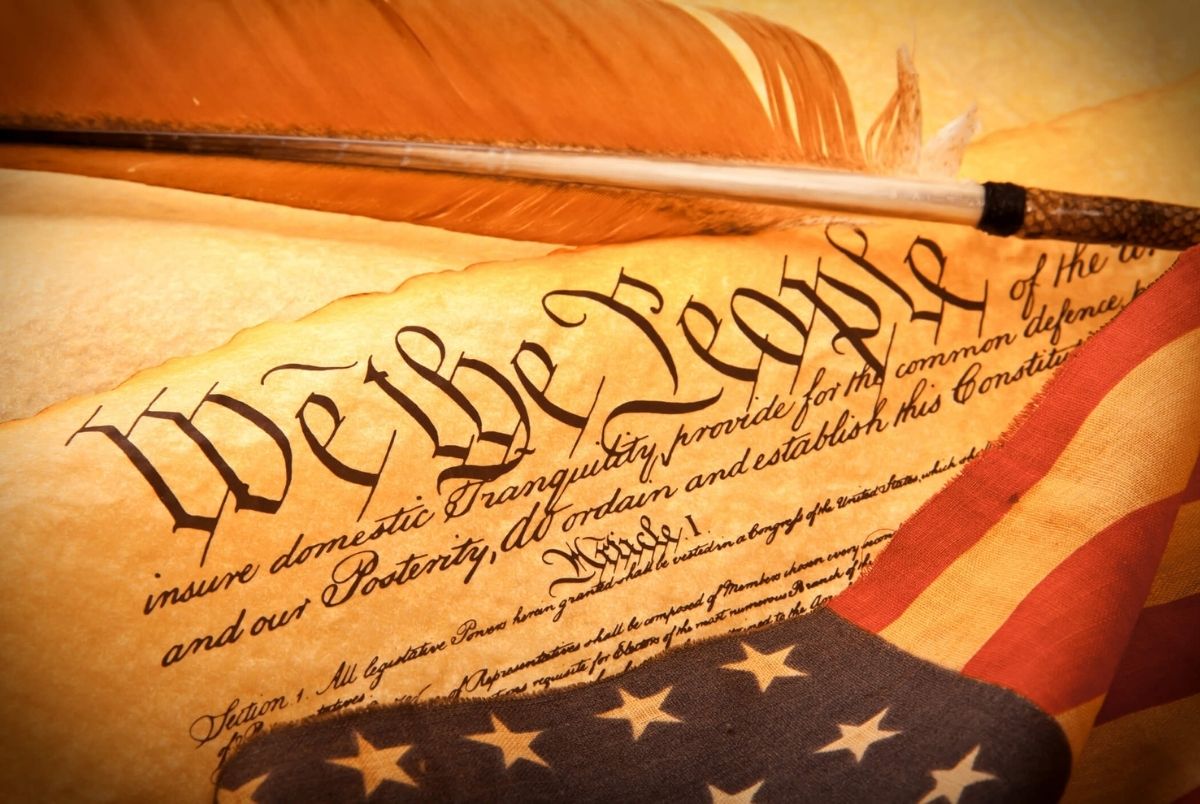
On the last day of the Constitutional Convention in 1787, Elizabeth Willing Powel, a prominent Philadelphia socialite, asked Benjamin Franklin what form of government was being proposed for the United States. In a reply that has become famous, Franklin said: “A republic, madam, if you can keep it.”
Franklin’s words, often cited to show that the Founders recognized the profound vulnerability of the republican order they crafted, are easy partisan fodder in times of controversy or crisis. Activists, pundits, and politicians have long invoked them to tag their opponents or their opponents’ ideas as precisely the sort of existential threat to a fragile American system that the Founders anticipated might arise.
It is highly unlikely, however, that any one policy, law, or politician would pose such a threat. Even presidents who pushed the limits of their office’s power, from Franklin D. Roosevelt to Donald Trump, have not dismantled our republic’s core institutions or set us on a course toward autocracy, monarchy, or dictatorship. This year, as we commemorate the 250th anniversary of the Declaration of Independence, we also celebrate a quarter millennium without an American Caesar or Napoleon.
Yet there is a sense building in the national consciousness that something isn’t right. A December 2025 Gallup poll found that just 24 percent of Americans were satisfied with the nation’s direction. A Politico poll from a month prior found that 49 percent of Americans thought that the country’s best times lay in the past, while only 41 percent thought that America’s best times are yet to come. As a professor, I interact frequently with young people. Among students of diverse political persuasions and worldviews, I have noticed a shared sense that our institutions, norms, and cultural and social fabric are collectively undergoing a period of decline.
As we approach our nation’s 250th anniversary, why do so many people believe that America is on the brink? The answer is complex.
Our civic and political structures remain fundamentally intact, even if they have been pushed to their limits in recent years and decades. Rampant judicial activism, presidential overreach, the amassing of power in the executive branch, and Congress’s abdication of its legislative and oversight responsibilities have all contributed to the gradual deformation of the separation of powers and the system of checks and balances conceived by our forefathers.
Still, these institutions are functional — at least at the minimum necessary. Budgets are passed (eventually); guarantors of social order, such as the military, police, and the criminal justice system mostly do what they are meant to do; civil liberties are protected; and social welfare programs chug along. After 250 years, our institutions may be struggling, but they have not failed.
Even so, there is a good reason behind the widespread pessimism about our country’s future. While our institutions themselves may subsist, our political culture — the fundamental pillar on which the health of our institutions rests — has become severely degraded, almost to the point of dysfunction.
George Washington put it well in his first inaugural address in 1789 when he noted that “the preservation of the sacred fire of liberty, and the destiny of the Republican model of Government, are justly considered as deeply, perhaps as finally staked, on the experiment entrusted to the hands of the American people.” What Washington told us then remains true: While constitutional structures, institutions, and political systems are of crucial importance, they will be effective only when they are supported by the people. That is, by the political culture. We must value our institutions enough to resist usurpations by their rulers, even when unconstitutional programs offer immediate gratification or the relief of urgent problems.
For the political culture to properly underpin our constitutional structures and institutions, certain virtues must be held and practiced by the people. But virtues must be nurtured by each generation. James Madison said that “a well-instructed people alone can be permanently a free people.” That is certainly true. But Madison’s words also point to the fact that even the best constitutional structures — which I believe ours to be — and the strongest structural constraints on governmental power — which I believe are features of our system, as conceived by the Founders — are mere parchment promises if people do not understand them, value them, and have the will to resist those offering something tempting in return for giving them up.
The Constitution was famously defended by Madison in Federalist No. 51 as “supplying, by opposite and rival interests, the defect of better motives.” He made this point immediately after observing that the first task of government is to control the governed, and the second is to control itself. He allowed that “a dependence on the people is, no doubt the primary control on the government, but experience has taught mankind the necessity of auxiliary precautions.” But even in this formulation, our constraints and institutions do not stand alone; indeed, they are presented as secondary. What is primary and entirely necessary is a healthy and vibrant political culture — “a dependence on the people” to keep the rulers in line.
As the ablest scholar and political theorist of the founding generation, John Adams understood as well as anyone the general theory of the Constitution. He knew that a healthy political culture was vital to ensuring that rulers stay within the bounds of their legitimate authority and act as servants of the common good and of the people they rule. Adams famously remarked that “our Constitution is made for a moral and religious people” and “is wholly inadequate to the government of any other.”
Why? Because people lacking in virtue could be counted on to trade liberty for protection, for financial or personal security, for comfort, or for having their problems solved quickly. In a democratic system — going all the way back to ancient Athens — there will always be people occupying or standing for public office who are happy to offer a deal: an expansion of their power in return for what they can offer by virtue of that expansion. The question, then, is how to form people fitted with the virtues that make them capable of maintaining limited government and our constitutional structures, institutions, and political system, even in the face of inevitable temptations to compromise it away.
Here we see the significance of the most basic institutions of civil society — the family; the religious community; private organizations that are devoted to the inculcation of knowledge and virtue; private (often religiously based) educational institutions; and others play the indispensable role of transmitting essential virtues. These are mediating institutions that provide a buffer between the individual and the power of the central state. It is ultimately the autonomy, integrity, and general flourishing of these institutions that will determine the fate of constitutional government.
These institutions perform basic health, education, and welfare functions as the only real alternative to the removal of these functions to government. But when government expands to play the primary role in performing them, the ideal of limited government is soon lost, no matter the formal structural constraints of the Constitution. The corresponding weakening of the status and authority of these institutions damages their ability to perform all their functions, including their moral and pedagogical ones. With that, they will lose their capacity to positively influence the political culture on which they depend.
It is difficult to conceive of a moment in our nation’s history when institutions devoted to the cultivation of virtue have been weaker. Many of our fellow citizens do not even know what a family is anymore, let alone how to be part of one or how to properly start a new one. Church attendance and religious affiliation are at record lows. And under recent progressive administrations, churches and private organizations whose dedication to the formation of virtue rendered them dissenters from progressive social, cultural, and moral doctrines were investigated, defunded, sued, and otherwise targeted.
This year, we mark the anniversary of a document that acknowledged certain truths to be self-evident, among them that all men are endowed by God with unalienable rights. From the moment of our country’s Founding, the authors of our constitutional and political order saw their project as premised on the notion that the citizenry — though diverse in ethnicity and creed — shared some fundamental premises about human nature and the human person. Now, though, the foundational components meant to form good, moral, and reasonable citizens are frail; they wield less influence in our society and in our politics than they did in the past. Our bonds are weakening; our civic fabric fraying.
If we are experiencing a period of American decline, it’s not because of the constitutional order and political system whose 250th anniversary we celebrate this year. The decline is attributable, rather, to the degradation of what Edmund Burke famously referred to as the essential “little platoons” of society: those building blocks of virtue, from families to voluntary associations, that work together to form an informed and virtuous citizenry. With the elements necessary to foster a healthy and vibrant democratic culture debilitated, is it any wonder that public confidence in our ability to keep our republic is so shaky?
Reprinted with permission from National Review by Robert P. George.
The opinions expressed by columnists are their own and do not necessarily represent the views of AMAC or AMAC Action.




So, 49% of Americans believe America’s finest hours have past. Can they say why? Public agencies of education no longer require competent knowledge of the US Constitution. Why not? Neither is American or world history a prerequisite for high school graduates. Why not? This has been the norm for nearly half of the population making up the current voting public. What are they voting for if not for sustaining the principles of our constitution? This is what Lyndon Johnson brought us with his “great society” sales pitch. He also partnered with the leftist crowd (an extreme minority) who sought the removal of Almighty God from our public schools. So, … no God, … no pledge of allegiance, … no knowledge of the US Constitution. Just America-haters, flag-burners, and God-hating pagans. Not quite what the founders had envisioned at all.
You keep the republic simply by getting rid of those who oppose it by whatever means necessary! That includes members of congress who are anti- American and other groups or people who claim they hate the United States!
Our problems stem from a Party who has a diabolical agenda in which they want to do away with Christianity, so they can be free to do what they want without any consequences. We must stop them in their tracks.- NOW, before it’s too late.
About the Declaration there is a finality that is exceedingly restful. It is often asserted that the world has made a great deal of progress since 1776, that we have had new thoughts and new experiences which have given us a great advance over the people of that day, and that we may therefore very well discard their conclusions for something more modern. But that reasoning cannot be applied to this great charter. If all men are created equal, that is final. If they are endowed with inalienable rights, that is final. If governments derive their just powers from the consent of the governed, that is final. No advance, no progress can be made beyond these propositions. If anyone wishes to deny their truth or their soundness, the only direction in which he can proceed historically is not forward, but backward toward the time when there was no equality, no rights of the individual, no rule of the people. Those who wish to proceed in that direction cannot lay claim to progress. They are reactionary. Their ideas are not more modern, but more ancient, than those of the Revolutionary fathers.
Excerpt from Calvin Coolidge Speech, Philadelphia, 1926.
We would do well to remember, we are one nation under God.
The Democratic Party and all of their allies are doing everything they can to destroy America and the American people! The Democratic Party are now wanting to continue to threaten our law enforcement agencies and officers and law binding citizens! The Democratic Party and their allies must be destroyed at all cost immediately! We need to stop take our country back now, even if we need a civil war!
President Calvin Coolidge: An excerpt from his 1926 speech in July in Philadelphia:
“About the Declaration there is a finality that is exceedingly restful. It is often asserted that the world has made a great deal of progress since 1776, that we have had new thoughts and new experiences which have given us a great advance over the people of that day, and that we may therefore very well discard their conclusions for something more modern. But that reasoning cannot be applied to this great charter. If all men are created equal, that is final. If they are endowed with inalienable rights, that is final. If governments derive their just powers from the consent of the governed, that is final. No advance, no progress can be made beyond these propositions. If anyone wishes to deny their truth or their soundness, the only direction in which he can proceed historically is not forward, but backward toward the time when there was no equality, no rights of the individual, no rule of the people. Those who wish to proceed in that direction cannot lay claim to progress. They are reactionary. Their ideas are not more modern, but more ancient, than those of the Revolutionary fathers.”
Something we all need to read, I think.
“… why do so many people believe that America is on the brink? The answer is complex.”
I disagree. The legacy media and many political figures have turned their backs on the Creator of this republic. The god of self is in control of our land. Child sacrifice has run rampant for decades, to the tune of more than 60 million babies murdered.
I believe the answer is simple. As Jonathan Cahn has stated, “We must pray for revival as never before…. We must work as never before… that revival may come. We must boldly spread the word of salvation…. …we must choose revival, that revival will come.”
If we, the people of this republic, humble ourselves before the Creator of the heavens and the earth, and return to serving Him, He will restore our republic. No other efforts will save this land.
I believe things will get worse because there is evil in this world & country. Our only hope is in Jesus. He’s the one we can depend for our future. People need need to right with God. The only way is through Jesus Christ to recieve him as Lord and Savior. It’s called being born again. He The way, the truth, and the light.
I have read some about Greek and Roman republics. The authors suggest that decline began as they moved toward being Democracies. Republics seem to be difficult to hang on to. Democracy seemed not to be the fair system many claim it to be.
To keep OUR Republic:
VOTE Dems out of office any level
Competitive media
Pro America Values
Purge Education & Media
Defund NGOs
Transparent
Downsize DC.
Term Limits
& add more
The radical liberals have been working for at least 50 years to gain control. They infiltrated our educational institutions with brainwashing our students and we did not stop them. They have to get the most vulnerable on their side to succeed. These radicals have worked diligently to ruin the American family by undermining any Christianity and Judaism. They must destroy the youngest’s respect for parents and that is now rampant. They want to destroy any type of law and order because they need chaos to take over with the lie that THEY will restore order and give the masses all the things they want. And then when they attain all of their evil goals, they treat the citizens like animals. Anyone who has ever studied the Communist takeover in other countries knows this. Since our young people never get a true account of history (it has been changed by the radicals), they have no idea what is going on. The one thing that the conservatives did that was lethal was to ignore the creeping radical liberal march to take us down. I pray there are enough sane Christians left to take them down.
How about we return to the seven virtues: Prudence, Justice, Fortitude, Temperance, Faith, Hope, and Charity. Today we have a deficit of ethical and moral conduct. There has been a rudeness and crudeness across the land for decades. To start with, members of our federal government abuse their power and skate without any consequences. They are in the public eye and set examples. This then flows down to state, county and city levels. Holding public office is a trust. We have a media, who in general, has lost their way. Take all of this together and you have a public who is frustrated and either don’t care, or some pick up the bad habits.
We have problem with the naturalized citizens, they ignore the Constitution, if you become a new citizen need to get more education specially in the constitution.
Very well stated! A well-considered reminder of our essential Biblical, Anglo-Germanic,
and Roman Republican values (in order of importance).
Well said, but also, so sad!
I go to a small church. We used to have about 50 members. But our pastor resigned and we are unable to find another one and it’s been about 15 months. Only about 20 people now attend. I have taken on the job of church secretary. Also, clean the church with my husband. And I have turned 70 so I don’t how much longer I can do this and play piano every Sunday, too. This is symptomatic of the lack of interest in serving God and community in our younger generation. What is in it for me? Is the manthra of today…
Congress seems incapable of passing g legislation due to extreme partisanship. I have a proposal. For every bill debated in Congress let the majority party have 2 victories within the bill for every 1 gi ven to the minority. The minority must be given some ground given that their points DO NOT make the majority wins mute. If both sides get something from every law there is chance of some degree of bipartisanship. I believe this how Vil Clinton and Newt Gingrich did it. It would be nice if everything the federal government does was by executive order
Trump has too many distractions going to look at his good & bad ideas. How is the raid on Fulton George election offices going to make America great? The 2020 election is history & Trump is not going to change this in 2026 and his own AG Bill Barr investigated in 2020 and said the election was not corrupt. Trump needs to let go of the past & lead the USA to lead the world again like we did following WWII. The GREATEST GENERATION would not believe what is happening to USA today !