
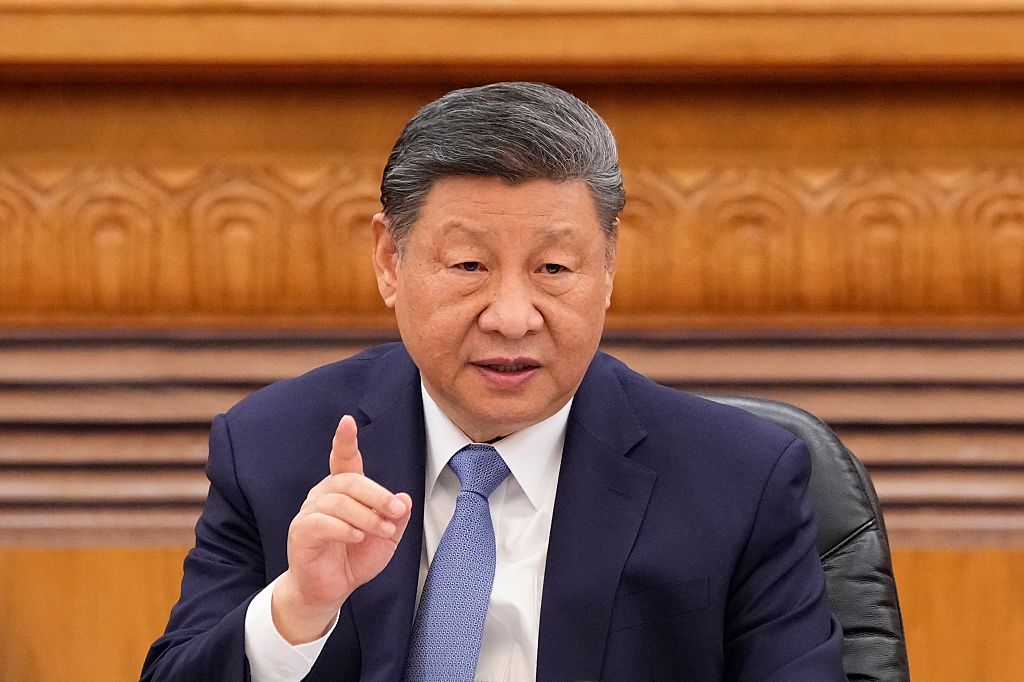
More than three-quarters of the way through 2025, it is becoming increasingly clear that China’s vaunted “Made in China 2025” initiative has failed to deliver on its promises. What was supposed to be a 10-year sprint toward global technological supremacy has instead been derailed by mounting internal problems, persistent industrial inefficiencies – and a decisive intervention from President Donald Trump.
Launched in 2015, the Made in China 2025 plan was the Chinese Communist Party’s (CCP) roadmap to transform the country into the world’s dominant player in high-tech manufacturing. The plan targeted 10 strategic sectors, ranging from semiconductors to robotics to aerospace, and envisioned China becoming a “manufacturing superpower” by mid-century.
On paper, it was a bold and sweeping vision for economic modernization. But in practice, it was riddled with contradictions.
Made in China 2025 was never just about economic growth. It was a political project – a propaganda tool meant to show the CCP’s ideological superiority over the West and reinforce Xi Jinping’s grip on power. Like the old five-year plans in the Soviet Union, it was heavy on slogans, vague benchmarks, and central planning jargon like “integrating” and “promoting,” but light on verifiable metrics or concrete deliverables.
“Economic plans were crucial primarily in Soviet politics and propaganda,” said Alexander Yakovlev, the architect of Perestroika. Joseph Stalin himself warned that economic plans should avoid too much specificity, lest the regime suffer embarrassment if goals weren’t met. Chaos, waste, theft, and corruption plagued those systems. The CCP has been no exception.
Professor François Godement of the Institut Montaigne put it bluntly: “Ideology and control” are “the main factors that hamper China’s drive for cutting-edge innovation.”
Two British researchers, writing in the peer-reviewed journal Research Policy, came to a similar conclusion. In a paper titled Does ‘Made in China 2025’ Work for China?’ they found no clear evidence that the plan had improved innovation or modernized China’s manufacturing capabilities. Instead, they pointed to outside forces – specifically, the “Trump trade war” – as the key factor undermining the initiative.
That trade war, launched in 2018 and intensified through 2020, was no mere rhetorical campaign. The Trump administration imposed sweeping tariffs on Chinese goods, raising the average rate from 2.7 percent to nearly 25 percent. Sectors targeted included steel, aluminum, washing machines, and auto parts. Chinese manufacturers saw profits shrink and were forced to redirect resources toward seeking new markets – a strategy that largely failed.
Far more damaging, however, were the administration’s restrictions on technology transfers. China had long assumed that access to U.S. tech would continue unabated. This assumption was so deeply embedded in the CCP’s thinking that, as one Chinese dissident told this author, it became “the brain and the bloodstream” of the Made in China 2025 plan. “Their own arrogance defeated them,” he said.
The centerpiece of the U.S. response was the Clean Network Initiative, launched by Under Secretary of State Keith Krach, a former Silicon Valley executive. Recognizing the threat posed by Chinese telecom giants Huawei and ZTE, which had long been accused of industrial espionage, Krach spearheaded a campaign to purge Chinese tech from Western infrastructure.
The Clean Network imposed strict requirements on equipment, software, and communications systems. All infrastructure had to be scrubbed of Chinese assets. The initiative gained rapid traction: within months, 26 of 27 EU countries, 27 of 30 NATO members, and 31 of 37 OECD nations had signed on.
“The success of the Clean Network has taken all the momentum away from Huawei,” Krach told Bloomberg. Huawei’s profits fell 69 percent in 2022 and dropped another 32 percent this year – its worst performance since 2011.
Meanwhile, China’s broader tech ambitions floundered. U.S. firms surged ahead with generative AI models like ChatGPT, while China’s efforts lagged. The most successful Chinese competitor, DeepSeek, turned out to rely heavily on Silicon Valley technology. Despite massive investments, China still hasn’t replicated SpaceX’s Starship or achieved breakthroughs in solid-state battery technology.
Made in China 2025 envisioned a sweeping leap forward, but the results tell a different story. China’s GDP growth post-COVID was just five percent, far short of the 8.5 percent target. The collapse of major property developers like Evergrande shattered faith in the housing market. Local government debt has ballooned to over 60 trillion yuan – 91 percent of China’s GDP.
That’s not the trajectory of a country confidently rising to global dominance. And it’s no coincidence that the decline coincided with the Trump administration’s decisive actions to expose China’s industrial vulnerabilities and decouple the U.S. from Beijing’s tech pipeline.
The CCP knows this and is quietly retreating from the plan’s language. Despite the name “Made in China 2025,” the Party now insists that China won’t truly become a manufacturing leader until 2049, the centennial of the Communist revolution.
Had it not been for President Trump’s tariffs, sanctions, and initiatives like the Clean Network, China’s plan might well have succeeded. Instead, it lies in shambles—another failed example of central planning and state-led ambition collapsing under the weight of its own contradictions.
Ben Solis is the pen name of an international affairs journalist, historian, and researcher.




There is little point if any about continuing or recognition of China as a competitor of the United States … they are plain and simply an enemy to be dealt with when it benefits the United States. Right now they matter because of their negative actions against the agriculture sector of the U.S. economy…
” The U.S. agriculture sector extends beyond the farm business to include a range of farm-related industries. Agriculture, food, and related industries contributed 5.5 percent to U.S. gross domestic product and provided 10.4 percent of U.S. employment; U.S. consumers’ expenditures on food amount to 12.9 percent of household budgets, on average. Among Federal Government outlays on farm and food programs, nutrition assistance far outpaces other programs.”
Trump is working on shutting down the acquisitions of U.S. Ag companies like… “Smithfield Foods, the world’s largest pork producer, was acquired by a Chinese firm in 2013 for nearly $5 billion — more than the company’s market value.” and land contiguous to U.S. Military Bases… “Gordon Chang, a China-U.S. relations analyst, told AFN aka Armed Forces Network that China’s interest in property near the Air Force base in the Grand Canyon State is a warning sign that could have implications similar to what the Russian miliary suffered in the drone attack by Ukraine.“At Luke Air Force Base, a Chinese party tried to rent a warehouse which is close to the runways there. They were denied that ability and then they tried six months later to rent a warehouse space at the other end of the runway,” he explains. “So, we know that they are surveilling our runways. And as we saw what Ukraine did to Russia’s bombers, the Chinese are, I think, trying to put into place the infrastructure to attack our planes on our own runways with their drones.”I could go on but you get the point.
I wish they could do something about alibaba. They are totally owned by chi na. Their slick commercials don’t reveal their ownership.
Do we the people need any more proof about “central planning”? I takes leadership like our President Trump, to sideswipe the efforts of this CCP, IMO.
American Blindness put this Colossus on it’s feet, they are of clay thank God, now hopefully it will shrink.
GOD said this Chinese failure would happen…and it did!
In my lifetime I’ve never seen a single product from China perform as what they copied and stole from US sources. As it stated in this article, China is only an intellectual parasite upon the U.S. and we need to remove them from the country and take back whatever land has been sold to any and all foreigners by Obama.
oh no, this article isnt mindless propaganda…….oh goodness no. it just fails to reflect the contnually growing trade imbalance between the US and China and the fact that the US is a bankrupt insolvent lying nation financially who can no longer find buyers for its debt instruments which, with a currency backed by nothing means…………it is toast.
Whats Chinas debt to GDP ratio and what is Chinas unemployment rate? Why can’t America build a vehicle that can be trouble free for at least as long as its warranty? Why are our military weapons a laughingstock when compared to other nations weaponry that was made at a tiny fraction of the crap we poorly make?
why is none of these matters ever addressed at this cultish website?