
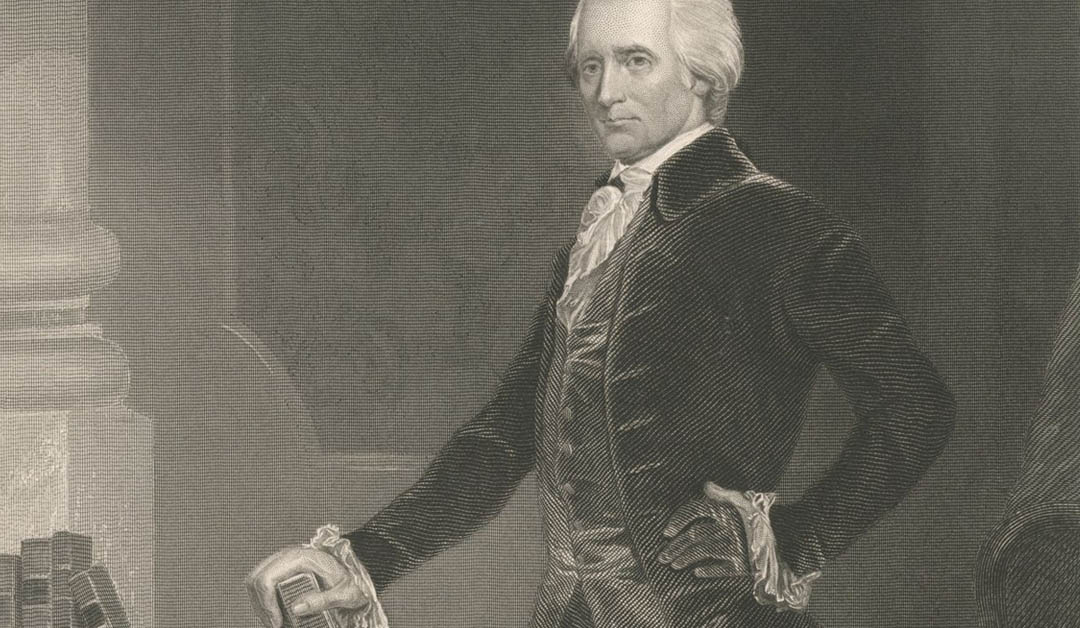
In the lead-up to Independence Day on July 4 each year, many scholars like to point out that we “should” celebrate our independence on July 2 because that is the day on which the Continental Congress passed a resolution “that these United Colonies are, and of right ought to be, free and independent States.”
However, that resolution was proposed in the Second Continental Congress nearly a month before. It was 250 years ago today—June 7, 1776!—that Richard Henry Lee of Virginia (the cousin of the famed cavalry officer Light-Horse Harry Lee) officially proposed our independence—no doubt an equally important milestone in the history of our nation.
The resolution offered by Lee was a complex one. He also proposed making foreign alliances to support the American cause and called for a “plan for confederation.”
Though Congress didn’t immediately pass Lee’s resolution, it did what Congresses always do and sometimes should do: It called for a committee. In fact, it called for three committees to act on the three parts of the resolution.
That probably wasn’t a bad idea. After all, not all these proto-Americans were themselves sold on the wisdom of becoming an independent nation. Many had been convinced of a need for independence by 1767, when the British Townshend Acts established taxes on tea, paper, glass, and other products. These “duties,” meant to show the colonists they would remain under the British government, had solidified many of those colonists’ conviction that what they suffered under was “taxation without representation.”
But independence remained an enormous risk. In addition to personal risk—every Founding Father was committing high treason against the most powerful empire on earth, a crime punishable by death—there was also real doubt that the American colonies could survive politically and economically as an independent nation.
Pennsylvania farmer John Dickinson was himself skeptical. He wrote, “If once we are separated from our mother country, what new form of government shall we adopt, or where shall we find another Britain to supply our loss.”
In that query about a form of government, Dickinson expressed the worry, as historian Wilfred McClay put it, “that the American colonies were too weak and divided to constitute themselves as a nation.” We look back to wigged figures striking familiar poses in paintings of the time, but independence-minded Americans have always been, well, independently minded.
Could they agree enough for unity? Would colonists separated from rule of the British Crown find themselves ruled by some other small-bore monarch? Would they be at the mercy of the mob?
In the words about loss, Dickinson was expressing a worry that the cultural and familial ties to Britain were too great to cast off. “Torn from the body to which we are united, by religion, liberty, laws, affections, relations, language, and commerce,” Dickinson warned, “we must bleed at every vein.”
As the Founders gathered to decide on independence, all of these worries were still operative, even in the midst of the war with the mother country that had been raging since April 1775. Some colonists were outright on the side of the British. Yet, the side that argued for the colonies to become something more than colonies was gaining strength. To the claim that Americans were not “ripe” for independence, John Witherspoon, one of its signers, replied, “In my judgment, sir, we are not only ripe but rotting.”
Though the nineteenth-century thinker John Henry Newman wrote, “Living movements do not come of committees, nor are great ideas worked out through the post, even though it had been the penny post,” the story of American independence shows that committees can benefit living movements—and those movements can work out quite a bit by mail.
Richard Henry Lee, known to many as the “Cicero” of the colonies, had been one of the main instigators and organizers of the Committees of Correspondence that had done such work in preparing the ground for independence. As with the post, so, too, the committees formed in response to Richard Henry Lee’s resolution. Unlike so many committees we have all experienced, they didn’t kill the movement but advanced it.
We all know that the decision to have Thomas Jefferson write the official Declaration of Independence was the correct one. The scholar of rhetoric Stephen Lucas called it “perhaps the most masterfully written state paper of Western civilization.” We also know that the Americans benefited from the support of the French—directly, at a certain point in the war—and the Spanish and Dutch all provided aid, comfort, and assistance to the American cause. Further, we all know that, eventually, Americans would find a form of government that was successful, brilliant, and a work in progress.
Ironically, Lee, who served in Congress as a Representative, then a member of the Virginia House of Delegates, and, finally, as a Senator from Virginia, voted against that 1789 Constitution. He thought the States were not given their due in this “consolidated” government. He thought the people were not given their due because there was no Bill of Rights.
In other words, the great debate about our nation continued. Lee was to see a Bill of Rights added in 1791, the year before he retired from public life. The Tenth Amendment addressed the question of the States, asserting that those powers not explicitly delegated to the federal government belong to the people or the States themselves.
Richard Henry Lee is a name that ought to be more widely known. The lessons he teaches us are obvious. Service to one’s nation requires a great deal of work that requires preparation (those Committees of Correspondence), daring (formulating the resolution to act), and following through when the goal (independence) has been accomplished.
Richard Henry Lee didn’t just desire the independence and good of his nation. He worked for it and persevered, even when the vote on constitutional ratification didn’t go his way. Instead, he kept working to amend it and improve it. So should we all.
David P. Deavel teaches at the University of St. Thomas in Houston. A past Lincoln Fellow at the Claremont Institute, he is a Senior Contributor at The Imaginative Conservative. Follow him on X @davidpdeavel.






I think our constitution needs no further amending. However, our government needs to get rid of inefficiency, cheating, and scams.
Our Constitution is just fine. The problem is that we have drifted so far away from it that we are practically completely ignoring it these days. It should be required that every member of our Congress read the Constitution in its entirety before every meeting they attend and every vote that they have. If they would do that, they would discover that the federal government has gone way, way beyond the 18 enumerated functions/responsibilities granted to it by the Constitution, which specify the duties, responsibilities, and authorities of the federal government. More than a century ago, the federal government began taking upon itself functions and responsibilities not granted to it by the Constitution. It was aided and abetted in this “power grab” by Courts that either did not understand the limits that The Founders and our Constitution put on the federal government, or had a political interest and agenda in expanding the federal government and its powers and consolidating more and more power in Washington, something The Founders clearly wanted NOT to happen. This expansion and “power grab” have brought us to where we are today, with a minimum of 2/3 of federal agencies, 2/3 of federal programs, and 2/3 of the federal budget flat out unconstitutional. If we do not find a way to get back to the Constitution, we are doomed as a nation.
This is a fabulous piece on our Constitution. I think what most people don’t understand and it certainly isn’t taught in schools today that this magnificent document is our CONTRACT!!!!!! It was made to be sacred and used for the states to use for the safekeeping of our sovereignty. These men who wrote the contract had high hopes that the peoples of the future would know how to take care of this land. I pray that this dream still exists in the hearts of people……GOD BLESS AMERICA ????????
Constitution is a God send, thank God for that, The only thing stopping Left from walking all over us, that’s why they would like to burn it on their bonfire , along with all else not to their liking.The worst is that the people still vote for them, not realizing it is not the party of 50 years ago, when they endorse and shield Nazi sympatizer, but would clobber a conservative, need there to be said more, young Biden, seriously, it will be a new world alright.
Thank you for this thoughtful look into our Nation’s beginnings as we head into summer.
Our Founders, Big or Small, I love them all, the greatest men of all time!
The were extremely smart to devise a country like we have today!
God Bless Americas!
If only we still had upright, honest and caring people like our founding fathers in our government today. It saddens me to see how far our government leaders have strayed from our Constitution. Only yesterday I was talking to a friend about the lack of quality in the current group of people running for government offices. We are witnessing the product of decades of brainwashing from the radical liberals who want power so badly that they have forgotten or never experienced what it is like to feel proud patriotism for their country. One thing I do know is if these evil people take control again in the near future, our Republic will cease to exist.
I first learned about Richard Henry Lee via the musical “1776.” I actually learned some history through that show, and that our quest for independence did not easily come about in the Continental Congress.
Jaleighluia‼️????????❤️????????‼️