
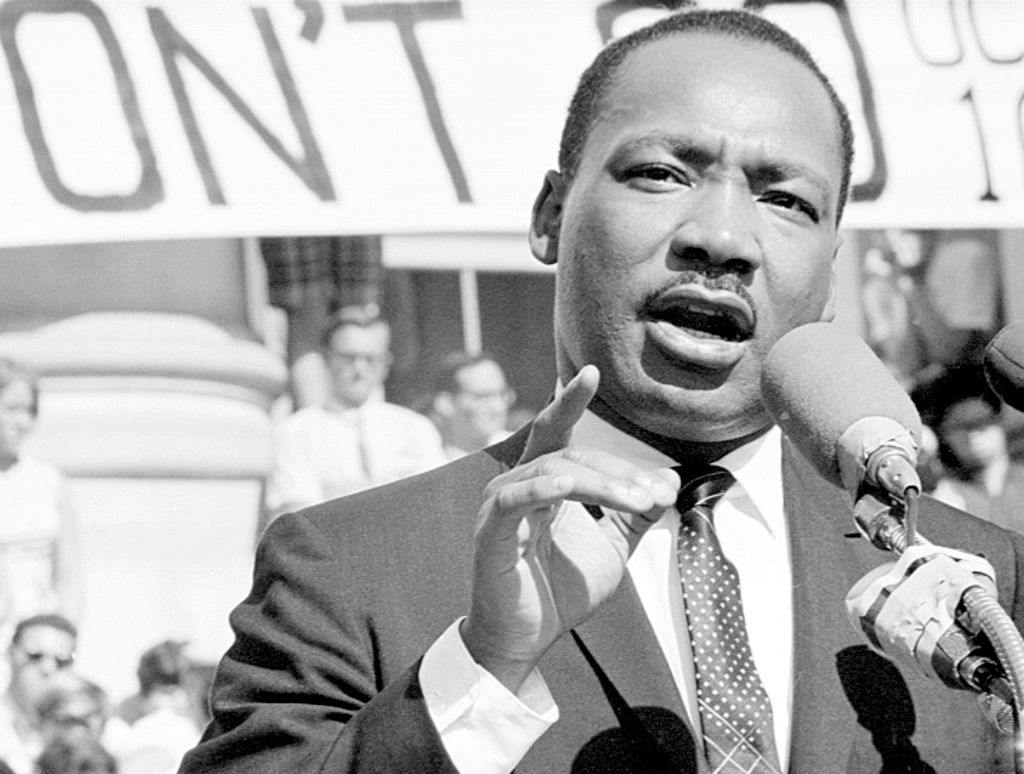
Dr. Martin Luther King Jr. stood in a place almost no one wants to stand today—what I call the radical American middle. He rejected both the quiet comfort of going along with injustice and the destructive rage of lawless revolt.
Instead, he rooted his resistance in the simple, explosive claim that every human being bears the image of God and therefore possesses an unshakable dignity that no law, mob, or government may deny.
Our commemoration of King’s life and legacy this week is particularly noteworthy this year as we mark 250 years of American Independence. We remember not only a civil rights leader, but a Christian pastor whose moral clarity reshaped the conscience of a nation to be more in line with its founding ideals.
King’s work was not merely political; it was profoundly theological. He grounded his vision in the Judeo-Christian conviction that every person is created in the image of God. This inherent dignity—unchanging, unearned, and universal—formed the bedrock of his vision for the future and the foundation of his appeal to America’s founding promise of equality before God.
In his 1963 Letter from Birmingham Jail, King warned that “injustice anywhere is a threat to justice everywhere.” This was not a slogan. It was a biblical imperative echoing the prophets’ cry for righteousness and Christ’s command to love one’s neighbor. His commitment to nonviolent resistance was not passive resignation but active moral courage. It was rooted in the conviction that “darkness cannot drive out darkness; only light can do that. Hate cannot drive out hate; only love can do that.”
This was not weakness. It was strength anchored in the belief that moral truth defeats physical weapons—but only through time, sacrifice, and suffering. The question for every generation is whether it will produce leaders willing to bear that cost for the sake of cultural preservation or, if necessary, revival.
One of the clearest examples of King defending the radical American middle came during the mid-1960s, when he was attacked simultaneously by Black Power advocates and white moderates. As riots erupted throughout the country, King refused to endorse violence, insisting that “riots are socially self-defeating and socially destructive,” even as younger activists accused him of being too slow and too gentle.
At the same time, King sharply rebuked moderates who urged him to “wait” for ending segregation, calling their preference for imagined “order” over justice a “great stumbling block” to freedom.
He stood between these poles—rejecting the rage that demanded revolution and the complacency that demanded silence.
King’s faith in the power of sacrificial love—modeled on the cross—transformed the civil rights movement into a spiritual awakening. His vision was inseparable from the Declaration of Independence, which proclaims that all men are “created equal” and “endowed by their Creator with certain unalienable Rights.” Segregation, he argued, was not merely unconstitutional; it was a sin against God’s created order.
Standing on the steps of the Lincoln Memorial in 1963, King invoked both the Declaration of Independence and the prophet Amos: “Let justice roll down like waters, and righteousness like a mighty stream.” His dream was not a secular utopia. It was a call for America to return to its covenantal identity—a nation under God, where every person is treated as an image-bearer worthy of dignity and respect.
Yet King’s legacy also confronts us with a modern danger: the rise of moral relativism. When law becomes untethered from objective truth, it risks becoming a tool of power rather than a guardian of dignity.
In my 2018 Liberty University Law Review article, “Imprisoning the Innocent: The ‘Knowledge of Law’ Fiction,” I argued that the complexity of modern legal codes creates a dangerous presumption—that citizens know unknowable laws. This fiction enables the state to punish the innocent through overcriminalization. That is not merely a legal problem; it is a moral one. Law without truth becomes arbitrary, oppressive, and unjust—precisely the condition King resisted.
King understood that justice requires moral clarity. In Letter from Birmingham Jail, he distinguished between just and unjust laws. “An unjust law is a human law that is not rooted in eternal law and natural law,” he wrote. Drawing from Augustine and Aquinas, he argued that laws violating God-given dignity must be resisted—not violently, but with principled, sacrificial love.
This is the radical American middle. It is neither blind conformity to unjust authority nor anarchic rejection of law, but courageous fidelity to moral truth.
King’s theology also shaped his understanding of redemption. He believed in the possibility of transformation—even for oppressors. In “Loving Your Enemies,” he wrote that “He who is devoid of the power to forgive is devoid of the power to love.” This echoes Christ’s call to forgive as we have been forgiven. King’s nonviolence was an attempt to awaken the conscience of the oppressor through suffering love, mirroring Christ’s redemptive work on the cross.
Today, as divisions threaten to fracture our nation, King’s legacy challenges us to reclaim the radical American middle. We must resist the temptation to dehumanize opponents and treat them as irredeemable.
We also must reject the moral relativism that justifies injustice in the name of ideology.
Instead, we are called to pursue justice with mercy, truth with grace, and love with courage. We must embrace the paradox of truth and grace residing together in one flesh—the only reality that allows a people to learn, grow, and heal.
King’s dream was not a call to ignore difference but to honor it within a beloved community. It was a dream rooted in the conviction that every person is created in God’s image, endowed with unalienable dignity and worthy of love.
As we remember Dr. King, may we heed his call to “let justice roll down like waters, and righteousness like a mighty stream.” And may we recommit to the radical American middle—where truth exposes sin, grace heals wounds, and love binds us together as one people under God.
In doing so, we honor not only King’s memory but also America’s founding principles and the God who created us in His image and calls us to live as His children.
Phill Kline is a former state legislator and the former Attorney General of Kansas. He is currently a law professor.




It’s too bad Don Lemon didn’t get Dr. King’s memo.
Excellent article on Martin L. King, Jr. Right now, he is rolling in his grave with the current national crisis that is going on. The situation will continue to get worse if people don’t wake up soon. The Adversary is having a field day right now.
Our nation is lost without moral clarity. This one time great experiment as we have called our republic lost it’s way many decades ago when we decided to kick God out of our public and private lives. We have accepted every immoral perverted lifestyle to become the norm. Our founding fathers would be ashamed of what we have become. George Washington even said you cannot rightly govern the nation without God and the bible. But we think we are too sophisticated for that. We need a revival in our nation . We need national repentance. We need to realize that if our constitutional republic is to survive our only hope is to return to our Judeo Christian heritage that’s where it all began. Yes we have lost our way but Jesus said, I am the way the truth and the life and no one comes to the father except through him. let’s really make America great again let’s turn our hearts and minds back to the God who blessed our founding fathers to bless us to live in America.
He was a voice of reason, not in the troublemakers vocabulary, his dream was not in accordance with the radicals who recognized the opportunity to grab the power. He was in the way, at the same time like hyenas they’ve been feeding off his corpse when suited the agenda.
Good article I haven’t done much research on Dr. Mostly thought he was a radical working only Black people
Just remember the DEMOCRATS ran the longest filibuster in history to STOP instigation .. They portray themselves as the champion of civil rights . Men in women’s sports , puberty blockers for the children . 72 jabs of vaccinations for all babies before the age of one , locking us down for COVID while they went about trips , & cruises … I think I made my point . TRUMP , I think GOD for you every day .
He was a big part of the un-civil rights movement of the sixties and along with communist Russia why we are in the miserable state we are in.