
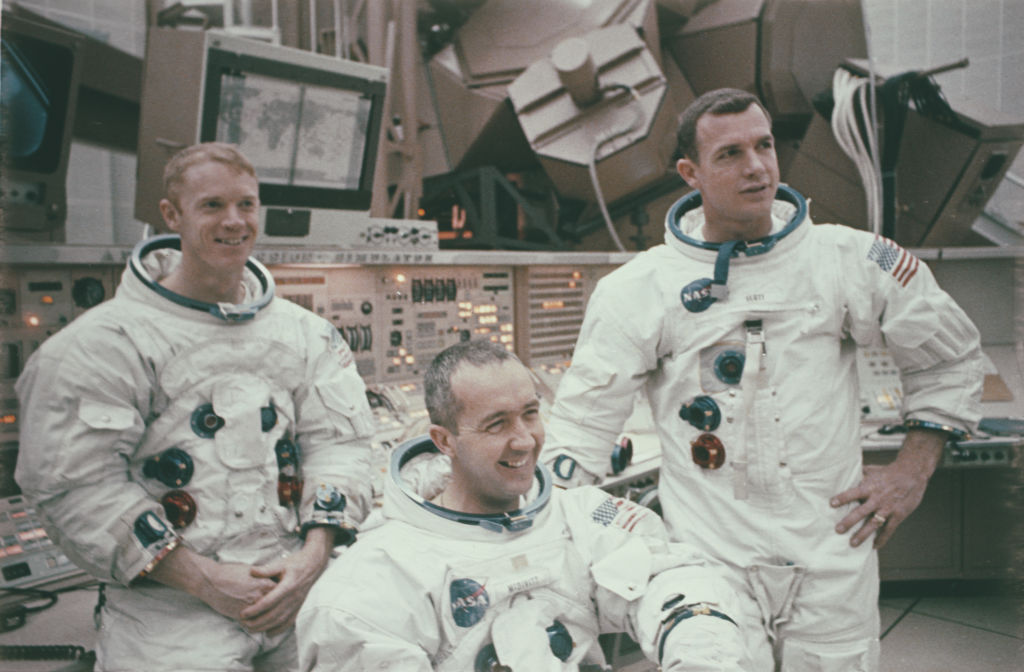
(L-R) Astronauts Russell Louis ‘Rusty’ Schweickart, James Alton McDivitt, and David Randolph Scott, the crew of NASA’s scheduled Apollo 9 mission, at the Kennedy Space Center in Florida, February 1969.
Fifty-seven years ago today, on March 13, 1969, the Apollo 9 spacecraft – operated by James A. McDivitt, David R. Scott, and Russell Schweickart, and guided by a computer nearly one million times less powerful than the cell phone in your pocket – splashed down in the Atlantic Ocean just 4.5 miles from its recovery ship after travelling 4.2 million miles over ten days.
While most Americans are familiar with the famous Apollo 11 mission that took place later that year, Apollo 9 was the crucial dress rehearsal that paved the way for Neil Armstrong’s famous first steps on the lunar surface. Apollo 9 tested the complete spacecraft – the Command/Service Module (CSM) and Lunar Module (LM) – in Earth orbit for the first time, validating the hardware, docking procedures, and spacesuits needed for landing on the Moon.
To begin the mission, the crew rode atop the Saturn V, a rocket that produced 7.5 million pounds of thrust, the equivalent of 120,000 cars accelerating at full power at the same moment. They sat above that force, strapped into a capsule the size of a walk-in closet, separated from the rocket’s fury by a thin aluminum pressure hull barely a quarter-inch thick. That same fragile barrier separated them from the vacuum of space. Their lives depended on that slender shell and on a guidance computer with less memory than a modern digital watch.
Apollo 9, and the entire Apollo program, reminds us that greatness is not measured by the sophistication of our tools, but by the clarity, discipline, and character of the people who dare to use them for the good of humankind.
Such courage did not rest on bravado or blind risk. It rested on faith – faith in something greater than themselves. The astronauts trusted in the discovered laws of physics because they trusted that the universe itself was ordered, coherent, and faithful. They believed, as many said openly, that creation was not chaos but design, not accidental, but intentional. Buzz Aldrin took Communion on the Moon. Frank Borman read Genesis from lunar orbit. Jim Irwin spoke of sensing “the power of God as I had never felt it before.”
These were men who understood that science is possible only because the cosmos is trustworthy, and the cosmos is trustworthy because it was first spoken into being. This understanding anchored their courage in a deeper confidence that the same hand that authored the laws of physics held them together as they rode fire into the heavens.
The Apollo program was also an ultimate manifestation of American exceptionalism. The men who crewed these first missions to the stars were the descendants of bold pioneers who crossed an ocean to face an unforgiving wilderness. The same spirit that drove the Pilgrims to survive that first frigid winter on Plymouth Plantation, that spurred Patriots forward during the darkest moments of the Revolution, and that fueled Westward expansion also drove American astronauts beyond Earth’s atmosphere.
Apollo 9 was likewise a triumph of American grit and tenacity. Two years earlier, on January 27, 1967, AS-204, the first crewed mission in the Apollo program, never made it off the ground. A cabin fire during a launch rehearsal test killed Command Pilot Gus Grissom, Senior Pilot Ed White, and Pilot Roger B. Chaffee, and destroyed the command module. Their name for the mission, “Apollo 1,” became the convention for naming all subsequent missions.
Were it not for the indomitable American spirit, the Apollo program might have died alongside those three brave astronauts. As President Kennedy put it in his speech to Congress in 1961, “In a very real sense, it will not be one man going to the Moon – if we make this judgment affirmatively, it will be an entire nation. For all of us must work to put him there.”
This remark reflected a supreme confidence in America’s unique ability to accomplish such a herculean feat. But that confidence did not appear suddenly in the 20th century. It was the inheritance of a civilization shaped by the Christian conviction that the world is intelligible, purposeful, and morally ordered.
Western culture gave rise to the University, born in monasteries and cathedral schools; to modern science, grounded in the belief that nature follows laws because it was crafted by a Divine Lawgiver; to hospitals and organized charity, founded by Christians who believed every person bears the image of God; and to the very idea that truth is discoverable and worth pursuing.
The Apollo program stood on this foundation. The mission was a triumph of technology, yes – but also of a worldview that taught generations to seek knowledge, to serve others, and to steward creation with courage and humility.
The same nation that sent three men into orbit atop a controlled explosion is the nation that crossed oceans to confront Nazi and Japanese aggression, liberated death camps, ended genocidal regimes, and then did something unprecedented in human history – rebuilt its enemies into free nations. We did not conquer for plunder or empire. We sacrificed blood and treasure so that others might live in liberty.
That is the moral imagination of a people shaped by the Western Judeo-Christian inheritance – a belief in objective truth, human dignity, moral responsibility, and the duty to use strength for the good of others.
Just as the architects of the Apollo program were confronting the threat of Soviet tyranny, today we face an ideological movement that seeks to tear down everything that is good about America and Western Civilization. It seeks to sever Western civilization from its Judeo-Christian roots, to dismiss its contributions – universities, science, hospitals, charity, human rights – as though they were accidents or oppressions rather than the hard-won fruits of a specific worldview. In doing so, it erodes the very foundations that made the Apollo program possible.
This is why the American story is not finished. A nation capable of dreaming beyond the horizon and yearning to touch the far reaches of space can still summon a rising generation to believe that their lives matter, that truth is real, that courage is possible, and that the future is not something to fear but something to build.
When Americans learn about the legacy that they have inherited – a legacy that forged civilization from wilderness, that won two world wars, and landed a man on the Moon – they begin to dream again. They are reminded that American exceptionalism is not a boast but a vocation to use our strength for the good of others, to pursue truth, and to live with the kind of courage that once carried three men into the heavens on a quarter-inch of aluminum and a prayer.
Phill Kline is a former state legislator and the former Attorney General of Kansas. He is currently a law professor.






Excellent article, Mr. Kline. Thank you.
Need a Lunar Base
routine shuttle to Moon from Earth, see movie 2001
Orbital Hub for business & shuttles to Moon
Very important article Phil , Well Done ! This article speaks well of the National Character, it speaks well of the good character of each of the Astronauts and it has the spirit of achievement in the picture too. Having a sense of purpose is a powerful attribute. This article is appreciated and it will enhance the life of American citizens who understand the qualities that are needed in order to bring the meaning of God bless America , land of the fry and home of the brave into their daily lives ..
Amazing article. Am sure many people will feel inspired to reach for betterment just by reading this INSPIRING article!
This nation is exceptional, capable, brave and magnanimous in victory, the rest of the world is not happy, it too could be in better shape, but the destructive ideology will not allow it. So it must bring down to it’s own level that, which dares to dare.I don’t think they are intelligent enough to realize that it would be the end of the world as they know it.
Ever since I saw the wave of evil rising in our country, my prayer has been that we would not squander our inheritance. So much has been sacrificed in the struggle for freedom; payment has been in earthly treasure and blood. God help us to learn from our history
Error in comment just send a minute ago ,–.
Land of the free is what is intended Somehow it became land of the fry ?
The history of NASA is underwhelming and unimportant.