


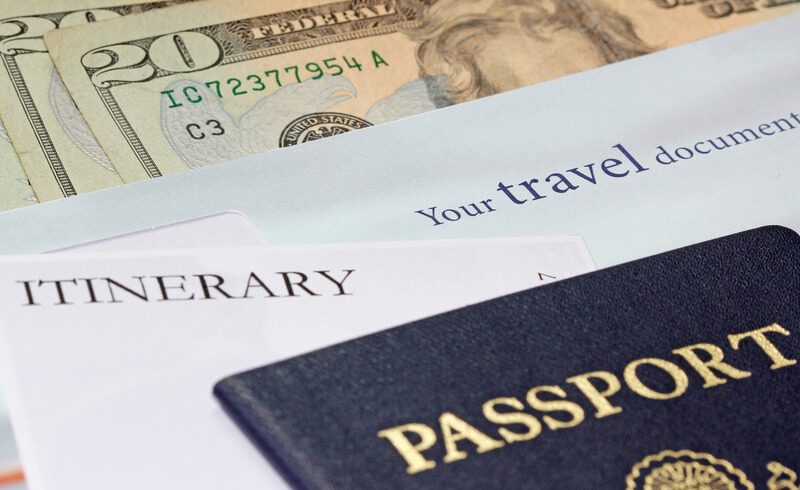
Ready to embark on the trip of a lifetime? Here’s all you need to know about what documents to bring, whether you’re staying in the United States or traveling internationally! Bon voyage!
Domestic
Air Travel
For passengers 18 and older, an acceptable government-issued photo ID must be shown to go through airport security. Acceptable documents include:
- REAL ID-compliant state driver’s license or ID card (look for the star on the card)
- U.S. passport or U.S. passport card (both work as ID for domestic flights)
- Trusted Traveler cards (e.g., Global Entry, NEXUS, SENTRI, FAST)
- Military ID (U.S. Department of Defense ID)
- Permanent resident card (green card), other DHS ID cards
- Certain tribal IDs or other federally accepted photo IDs
Don’t have any of these? If you don’t have a REAL ID or an acceptable ID, some airports may still offer an alternative verification process (like TSA ConfirmID), but that may involve extra fees and delays.
Tip: Check passport expiration well ahead of time: Many countries won’t admit travelers if the passport expires within 6 months of the return date.
Land Travel
For travel by car, train, or bus, you generally only need a government-issued photo ID (driver’s license or passport) if ID is requested, but TSA rules strictly apply to commercial air travel.
Cruises
(Domestic applies to cruises that start and end at the same U.S. port, often called “closed-loop cruises” — common for Alaska, Hawaii, and some coastal routes.)
For U.S. citizens, most domestic cruises allow one of the following:
Option 1: Passport (Recommended)
- U.S. passport book (valid for the length of the cruise)
- This is the safest and most flexible option, especially if there’s an emergency or unexpected port change
Option 2: Passport-Free (Allowed on Many Closed-Loop Cruises)
- Original birth certificate (or certified copy)
- Government-issued photo ID (driver’s license or state ID)
PLEASE NOTE: This option is allowed on many domestic/closed-loop cruises, but not all. Cruise lines set their own rules. Always check the cruise line’s documentation page before booking.
Important Notes for All Domestic Travel:
- A passport is still strongly recommended, even when not required. If you need to fly home unexpectedly (medical issue, missed port, itinerary change), you will need a passport.
- Name matching: Your cruise booking name must exactly match your ID (watch for maiden vs. married names).
International
Passport
U.S. citizens must have a valid passport book to depart and re-enter the U.S. — even if traveling to Canada, Mexico, the Caribbean, or overseas. Passports should be valid at least 3–6 months beyond your planned return date for many countries. Check your destination’s entry rules just to be safe!
Visas & Entry Documents
Many countries require a visa or electronic travel authorization (ETA) before arrival. Requirements vary widely by destination and nationality. Some countries require proof of onward travel (return ticket) or proof of funds. These are typically for longer stays, not shorter vacation travel.
Additional Documents Seniors Should Carry!
Highly recommended (even when not required):
- Health insurance card: Medicare typically does not cover medical care abroad, so a separate travel insurance policy is highly recommended.
- Travel insurance documents (especially medical evacuation coverage): Especially for medical evacuation and unexpected illness abroad — Medicare doesn’t cover non-U.S. health care.
- Medication list + prescriptions (original containers): Carry enough medication for the trip plus extra, and keep prescriptions in original bottles with your name.
- Emergency contact list
- Paper & digital copies of all IDs and travel documents: Keep digital and paper copies of passport, insurance, IDs, and critical medical info.
REMEMBER TO: Always check the Travel Advisory of the country you are visiting for all requirements, including tourist visas, vaccinations, valid passport requirements, allowed currency upon entrance and exit, and more pertinent information.


3 Comments