
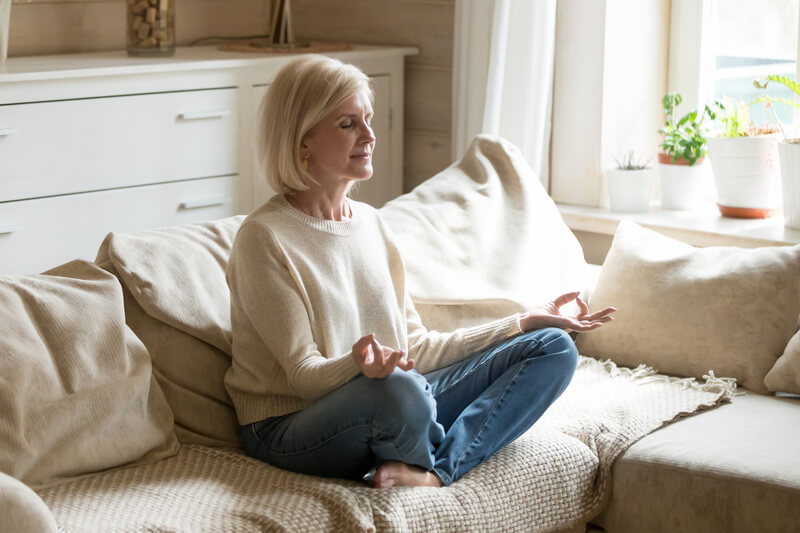
January naturally invites reflection. A new year feels like a clean slate and a chance to reset habits, priorities, and intentions. Speaking from personal experience, traditional New Year’s resolutions focused solely on diet or exercise don’t always stick.
In 2026, my challenge to you is to view your health through a whole-person lens, recognizing that what nourishes us goes far beyond what’s on our plate. I like to encourage the idea of health harmony rather than balance. In real life, the areas of health aren’t perfectly equal, and that’s okay. Balance suggests everything must be even at all times. Harmony, on the other hand, allows different areas of life to rise and fall with the seasons we’re in. You may be deeply focused on family one year, faith another, health another.
Primary Food vs. Secondary Food
One of the foundational teachings from the Institute for Integrative Nutrition, which I find helpful, is the concept of Primary Food and Secondary Food.
- Primary Food is the nourishment you receive off the plate: relationships, purpose, spirituality, joy, movement, and environment, to name a few.
- Secondary Food is the actual food on your plate—nutrition, hydration, supplements. (Check out the new 2026 U.S. Dietary Guidelines)
Both matter deeply. But focusing on one without the other often leaves people feeling stuck. You can eat a healthy diet and still feel depleted. Likewise, rich relationships and purpose don’t replace the need for nourishing meals. Health is affected by far more than the food we eat.
Thriving happens when both are supported.
The Circle of Life: A Self-Assessment Tool
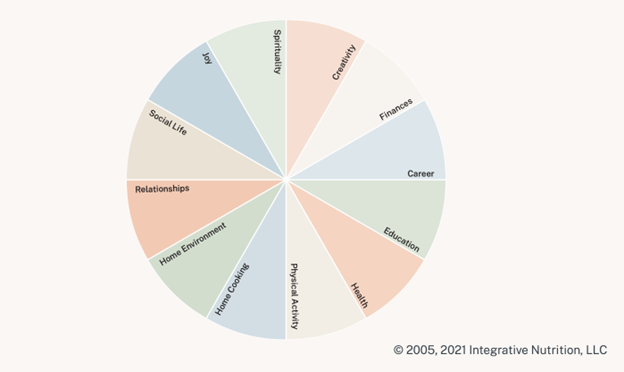
The Circle of Life, developed by IIN, reflects 12 areas of Primary Food that influence overall well-being:
- Spirituality
- Creativity
- Finances
- Career
- Education
- Health
- Physical Activity
- Home Cooking
- Home Environment
- Relationships
- Social Life
- Joy
How to Use the Circle of Life
- Print the Circle of Life image below.
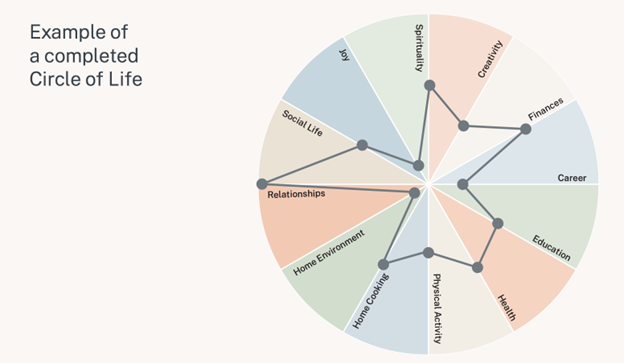
- Place a dot in each section to indicate your level of satisfaction in that area. A dot toward the periphery indicates satisfaction, and a dot closer to the center indicates dissatisfaction. For example, if your health is feeling great, place a dot toward the outer edge of the circle. 2| Connect the dots to see your Circle of Life.
Identify your current areas of focus. Determine where to spend more time and energy to cultivate harmony.
Example of a Completed Circle of Life:
Reflection questions: (quick tip-try these as journaling prompts)
- Which areas feel full and supportive?
- Which feel thin or show room to grow?
This tool isn’t meant to diagnose or criticize—it’s simply a snapshot of your current season of life.
Looking Ahead: Practical Ways to Create More Harmony
Here are a few gentle, realistic ways to support key areas of Primary Food:
Joy
- Schedule one thing each week that you genuinely look forward to
- Revisit a hobby you loved but set aside
Social Life
- Call one friend you haven’t spoken to in a while
- Say yes to one social invitation, or initiate an invitation to someone else
Spirituality
- Begin your day with five minutes of quiet reflection or prayer
- Explore community through faith-based gatherings or learning
(You may enjoy the launch of AMAC Faith, including an upcoming webinar focused on peace.)
Relationships
- Practice being fully present during conversations
- Express appreciation more often
Home Environment
- Declutter one drawer or small space
- Bring in light, plants, or comforting scents
Physical Activity
- Focus on consistency, not intensity
- A daily walk, gentle stretching, or strength training twice a week all count
Choose one area of the Circle of Life that feels most in need of support. Set one small, achievable goal to nurture it this month. While all are helpful, adopting even just one or two can be more powerful and effective than you realize.
Not to “fix” it.
Not to perfect it.
Simply to bring it into greater harmony with the rest of your life.
Melanie Griffin is a health and wellness professional with over 20 years of experience in fitness, nutrition, and chronic disease prevention for midlife and older adults. She holds a B.S. in Sports & Fitness, is a NASM Certified Fitness Nutritionist, ACE Senior Fitness Specialist, Certified Brain Health Trainer, and an IIN Hormone Health Graduate, and is currently pursuing a Master of Science in Integrative and Functional Nutrition. Her work focuses on whole-person health, integrating nutrition, movement, and lifestyle factors to support long-term vitality and quality of life.






These suggestions are wonderful but spend time with God in the morning, during the day and in the evening before going to bed and you will be at peace all the time no matter what your day throws at you.