
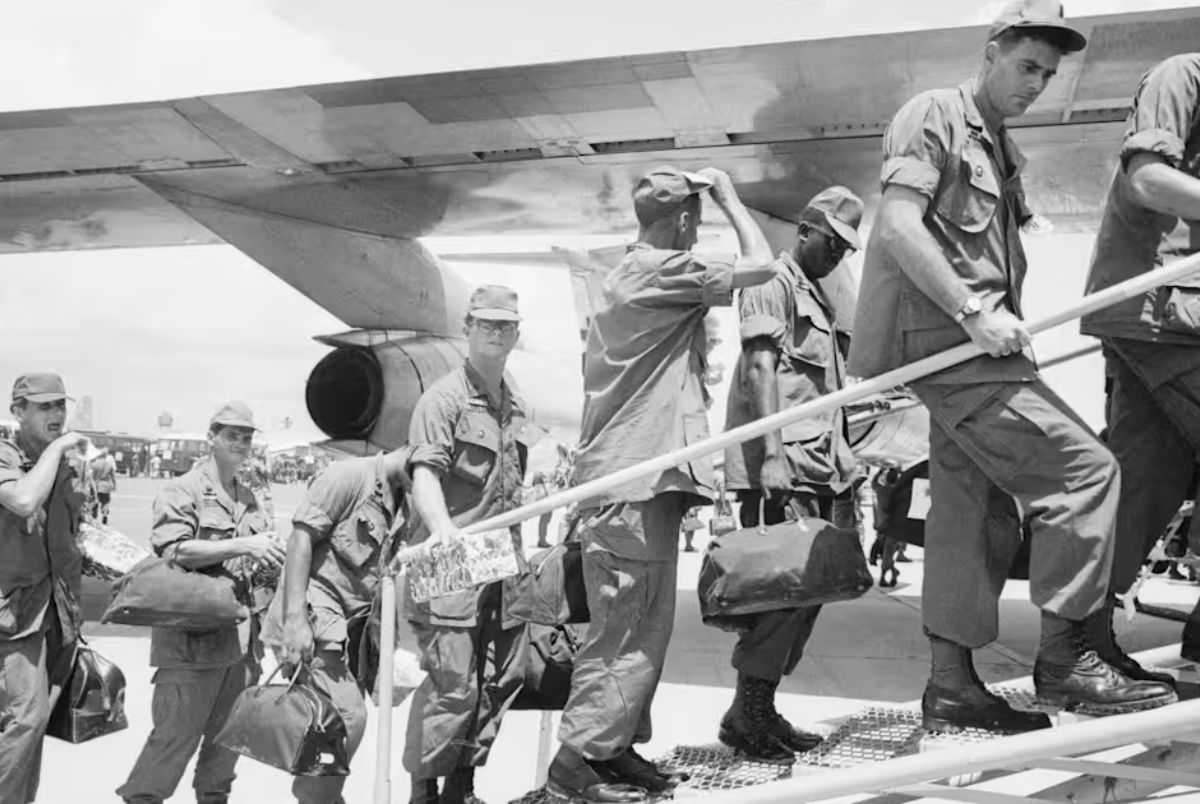
On July 8, 1969, the first American combat troops officially departed South Vietnam, marking the beginning of the United States’ long and gradual military withdrawal from one of the nation’s most divisive conflicts. A battalion of 814 soldiers from the U.S. 9th Infantry Division left Saigon as the first installment of a planned withdrawal of 25,000 troops announced by President Richard Nixon just one month earlier. Although the Vietnam War would continue for several more years, the departure represented a major turning point in American policy.
When Richard Nixon entered the White House in January 1969, more than 540,000 American troops were stationed in Vietnam. The United States had been deeply involved in combat since 1965, yet despite years of fighting and tremendous sacrifice, victory remained elusive. More than 31,000 Americans had already lost their lives, anti-war demonstrations had spread across the country, and public support for the conflict had steadily declined. Nixon inherited a difficult challenge: reducing America’s military involvement while preserving South Vietnam’s ability to defend itself.
To accomplish this, Nixon introduced a strategy known as Vietnamization. Rather than abruptly ending U.S. involvement, the plan called for American forces to gradually withdraw while expanding the size, training, and equipment of the South Vietnamese military. Nixon argued that South Vietnam should increasingly assume responsibility for its own defense, allowing the United States to achieve what he described as “peace with honor.”
The first withdrawal was largely symbolic in size but enormous in significance. Farewell ceremonies were held before the soldiers boarded aircraft bound for the United States. Their departure signaled that America’s role in Vietnam was beginning to change after years of escalating troop deployments. Additional withdrawals followed in carefully planned phases, eventually reducing the U.S. military presence by hundreds of thousands of troops over the next several years.
Yet the road to peace proved far more difficult than many had hoped. Even as American troop levels declined, fierce fighting continued throughout Vietnam. North Vietnamese and Viet Cong forces launched new offensives, while American air power remained heavily engaged in support of South Vietnamese forces. At home, protests against the war intensified, particularly after the expansion of military operations into Cambodia in 1970.
The withdrawal process stretched far beyond the initial announcement. Following fourteen additional phases of troop reductions, the last U.S. combat forces departed South Vietnam after the Paris Peace Accords were signed in January 1973. Two years later, in April 1975, North Vietnamese forces captured Saigon, bringing the Vietnam War to an end with the reunification of the country under communist rule.
The departure of those first 814 soldiers on July 8, 1969, remains an important milestone in American history. It marked the beginning of the nation’s exit from a conflict that profoundly shaped U.S. foreign policy, military strategy, and public opinion for generations. The Vietnam War left lasting lessons about the costs of war, the challenges of nation-building, and the enduring sacrifices made by the men and women who served.





Many people only remember Nixon’s faults, but he started our military withdrawal from the Vietnam War. He should have been the hero of every hippie who protested the war. I met men who had served in Vietnam, and a few who were going there. All of them were glad that an end was in sight.