
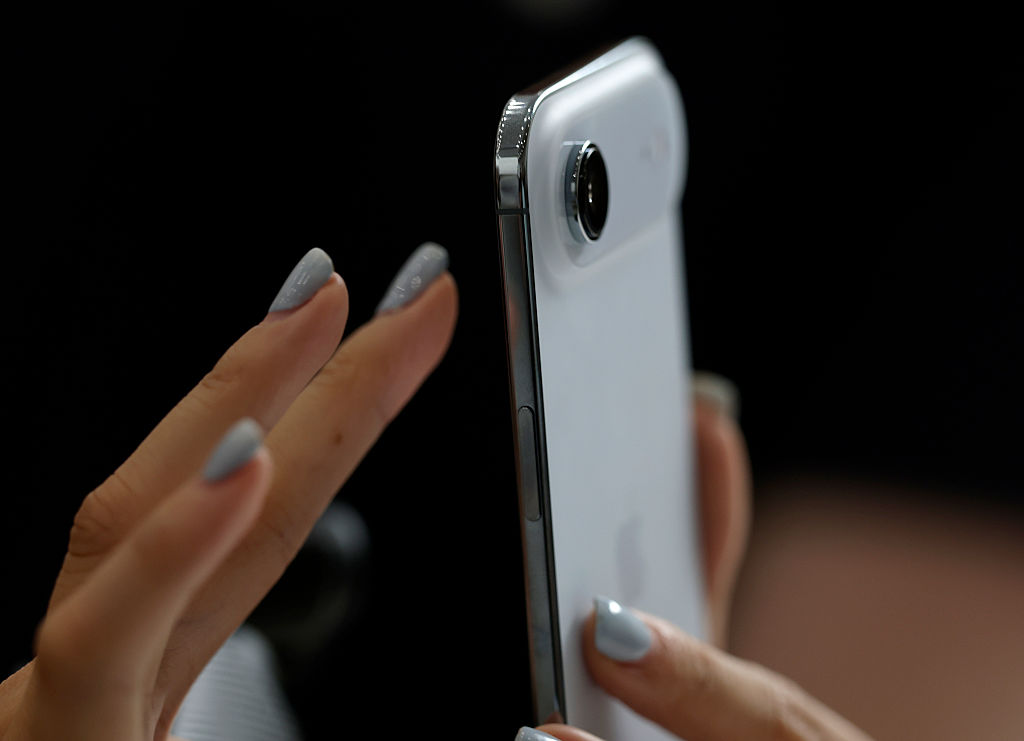
When Steve Jobs unveiled the iPhone at Macworld in San Francisco in 2007, he called it a “revolutionary and magical product” that was years ahead of its time. Apple said the device would “completely redefine” what users could do on a mobile phone.
Both descriptions may have been accurate. But nearly two decades later, economists say one of the great symbols of the tech boom may have helped fuel America’s baby bust.
In a recent working paper from the National Bureau of Economic Research (NBER), economists Caitlin K. Myers and Ezekiel Hooper argue that the iPhone’s rollout helped drive a fertility decline that researchers have struggled to explain for nearly 20 years.
Of course, there’s nothing inherently sinister about the iPhone compared to other smartphones with internet access. But because the iPhone was the first smartphone to be sold at scale and still dominates the American market (more than half of all smartphones in use today in the United States are iPhones) its rollout and adoption provide a useful proxy for the impact of smartphones generally.
The American general fertility rate has fallen 22 percent since 2007 — a sustained drop the authors note is not easily explained by any one factor alone. Many assumed it was a hangover from the Great Recession and would reverse once the economy healed. It didn’t. Myers described those years to Fortune as a “baby-less recovery.”
When Apple launched the iPhone in June 2007, the device was available on only one carrier — AT&T — and it stayed that way until early 2011. Because AT&T’s mobile network reached different parts of the country at different times, the researchers could compare communities that got the iPhone earlier against otherwise similar communities that got it later.
The study found that births declined faster in places where people could buy an iPhone than in places where they could not. The researchers ran the same test on Verizon and Sprint’s pre-2011 coverage — carriers that did not yet sell the iPhone — and found no comparable effect.
In other words, there was a direct link between access to the iPhone and declining birth rates.
The estimated effects were largest among young people. Access to the iPhone reduced births by 4.5 to 8 percent among women ages 15 to 19, and by 3.2 to 6.6 percent among women ages 20 to 24, with smaller declines among older women.
Between 2007 and 2024, U.S. birth rates fell 70 percent among women ages 15 to 19 and 47 percent among those aged 20 to 24, but only seven percent among women aged 30 to 34.
Myers and Hooper do not claim that the iPhone is the sole cause of the fertility crisis, but they estimate that its diffusion explains 33 to 52 percent of the decline in the general fertility rate from 2007 to 2011.
Why would a phone suppress the birth rate? The study points to national survey data showing that the device is associated with less in-person interaction, more pornography use as a substitute for partnered sex, and less frequent sex.
Between 2003 and 2024, time spent with friends in person collapsed from 141 minutes a day to 43 among teenagers, and from 107 minutes to 49 among adults in their early 20s.
Meanwhile, Google searches for the term “porn” more than doubled over the iPhone’s first four years.
The study’s causal evidence links iPhone access to births, not to each specific behavior. But the trends fit the broader picture. The phone is the always-available alternative to being with another human being.
Most fertility debates miss this. The usual proposals to reverse the birth rate collapse are tax credits, paid family leave, and childcare subsidies, all designed to lower the cost of starting and raising a family.
But this toolkit does little to address the behavioral shift in the NBER paper. The authors cite research findings that raising child-related tax benefits by 10 percent of household income lifts birth rates by only about 0.5 to 4 percent.
Money matters. But a bigger problem is young people who never form relationships in the first place. If the smartphone era has meant fewer first dates, fewer friendships, and more hours spent alone behind a glowing screen, then the baby bust begins long before anyone prices daycare or a starter home.
It begins in adolescence, when children turn to the internet to flee boredom, awkwardness, and loneliness at the very age they should be learning to handle all three.
Parents bear the first responsibility. Children mimic their parents, and a child who sees adults scrolling through dinner and bedtime receives all the wrong messages about where their attention is supposed to go.
But schools can reinforce what should start at home, and the country finally seems to be moving in the right direction. Florida became the first state to restrict phones in classrooms in 2023, and by this school year, more than half the states had adopted some kind of phone restrictions.
The issue has found widespread bipartisan support. A 2025 Pew Research Center survey found that three-quarters of American adults now support banning phones during class, up sharply from the year before.
Teachers in districts that have banned phones are describing classrooms that have come back to life, with students paying attention and talking to one another again.
We already keep certain things out of children’s hands until they are old enough to handle them — alcohol, tobacco, even cars. The smartphone, which offers unfettered access to pornography, strangers, and algorithms engineered to be addictive, belongs in that conversation.
Like any powerful tool, the iPhone is not evil in itself. A gun can defend the innocent or do terrible harm, depending on the person holding it and the judgment governing its use. The same is true of the device in a child’s pocket.
It can connect loved ones across great distances and put a library of information at our fingertips. But powerful tools require adult judgment, and we have spent nearly two decades handing the most powerful device ever created to children with too little guidance and almost no supervision.
Myers and Hooper offer no tidy fix. But they point to the question many fertility debates keep skipping: What kind of childhood produces adults who will form relationships, marry, and raise a family?
We must defend the unglamorous, face-to-face life that good character is built on — from conversation at the dinner table to awkward first dates and relationships that form because two people were in the same room without a phone screen in between them.
Sarah Katherine Sisk is a proud Hillsdale College alumna and a master’s student in economics at George Mason University. You can follow her on X @SKSisk76.







The article is B.S. I’m 70, widower now, got married late in life and only had time for two kids with my perfect late wife. The kids are wonderful now in adulthood.
The reason couples have fewer kids this day and age is simple: “IT COSTS A PILE OF MONEY TO RAISE THEM AND GET THEM EDUCATED SO THEY HAVE A GOOD START IN LIFE!!” Period!! Another reason is more couples don’t get married until later on in life in order to complete an extensive education first! (I was in that group.) THIS HAS NOTHING TO DO WITH A FREAKING CELL PHONE!!! The author is a complete retard!
I agree that the iPhone is a pain, but I don’t see it from perspective as with a ” Baby Bust”. My wife and I had 5 children (3g/2b), 24 grandchildren, 17 great grandchildren, and 1 great-great grandchild. Doesn’t seem to have affected our family.
Use Android phones
rofl. Seriously. Best laugh I’ve had all month.
????????????????????????????????
In my humble opinion a 70% falling birthrate among women in the 15 – 19 age group can only be looked at as a positive thing. How did that demographic get included in this falling birthrate article? When I was in high school there probably would have been no birthrate info needed for that age group. But then I’m seeing commercials encouraging parents to get their nine-year-olds HPV vaccinations. Maybe that’s to encourage the birthrate to climb in the 15 – 19 age group. What a crazy article.