
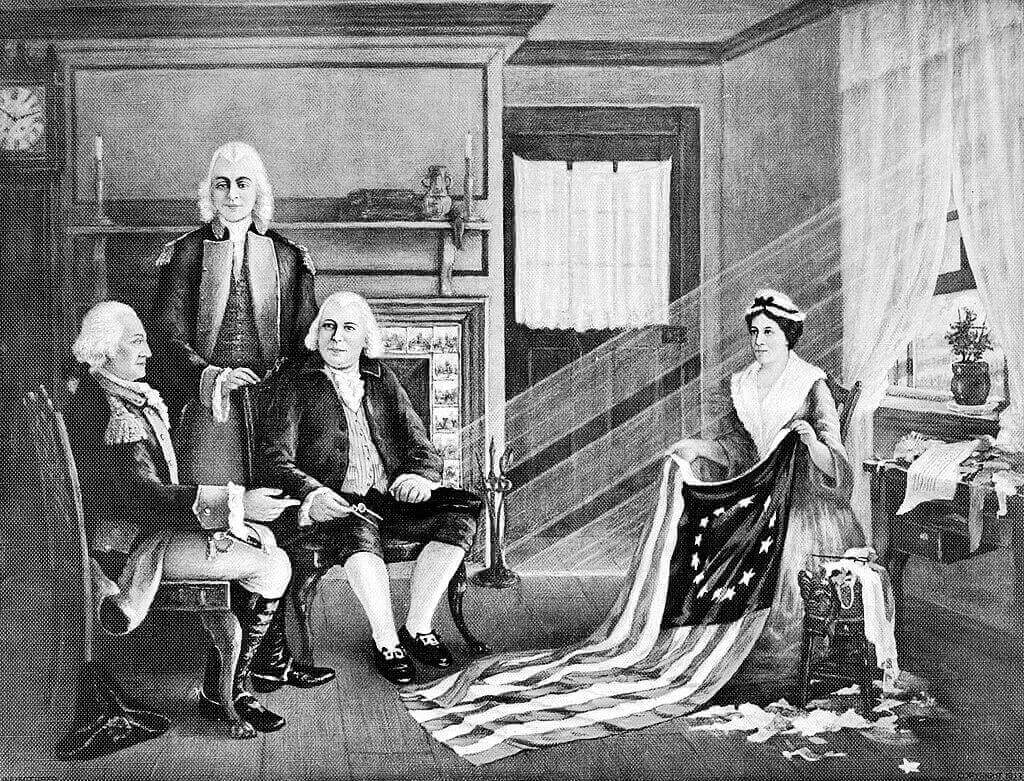
Test your knowledge of Betsy Ross, the heroine associated with creating the first American flag. Although historians continue to debate the accuracy of the flag story, Ross became a lasting symbol of patriotism, craftsmanship, strength, and perseverance during the Revolutionary era.
1) What was Betsy Ross’ paid occupation?
a. Printer
b. Upholsterer and seamstress
c. Schoolteacher
d. Silversmith
2) According to her family accounts, who visited Betsy Ross in her shop in 1776 to ask her to sew a flag for the new nation?
a. Benjamin Franklin, Thomas Paine, and John Adams
b. Abraham Lincoln, Hannibal Hamlin, and Andrew Johnson
c. George Washington, Robert Morris, and George Ross
d. George Washington, Abraham Lincoln, and Benjamin Franklin
3) Why is the story of Betsy Ross making the first American flag considered debated history?
a. No one knew how to sew flags in the 1700s
b. The story was mainly shared through family accounts
c. The American flag did not exist until the Civil War
d. Ross denied ever making flags
4) How did Betsy Ross become widely remembered after her death?
a. As a model of patriotism
b. As a famous general
c. As the first president’s official historian
d. As the founder of Philadelphia
5) How many spouses did Betsy Ross have during her lifetime?
a. One
b. Two
c. Three
d. Four
6) Who was Betsy Ross’s first husband, with whom she eloped?
a. Joseph Ashburn
b. John Claypoole
c. John Ross
d. Bob Ross
7) What happened after Betsy Ross married her first husband?
a. She was expelled from the Philadelphia Society of Friends for marrying outside the Quaker community
b. She moved to England permanently with him, but returned briefly to sew the flag
c. She stopped working as an upholsterer and became a writer
d. She became a member of Congress
8) Which religious group did Betsy Ross eventually join, where women were considered equal spiritual partners to men?
a. The Society of Free Quakers
b. The Puritans
c. The Shakers
d. The Methodists
9) In addition to making flags, what else did Betsy Ross do?
a. She made uniforms and blankets
b. She made tents
c. She prepared ammunition for the Continental Army
d. All of the above
10) After John Ross’s death, what did Betsy Ross continue to do?
a. Run an upholstery business
b. Command a regiment
c. Write the Declaration of Independence
d. Serve as the governor of Pennsylvania
11) Which statement is untrue of Betsy Ross?
a. She has been buried in three places
b. She was one of 17 children, though only 9 survived into adulthood
c. She made flags for the Pennsylvania Navy during the American Revolution
d. She hid receipts in the wall of her upholstery shop to prove she created the first United States flag.
12) What challenge did Betsy Ross face in the final years of her life?
a. She went blind
b. She lost her citizenship
c. She was forced to leave Philadelphia
d. She was imprisoned for supporting the Continental Army
13) Where is Betsy Ross reinterred today?
a. Arlington National Cemetery in Virginia
b. The grounds of the Betsy Ross House in Philadelphia
c. Independence Hall in Philadelphia
d. Mount Vernon in Virginia
14) Which description best reflects Betsy Ross’s life and work?
a. A hard-working business owner, widow, single mother, and property manager
b. A military commander and battlefield strategist
c. A royal official in colonial government
d. A novelist who wrote about the Revolution
15) What is one reason Betsy Ross remains an important figure in American memory?
a. Her story connects everyday labor, women’s work, and patriotism during the Revolutionary era
b. She signed the Constitution
c. She became the first mayor of Philadelphia
d. She invented the sewing machine
Scoring Guide
- 13–15 correct: Betsy Ross expert
- 10–12 correct: Strong knowledge
- 7–9 correct: Solid start
- 4–6 correct: Keep learning
- 0–3 correct: Try again and review the answers
Answer Key
- b. Betsy Ross worked as an upholsterer and seamstress.
- c. Ross’ account (per family tradition) says George Washington, Robert Morris, and George Ross visited her shop.
- b. The flag story comes mainly from family accounts shared decades after the Revolution.
- a. After her death, Ross became a popular symbol of American patriotism.
- c. Betsy Ross had three spouses: John Ross, Joseph Ashburn, and John Claypoole.
- c. John Ross was her first husband.
- a. She was expelled from the Philadelphia Society of Friends because John Ross was outside the Quaker community.
- a. She later joined the Society of Free Quakers.
- d. Her works included all of those listed – producing blankets, tents, and uniforms, and preparing ammunition and other supplies for the war effort.
- a. After John Ross’s death, she continued operating her upholstery business.
- d. Ultimately, no historical records have been found to verify Betsy Ross’ story regarding the creation of the first flag.
- a. Ross became blind in the final years of her life.
- b. She is currently reinterred on the grounds of the Betsy Ross House in Philadelphia.
- a. Her life reflects the responsibilities of a business owner, widow, mother, and property manager.
- a. Ross remains significant because her story links women’s skilled labor with Revolutionary-era patriotism.
Hope you enjoyed this quiz. Happy 4th!






Learned about quite a few facts about Betsy Ross that I did not know before. Thanks for this lesson of history.