


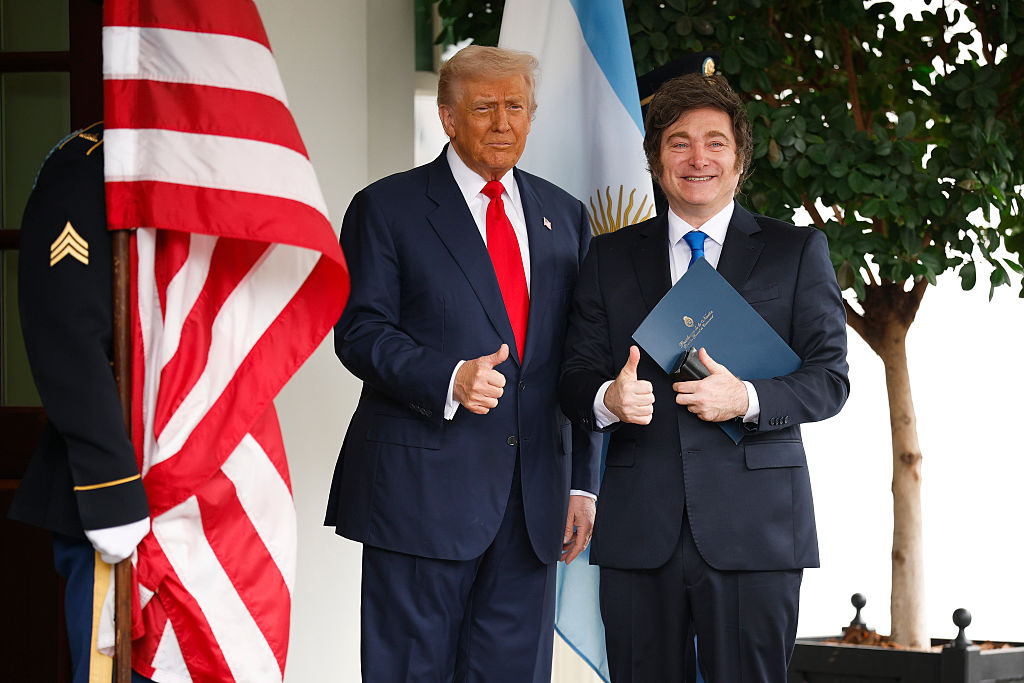
When the Trump administration announced a $20 billion currency swap with Argentina in early October, liberal media pundits and elected Democrats quickly branded it a “bailout” for a country long associated with fiscal crises and repeated defaults. But the naysayers appear to be wrong once again, and Trump’s deft move looks to be another victory for the master of the “art of the deal.”
What critics branded a simple bailout was actually a shrewd, revenue-positive deal that strengthened America’s hand abroad without costing taxpayers like most foreign aid. Through the currency-swap arrangement, the U.S. Treasury agreed to temporarily exchange dollars for Argentine pesos, essentially giving Argentina access to U.S. currency to stabilize its economy while holding the pesos as collateral and charging interest.
Unlike a handout, this swap operates like a secured loan: the U.S. gets its dollars back with profit (assuming the Argentine economy recovers), and American taxpayers face minimal risk. Treasury Secretary Scott Bessent has already confirmed the U.S. earned money on the deal.
Just as importantly, the U.S. has reasserted its influence in Latin America, countering China’s growing financial foothold in the region without committing a dime in foreign aid. Far from a bailout, Trump’s move looks to be a textbook example of how to turn smart diplomacy into a win-win for America’s economy and global position.
The political logic behind the currency swap came into focus late last month. In the October 26 midterm elections, Argentine voters handed President Javier Milei a decisive victory, giving his coalition enough seats in Congress to protect his priorities and advance his austerity and pro-market reforms.
Trump had explicitly tied continued U.S. support to the performance of Milei’s governing coalition in those elections. The swap was never an open-ended rescue package; it was a conditional, structured bet on a leader intent on slashing inflation, shrinking the government, and aligning Argentina more closely with the United States instead of backsliding into failed socialist policies that could destabilize the entire region.
Analysts speculate roughly $2.7 billion from the swap reimbursed earlier U.S. interventions in Argentina’s foreign-exchange market, and that Washington likely sold peso-denominated notes at a profit, further weakening the “bailout” narrative. Rather than a one-way transfer of American money to a troubled government, the swap has so far looked like a profitable short-term financial move.
Much of the backlash to the U.S.–Argentina deal stemmed from a misunderstanding of how a currency swap works. It is not an outright loan. Instead of sending cash to a foreign government, the United States exchanged dollars for peso-denominated notes issued by Argentina’s central bank. The Treasury earns a return on those instruments and has no obligation to extend additional support. Exchange Stabilization Fund (ESF) transactions like this are built for foreign-exchange operations, not for subsidizing failing governments.
The swap also made economic sense given what Javier Milei inherited. As the Cato Institute noted, Argentina has endured repeated currency collapses caused by chronic peso manipulation and deficit financing. Milei took office facing 211 percent inflation, a quasi-fiscal deficit near 15 percent of GDP, collapsing reserves, and recession.
Since then, his reforms have shown big results. According to The New York Times, inflation has fallen to about 30 percent, federal spending has been cut roughly 30 percent, the number of ministries has been reduced from 19 to 9, about 55,000 public-sector jobs have been eliminated, and Argentina posted its first budget surplus in 14 years.
Trump, in other words, didn’t throw money at a failing government – he supported a leader who is restoring fiscal discipline and aligning more closely with the United States. The swap gives Milei room to continue those reforms while the peso continues to steady.
Trump’s asymmetric risk approach is not new. It mirrors the Intel deal he forged earlier this year, another policy critics lambasted until the results proved the President correct. Instead of distributing $9.9 billion in CHIPS Act subsidies with no strings attached, the administration converted that money into an equity stake, buying roughly 10 percent of Intel at $20.47 per share.
As AMAC Newsline reported, within weeks, Intel’s stock rose more than 50 percent, turning what would be a routine subsidy into a profit-sharing arrangement for the public while bolstering domestic chipmaking. The peso swap reflects that same style of decision-making.
Even outlets rarely sympathetic to Trump have noted that the bet could pay off big time. Before the Argentine election, The Economist reported that the swap line and the Treasury’s peso purchases were already helping to steady Argentina’s bonds and currency, and that Washington was signaling a broader $40 billion support framework combining public and private funds. The magazine acknowledged that if Milei’s reforms continued to gain traction, as they have, “Mr. Trump could still win his bet.”
The Times likewise noted that Milei’s midterm victory gives him enough seats in Congress to keep advancing his fiscal reforms. The peso even strengthened in crypto markets on election night as investors digested the results, a sign that Argentine assets, including those now held by the United States, may be appreciating rather than deteriorating.
Upon closer look, the swap bears little resemblance to the bailout critics describe. It limits America’s commitments, creates genuine upside, and supports a government pursuing reforms that align with U.S. interests.
The political noise around the deal obscures a simpler point: Trump has long operated as a highly skilled broker of calculated risk. Seen through that lens, the Argentina arrangement is less a rescue than an intelligent wager — one that is already paying off.

About the author
Sarah Katherine Sisk
Contributing Writer
@SKSisk76All articles by Sarah Katherine Sisk →
Expertise
- • Economics
Credentials
- • Hillsdale College alumna; pursuing a master’s in economics at George Mason University


18 Comments