
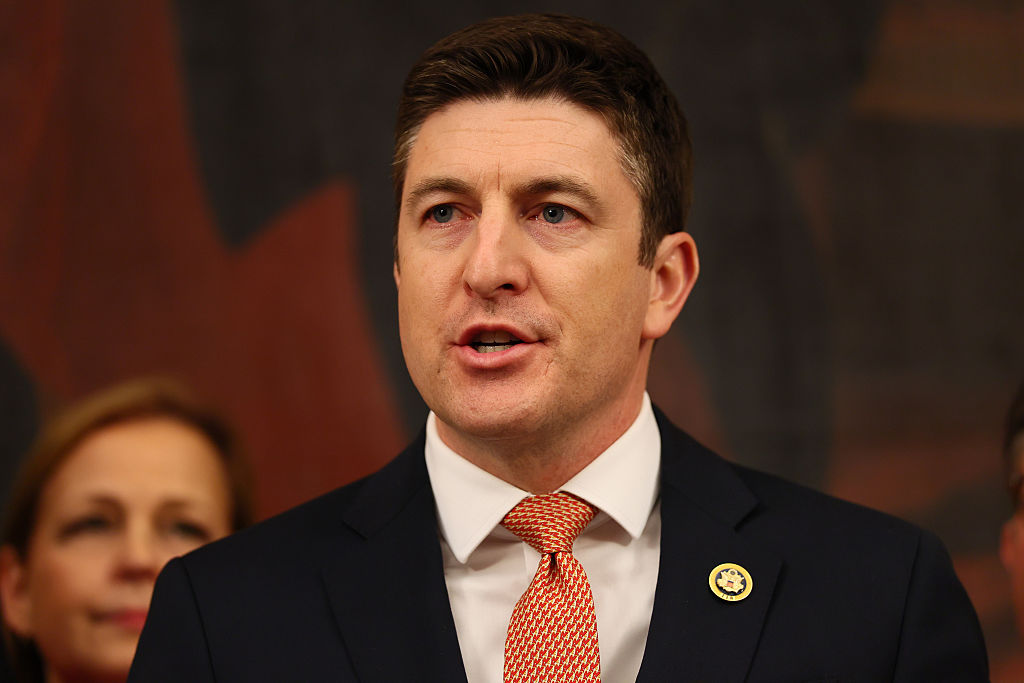
This week, Congressmen Daniel Webster (R-FL) and Greg Steube (R-FL) reintroduced the Helping Everyone Access Long Term Healthcare (HEALTH) Act, which provides a tax deduction to healthcare providers for pro bono health services to low-income Americans. As debate over the future of healthcare policy takes center stage on Capitol Hill, the HEALTH Act – first championed by late AMAC Founder Dan Weber – is a simple yet powerful bipartisan tool that could lead to better health outcomes for millions of Americans.
The HEALTH Act offers an innovative solution to one of the most persistent problems in American healthcare: lack of access to primary care. Today, roughly 92 million Americans depend on Medicaid and the Children’s Health Insurance Program (CHIP), yet many struggle to find a family doctor willing to see them. Because of burdensome paperwork, low reimbursement rates, and red tape, many physicians have stopped accepting Medicaid patients altogether.
As a result, too many low-income Americans forgo routine checkups and end up in hospitals when illness strikes. According to research, 44 percent of Medicaid patients visit the emergency room each year – almost four times the rate of those with private insurance.
By providing doctors with a straightforward tax deduction for pro bono medical services, the HEALTH Act would remove administrative barriers while expanding access to care. The concept is simple: instead of filing extensive Medicaid or CHIP claims for a minimal reimbursement, physicians could choose to treat eligible patients at no cost and deduct the value of that service on their taxes. The bill rewards charity and compassion while reducing paperwork for doctors and saving billions for taxpayers.
As AMAC CEO and AMAC Action Chairwoman Rebecca Weber explained, “AMAC Action proudly supports the HEALTH Act, which allows physicians to deduct pro bono care for CHIP and Medicaid-eligible patients. This commonsense reform gives American citizens access to timely primary care and also supports physicians who struggle with the complexity of the Medicaid and CHIP reimbursement systems, relieving pressure on emergency rooms and strengthening care in the communities where it is needed most.”
The impact of such reform could be transformative. Nearly 40 percent of U.S. physicians already provide some level of free or reduced-cost care, but current tax law only allows deductions for services rendered through registered charities – not through private practices. The HEALTH Act would correct that inequity and unleash enormous untapped potential in the medical community.
Studies show that if just seven million of the roughly 20 million emergency-room visits made annually by Medicaid patients were replaced with non-hospital visits, taxpayers would save about $6.5 billion each year. Eliminating the administrative costs that plague Medicaid billing could save an additional $2.8 billion annually in primary-care visits alone.
Just as importantly, the HEALTH Act strengthens the doctor-patient relationship. Instead of navigating bureaucratic hurdles or third-party reimbursement systems, doctors could treat low-income patients directly, building the trust and continuity of care that lead to better long-term health outcomes. For patients with chronic conditions, this consistent access to a primary-care physician can mean earlier detection, better management, and fewer hospitalizations – all without costing taxpayers a dime.
At a time when Americans are struggling with rising premiums and a healthcare debate dominated by calls for bigger government and higher subsidies, the HEALTH Act should stand out as a rare opportunity for bipartisan agreement. It expands care without expanding bureaucracy. It rewards generosity rather than dependence. And it reminds Washington that the most effective solutions come not from federal agencies, but from empowering individuals and communities to help one another.
The idea behind this reform has deeply human roots. The late Dan Weber, founder of AMAC, was moved to act after a personal experience that revealed just how broken the system had become.
During a summer trip to upstate New York, Weber took his child to a local emergency room and was stunned by the long lines of people waiting for care. As he spoke with those around him, he discovered many were there simply because they had no access to a family doctor – most physicians in the area had stopped accepting Medicaid patients. Then came a tragedy that stuck with him for the rest of his life: a young mother arrived whose baby had died of whooping cough, an illness that could have been treated easily if she’d had access to a pediatrician.
Dan Weber never forgot that child. Out of that heartbreaking encounter came his determination to make sure no family would ever face the same situation again. The HEALTH Act was born from that conviction – a belief that America’s doctors should be free to help those in need without being punished by the tax code.
Though Dan passed away in 2020, his legacy continues to guide AMAC’s work. The HEALTH Act is not just another policy proposal; it is a reflection of the principles that defined his life – faith, compassion, and a commitment to improving the lives of everyday Americans. From the beginning, AMAC played an instrumental role in developing and advancing this legislation, working closely with Rep. Webster and other leaders in Congress to transform Weber’s vision into actionable reform.
As Rep. Webster noted, “This bill helps more Americans have access to the care they need, from the doctor they choose, at a price they can afford.” Rep. Steube added that the HEALTH Act “will honor [doctors’] contributions by creating a tax deduction for the charity care they provide to lower-income families and children. Not only will this reaffirm our country’s support for those who give back, but it will expand access to quality healthcare for families in need.”
AMAC applauds Representatives Webster and Steube for leading this effort and urges Congress to move quickly toward passage. At a time when partisan divides dominate nearly every issue, the HEALTH Act offers a rare opportunity for unity – a practical, compassionate reform that embodies the best of America’s spirit.
AMAC and its 2.2 million members remain committed to seeing this bill across the finish line so that Dan Weber’s vision – helping everyone access care without unduly burdening taxpayers – can finally become a reality.






Scan all prograns and remove violaters and illegals. Just because our government allowed those to become US citizens if born here, that does not mean we need to support their families. Remove these children, put in orphanages or adopt them out and send their families back home. We have to start taking a stand or we will be destroyed by our generosity.
Also, start making able-bodied people to get emplooyment and stop taking benefits meant for the truely handicapped and elderly.
Another major problem is illegals holding offices in our government, whether local or federal. They are not here to impose their beliefs and ideas upon us. We do not want socialism or communism in our country. History has proven they don’t work no matter how many times they try.
The iadverse mpact of illegals upon this country cannot be denied. Our middle class is being decimated because all the programs designated for handouts. If people have no means to escalate their livelihoods, we will be in poor shape and our country will be doomed.
Not quite sure this analysis is accurate. Unless the government lowers the spending that creates a larger tax burden on everyone, creates greater inflation (the unnamed tax on everyone) and an almost insurmountable national debt bill that must be paid by taxpayers, doesn’t reducing taxes on one group merely increase the unchanged burden on another? Doing this just shifts the same exact cost burden when what needs to be done is lowering the cost of healthcare itself via free-market competition and ending the Socialist debacle known as Obamacare.
This sounds good, but could backfire as the uninsured might stay uninsured because they will be getting free care on an ongoing basis. I’ve been a nurse for 45 years and the system is crumbling. We need a team of people who can figure out a better way. There are some good ideas out here, but no one listening to them.
What about people like me who don’t qualify for Medicaid but can’t afford a regular health care plan. I’m considering going with no insurance at all because I can’t pay my other bills too. I have also had cancer ounce and its probably not wise to drop it, but I don’t know what else to do.
I certainly believe that this is a workable solution to downsize the burden of the ER and make available primary care. I do see an issue that could be created with over burdening a primary care provider’s everyday expenses and cash flow. What would the primary care provider adjust so that his/her practice has enough cash flow to pay everyday expenses, payroll, equipment, rent, etc. The tax benefit, in dollars, doesn’t appear to be able to make a total readjustment of the practice.
I’ve been in Medicine since well before CMS, Medicare and Medicaid. i can help with the access problem and many other government medical problems. 817 989-7777
Where I live its not so much costs but availability. Doctors love to get their MD License in WV but leave the state because their annual income potential is so much less than what they can make in larger urban areas. They choose to leave because their costs to become a Dr are the same as any other large university but the ability to repay this expense is highly limited here. Perhaps revamping the college loan repayment program to actually pay for what you borrow instead of getting involved in the governments racket of paying illegal (if a private person was doing it!) Interest rate is what needs addressed this could be done across the board not just medical students if you are getting my drift. I think starting over for everyone would eliminate some of the problems involved with the system.
I have read and agree with most of the comments so far. One item that I haven’t seen addressed is FRAUD, either by the doctor, his office, or the patient. We, in Minnesota, are very skeptical that, given the right circumstances, anyone eventually can find a way to “beat the system” and do what is morally wrong, while the rest of us pay for it. It’s hard to find a good solution when so much is wrong and needs to be fixed. I feel bad for those who really need care and can’t get it for any reason. And I feel bad for doctors and nurses who want to give care but can’t. Something needs to be done, and I see no reason, with the proposed Health system and some kind of fraud check, we shouldn’t begin there. It certainly sounds better than what we have.
Here’s an idea for seniors:
Allow seniors to transfer funds tax-free from their traditional IRA or 401k into an HSA. I suggest up to $5,000 per year beginning either at 59 1/2 (when withdrawals can be made penalty free) or 62 (earliest age to start collecting social security) or 65 (when Medicare begins) or 67 (full retirement age) or age 70 (latest age to begin collecting social security).
Most people get their medical coverage through their employers and few offer the High Deductible Medical Plans needed to establish an HSA. Therefore, few seniors have access to an HSA at a time when it is most needed. As we grow older, it is expected that our medical costs will increase and so will our out-of-pocket expenses. Also, with Medicare straining, one can expect a greater burden being placed on its recipients either through higher plan premiums or larger deductibles. Allowing seniors to establish an HSA will allow them to pay for out-of-pocket expenses using pre-tax money. It would also help ease the burden of RMDs and the 7.5% of AGI hurdle to get a tax break for medical expenses. As is the case currently, HSA money can be transferred to a traditional IRA at any time if the money is needed for other purposes.
One area this Plan misses, is Medicare! Us retirees on med advantage plans still have great difficulty in finding Drs that will accept these plans. The companies that do take them have so many restrictions and limitations that reduce the actual ability to get care by a significant amount. The rules allowing eligible dates are always difficult to use as it is so compacted that it is very hard to find the correct plan, especially when some of the companies withdraw from the program.
I just emailed my Democratic Congresswoman asking her to consider supporting the HEALTH Act.