
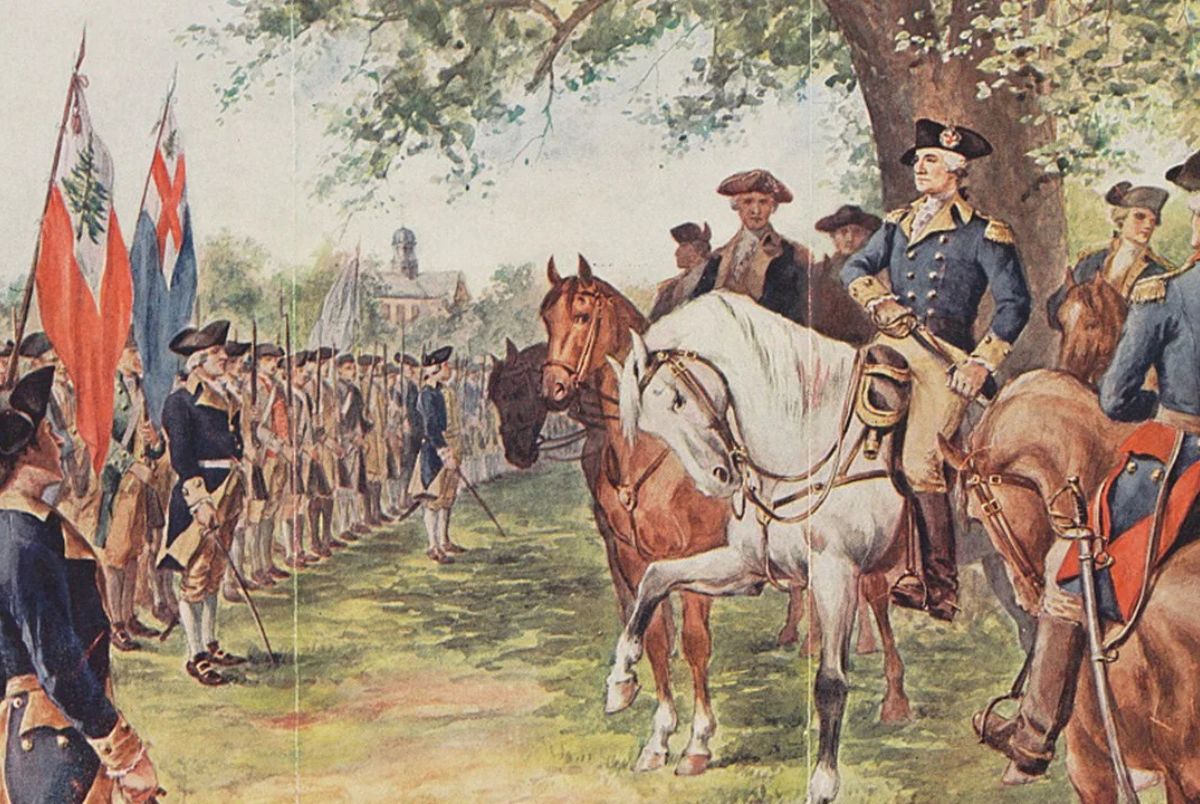
On July 3, 1775, beneath the shade of a great elm tree in Cambridge, Massachusetts, George Washington formally took command of the Continental Army. It was a defining moment in American history. Just weeks after the Second Continental Congress unanimously appointed him commander-in-chief, Washington assumed leadership of a loosely organized force of colonial militias surrounding British-held Boston. His acceptance of command marked the beginning of an eight-year military struggle that would ultimately secure American independence and establish him as one of the nation’s greatest leaders.
The Revolutionary War had already begun. The Battles of Lexington and Concord on April 19, 1775, ignited open conflict between colonial militias and British troops. In June, the bloody Battle of Bunker Hill demonstrated that the colonists were willing to fight a professional army, even at great cost. Yet despite their determination, the American forces lacked the organization, discipline, equipment, and unified leadership necessary to wage a prolonged war.
Recognizing these challenges, the Continental Congress selected George Washington on June 15, 1775, to command the newly created Continental Army. Washington, then 43 years old, brought valuable military experience from the French and Indian War and enjoyed widespread respect throughout the colonies. Equally important, he hailed from Virginia, helping unite the Southern colonies with the New England states already engaged in combat. Congress hoped his leadership would transform a regional rebellion into a truly national cause.
When Washington arrived outside Boston on July 2, he found approximately 16,000 soldiers encamped around the city. Many were courageous but poorly trained, short on supplies, and enlisted for only brief terms of service. The camps suffered from inadequate sanitation, limited ammunition, and a lack of military discipline. Washington immediately set about inspecting the troops, organizing the camps, improving training, strengthening command structures, and establishing consistent standards for the army.
Despite the enormous challenges, Washington inspired confidence. He understood that defeating the British would require patience as much as battlefield victories. Rather than risking the army in reckless engagements, he focused on preserving the fighting force whenever possible—a strategy that would become one of his greatest strengths throughout the war.
Washington’s first major success came the following spring. In March 1776, after Colonel Henry Knox transported captured cannons from Fort Ticonderoga across hundreds of miles of frozen terrain, Washington placed artillery on Dorchester Heights overlooking Boston Harbor. Faced with the prospect of devastating bombardment, British General William Howe evacuated Boston on March 17, 1776, giving the Americans their first significant strategic victory.
Washington remained commander-in-chief throughout the Revolutionary War, enduring defeats as well as triumphs before achieving final victory at Yorktown in 1781. Perhaps even more remarkable than his military leadership was his willingness to surrender power after the war ended. By resigning his commission in 1783 rather than seeking personal authority, Washington established the enduring American principle of civilian control over the military.
The ceremony on July 3, 1775, was therefore more than a change in command. It marked the emergence of a leader whose character, perseverance, and devotion to liberty would help shape the birth of the United States and define the ideals of the new republic for generations to come.






Thank you for this wonderful historical summation. Makes me proud of our roots.