
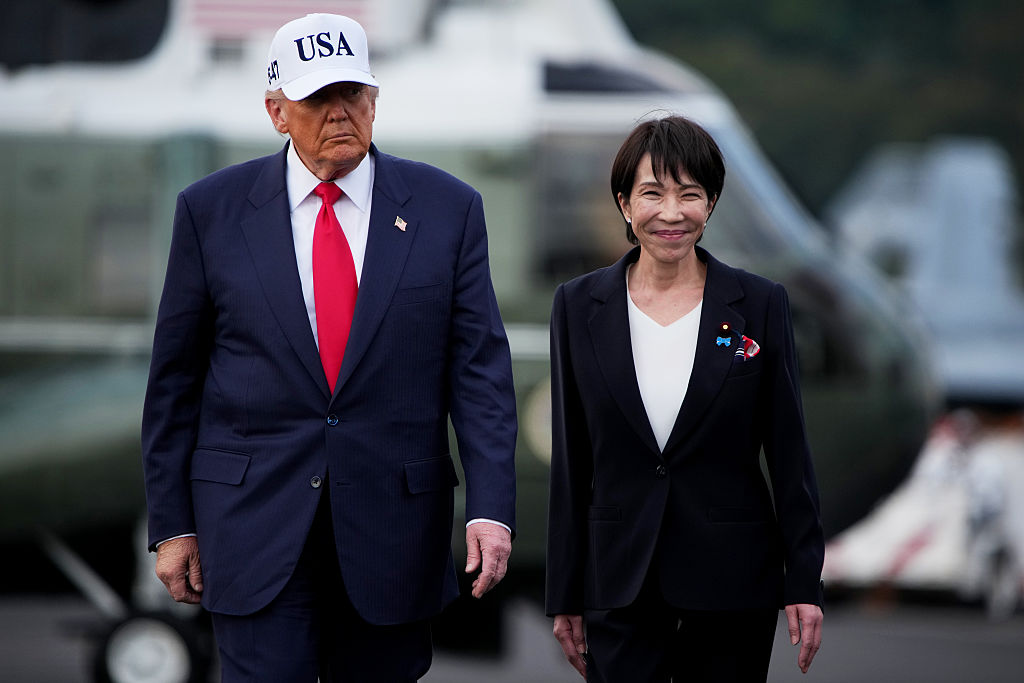
Since taking office earlier this year, new Japanese Prime Minister Sanae Takaichi has taken a hardline stance against Chinese aggression in the South Pacific, particularly regarding Taiwan. While Chinese Communist Party (CCP) officials have responded with plenty of rhetorical bluster, the United States has stood beside the new leadership in Tokyo, further isolating Beijing.
In early November, Takaichi ignited a diplomatic war of words when she stated, “If battleships are used and a naval blockade involves the use of force [around Taiwan], I believe that would, by any measure, constitute a situation that could be deemed a threat to Japan’s survival.” The comment has prompted ongoing outrage from Beijing, including this week when a Chinese foreign ministry spokesperson again demanded that Takaichi retract her remarks. Beijing has also initiated a boycott on travel to Japan.
Japanese leaders have long recognized that Chinese military action against Taiwan would imperil Japan’s security and survival. Yonaguni Island, Japan’s southernmost territory, sits just over 60 miles off the coast of Taiwan. A Chinese blockade of Taiwan (which Beijing has claimed sovereignty over since the Republic of China government relocated there after losing the Chinese Civil War in 1949) would by default affect maritime traffic to Japan. Beijing and Tokyo have maintained frosty relations since the end of World War II.
Any Chinese attack on Taiwan would block vital shipping routes during a conflict, and possibly afterwards. Yonaguni could become a key battleground, as illustrated by 2022 drills in which a People’s Liberation Army (PLA) missile landed about 50 miles from the island. Experts believe that the Chinese invasion plan could also include an attack on this island, and that Japan will be drawn to war due to its geography.
But while Japanese officials have long underscored the strategic importance of an independent Taiwan, no sitting prime minister to date has ever so clearly referred to a concrete scenario that could possibly trigger the deployment of Japan’s Self-Defense Forces (SDF) into armed conflict with the PLA. Past leaders have studiously circumvented drawing such a clear “red line.”
But as Beijing’s provocations grow increasingly blatant, Takaichi has recognized that it is continued appeasement and fear of escalation which may ultimately be the surest path to conflict. While critics have charged that a military buildup will make a Chinese attack more probable, Takaichi appears to have embraced the famous line from former Secretary of Defense Donald Rumsfeld that “weakness is provocative.”
The United States under President Donald Trump has mirrored that approach, backing its allies in Tokyo. Following a call between Takaichi and Trump late last month, the Japanese prime minister reported that Trump “mentioned that he and I are extremely good friends, and that I should call him anytime,” adding that Trump reached out to her first. U.S. Ambassador to Japan George Glass also stated that the U.S. supports Takaichi’s government in the face of Chinese coercion.
Bolstered by U.S. support, Japan under Takaichi’s leadership is following through on promises to strengthen its defenses. All along the Ryukyu island chain, which stretches from Yonaguni Island to the Japanese mainland, the SDF is installing missile batteries, radar towers, ammunition storage sites, and other combat facilities. Japanese forces have also conducted military exercises in the waters around Taiwan.
In response, the CCP has launched an information warfare campaign against Takaichi, portraying her as a warmonger and her government as imperialist – a common tactic deployed whenever tensions rise with Tokyo. Beijing has also accused Takaichi of issuing a direct threat against China, misconstruing her words as a promise of military intervention.
China has also responded with military deployments of its own as a show of force. The PLA aircraft carrier Liaoning, accompanied by three guided-missile destroyers, recently conducted takeoff and landing drills near Taiwanese and Japanese waters. Overall, PLA aircraft completed at least 140 takeoffs without notifying Tokyo.
In response, the SDF scrambled its jets, preparing to respond to a potential attack. Chinese J-15 fighter jets then locked their radars onto the Japanese aircraft – a move that indicates preparations to fire weapons. “It should come as no surprise that sowing seeds of fear is the CCP’s weapon of choice,” a former Japanese military official told me. “With provocations like a show of force, the CCP seeks to intimidate nations from even contemplating their own defense.”
Chinese aggression in the region is nothing new. But what appears to be different now is Japan’s response to it. In the past, Tokyo would choose silence and not react; this time, Takaichi’s government is responding by holding its ground and doubling down on defense investment.
A Nikkei poll shows that this pivot toward a position of strength is popular with the Japanese people, with 55 percent of respondents approving of Takaichi’s initial remarks that sparked the controversy.
With President Trump standing firmly beside Japan’s new leadership, Beijing is discovering that its old playbook of coercion and intimidation no longer works. A united front between Washington and Tokyo signals that the free world is done indulging Chinese aggression and is prepared to meet it with strength.
Ben Solis is the pen name of an international affairs journalist, historian, and researcher.






Stand strong, Japan.
Beijing” outraged”, oh no! Japan is a “warmonger” and “imperialist”, whatever shall we do? I know, let’s protest. The CCP is a brutal, dictatorial, authoritarian regime. All you need to know is that it’s a communist ideology, which has no redeeming qualities, and never has. Should it come to a war, we will see a lot of Chinese cannot fodder make the sacrifice. You can train all you want, stand nicely in information and march, but when it comes to the chaos of war, for a military that has not had any combat engagement since 1979 (small engagement with the North Vietnamese), it’s unknown ground. Beijing likes to use a lot of what I call 50 cent words in their narratives, but that’s whistling pass the graveyard.
I admire Prime Minister Takaichi, she is feisty, and has been compared to Margaret Thatcher, the former PM of England, who revolutionized the government, and was a lot like Reagan, and not unafraid to speak up. Japan is smart to equip all of their islands for eventual activity. A small transition is taking place in Japan with a subtle shift to a self-defense policy on steroids. Japan is a close ally, trade and security wise. With the US helping the Philippines to beef up their security, especially on the northern end of the Luzon Island, Beijing is going to have their hands full should they start something. I am not a war monger, but when you have a bully who lives in the neighborhood you need to be ready. This a geopolitical issue, and we have a vested interest.
Emma, Ashley – No thanks, sounds like you’re deeply involved in Medicaid fraud from home.
See you in the headlines (not mainstream).
I’m very pleased with this new Japanese president. It takes a strong woman to do what the men wouldn’t/couldn’t do…
I hope the world still trusts the USA.
Ashley, does this wonderful job that you have involve laying on your back and spreading your legs?