
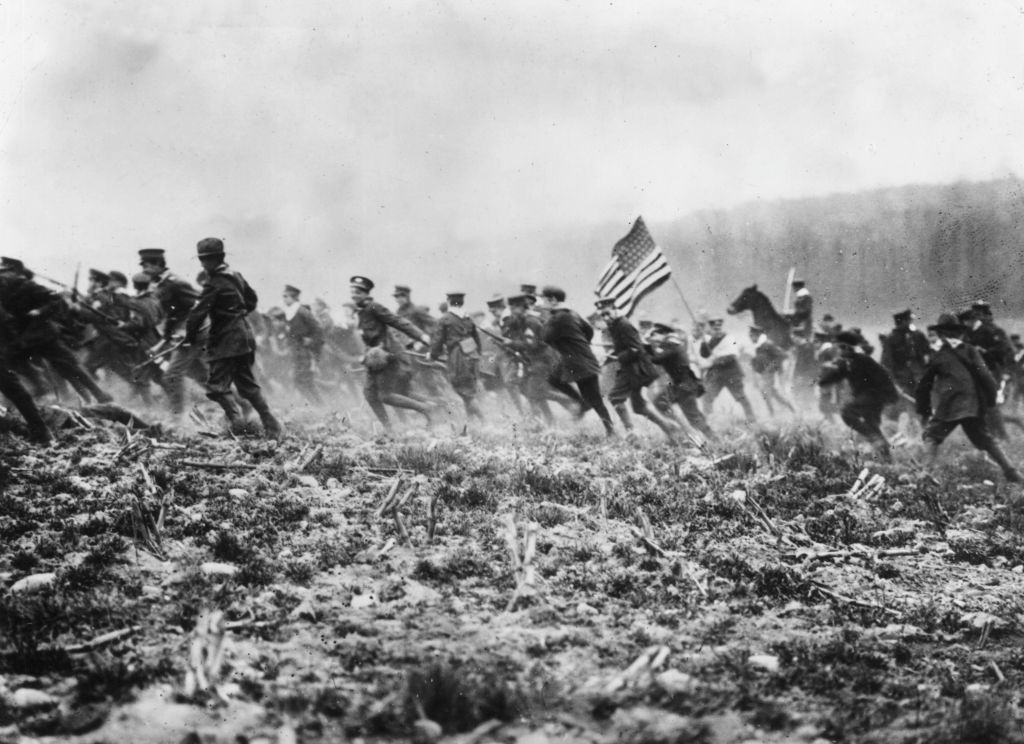
Although Veterans Day began as a celebration of the Armistice of 1918, World War I is no longer a part of the American imagination. Instead, Americans (and the West more broadly) look to World War II as the key event of the 20th century into which mature Americans arrived.

It is, of course, fitting to have a day to honor the veterans of every armed conflict in American history, including World War II. But there is both a sadness and a historical blindness to our forgetting of the original “World War” and our place in it. The generation that fought the “Great War” was every bit as heroic as that of their sons in World War II—and deserves to be remembered.
In his best-selling The First World War, historian John Keegan wrote that even before the U.S. had entered the war, there were Americans who had already joined the fighting with the British and Canadian armies as well as the French Foreign Legion. “A large group of American pilots,” Keegan writes, “was already serving in the French air force, where they formed the Lafayette Escadrille, one of the leading air-fighting units on the Western Front.”
Though the U.S. Army was at a low in the beginning of 1917, with only a little over 100,000 men, by the latter part of the year, American Expeditionary Force commander General John “Black Jack” Pershing was planning to have eighty divisions with almost three million men to turn the tide in the war. By March 1918, 318,000 men were in France—with nearly one million more set to arrive over the next five months.
The U.S. had decided conscription was the way to assemble this large army. 24 million young men registered, of which 2,810,000 were drafted. One of them who was called up was my paternal great-uncle, George Bryant Harbaugh.
Thanks to Lori Samuelson, a genealogist and historian (and the wife of my cousin, George’s grandson), I was able to read the letters that George wrote to his fiancée, a young first-generation Swede named Elsie Wilhelmina Johnson, during the “War to End All Wars.”
In Thanks to the Yanks: WWI Letters from an Indiana Farm Boy to His Sweetheart, Samuelson presents images of original letters from George to Elsie (and a few other related letters to and from George) along with transcriptions, a narrative at the beginning of letters from each place, and notes about and pictures of people and places involved.
The first letter is from the new conscript dealing with the side effects of mandatory vaccinations at Camp Taylor, Kentucky, on April 2, 1918. The last is from the U.S. Army Base Hospital at Camp Sherman, Ohio, where the veteran, desperate to finally be with his beloved, underwent surgery to fix a shell wound that had not healed properly.
A native of Northern Indiana and one of 11 children born to George Frederick and Margaret Long Harbaugh (see my review of Samuelson’s book Perseverance Amidst Adversity: The Ancestry of Three George Harbaughs here), George was 22 and living in Miller, Indiana, when he was drafted. In his job as a watchman for the Elgin, Joliet, and Eastern Railroad, he had already had a shootout with a disgruntled mill worker. Despite attempts by his employer to get him an exemption from service, George was called up anyway.
At Camp Taylor, George and his company of 250 men trained and drilled constantly, singing songs that included “Indiana,” “Tipperary,” “My Little Girl,” “There’s a Long Trail,” and “Over There.” He reports that his “army rifle is a dandy” and he is “pretty good in shooting.” He recounts meeting soldiers from Kentucky hollers who had never seen trains and had little education. He laments that some men “get the big head when they get to be corporal,” but admits “most of them are just dandy fellows.”
While George reports books and magazines available, he writes to Elsie that they have little attraction for him; he has been reading the Bible she gave him. In fact, a patriot that he is, his letters indicate that his heart is constantly with Elsie, for whom he had yet to get an engagement ring. He laments that she hasn’t sent him her ring size, worries about whether she is okay with him telling other Hoosiers about their engagement since she doesn’t have the ring, and worries about whether she’ll wait for him to return. “Do you think you can wait a year, or even two, for me?” he writes. “I hope the war will be over sooner than that, but it may last that long yet, and I would sooner die on the field of battle than come back and find the girl I love married to someone else.”
And lest Elsie fear she’s simply being strung along, he tells her, “You need have no fear of my writing to other girls. I could write to dozens if I wished, but there is only one I care to write to and you know her, don’t you?”
At the end of April, George is moved. A postcard he sends from Florin, Pennsylvania (“a pretty country”), has a painting of the Pennsylvania Railroad’s famous Horse Shoe Curve on it. On April 30, he arrived at Camp Upton on Long Island, New York, where he awaits his trip to Europe. Writing to Elsie on the day before her birthday, he tells her she wouldn’t recognize her “Sammy” (from “Uncle Sam”) in his steel helmet and gear. He promises never to kiss anyone else: “Not even the French and English girls ha ha.”
By May 16, he writes from “Somewhere along the Coast” on “a large vessel ready to sail.” The precautions taken with mail were in full force—and effective. In his history, Keegan observes that of those million American soldiers coming from March to August 1918, “not one had been lost to the action of the enemy in oceanic transport.”
From England, George writes that he “saw some of the most beautiful places I have ever saw,” adding parenthetically, “outside of Indiana.” When he passes to France at the end of May, he reports how the houses “are very odd” with “no modern conveniences” such as “an oil stove or a range.” And the farming is done by “American methods 100 years ago.” He is somewhat impressed by “the city where the ‘Ladies latest Styles’ originated”—Paris!
By July, however, George, who had been assigned to the 28th Division, was in combat. On July 18, the Allied forces, including the French and the U.S. 3rd and 28th Divisions, were attempting to beat back a German offensive designed to get them to Paris at Chateau-Thierry on the Marne River. George was gassed—probably mustard gas or phosgene—an injury from which he would never really fully recover. “As my name may have appeared in the paper,” he tells Elsie, “I’ll write you so you’ll know I’m still alive. Well, we were in it and I got a little used up not badly, though. I’ve still got 2 arms 2 feet 2 eyes 2 ears a nose and I can eat anything they give me….”
He expected to be back in the fight soon. From there, he went to the Battle of the Argonne Forest, launched on September 26, 1918, and part of the broader Argonne-Meuse Offensive that continued until the Armistice. Of the 1.2 million American soldiers fighting, 26,000 were killed and 95,000 wounded. That included George, who was hit by parts of artillery shells. On October 5, he wrote of a “little set to we had with the Germans on the Argonne Forests sector.” He notes that his writing proves “I’ll have at least one arm to put around you at Xmas time.”
On October 18, he reveals that he has been in bed because the wounds also include both legs. Indeed, George would be in the hospital for over two months, during which time the Armistice was signed. He doesn’t feel sorry for himself, and he worries that the Influenza epidemic has been worse back in the States. He sends mistletoe to Elsie from France, and he writes of the controversies over service stripes—some American soldiers didn’t want combat veterans to be distinguished on their uniforms.
But mostly, he is proud of his work and desperate to be home. “We have finished the job we came over to do, so we can wait till they get ready to take us back,” he writes. By May 22, 1919, George can write from Camp Merritt, New Jersey, about his gladness at being “back in God’s country again.” Yet, it would be several more weeks due to the medical attention needed for his wounds.
When he returned, Elsie had indeed waited for him. They married at the Lutheran Church in Miller and took up residence in Elsie’s mother’s upstairs apartment. By 1924, the Purple Heart winner would build the home in which Lori Samuelson later found the packet of letters from him—from a Sears kit. George worked as a fireman and later for an ordnance plant. He was a union delegate. He invented a crystal radio featured in National Radio Weekly. His was a full life.
In 1941, when America was again on the brink of war, George counseled caution about this impending “foreign war” in a series of letters to local papers. But, he added, all Americans must agree that “This Is Our Country, the best country in all the world, and nothing shall be left undone to preserve it….” His own son, also George, would serve in this war, becoming a German POW and taking part in the famous Black March. As Samuelson writes, “George the father came to understand the waiting, the fear, and the helpless pride his own parents must have felt decades earlier.”
I knew cousin George of World War II fame and his siblings, Betty Jean and Bob, but never met Uncle George or Aunt Elsie. He died after a work accident in 1954 at the age of 58. She died ten years later. But I am proud of them both as members of my family and as Americans.
Those World War I veterans never got a moniker like “The Greatest Generation.” But it was their bravery and public spirit that raised up sons who would also fight when called to do so. We do well to remember them.
David P. Deavel teaches at the University of St. Thomas in Houston. A past Lincoln Fellow at the Claremont Institute, he is a Senior Contributor at The Imaginative Conservative. Follow him on X (Twitter) @davidpdeavel.




Jesus said “There will always be wars, and rumors of war.” He also said, “Blessed are the peacemakers.” What does it take to get some factions to stop fighting, and negotiate for peace? Meanwhile we choose to honor those who sacrifice to serve in the military during times of war. They are the brave who live a life of purpose, loyalty to the principles our country was founded on, and devotion to home and family. Because of them, we are able to enjoy freedom that the rest of the world envies.
Thank you for sharing. I have two great uncles who served in WW1. One died in France on 11/8/18, the other lost an arm in his first battle. I am blessed to have their letters home.
What a lovely story. Thank you Uncle George for your service and all those other dough Boys of the first World War. Like always Americans are always the first to volunteer. Can we say that about the young generations of today? So sad that we have created so many generations that want the government to take care of them. They want to have everything their grand and great grandparents have. They worked hard for it. Took the responsibility for themselves serious. They wouldn’t be caught dead at a welfare office. That would hurt their pride. Thank you for all the soldiers who fought in any war or conflict and kept our freedom in America for every citizen. May God bless you and may God bless the USA.
GOD BLESS OUR VETERANS!
KUDOS to ALL veterans and active-duty service personnel! My dad fought from a ship in the Central Pacific in WW2 and his brother was an Army soldier in Europe who closely survived the Battle of the Bulge. My cousin is currently a Captain in the USN.
Given what men and women in our military have given, life and limb, this day should be celebrated EVERY DAY not just one day a year.
Recognize vets in all wars since WW1 to date
Thanks to all veterans for our freedoms we enjoy today . From the everyday people who fought a King to the generation that fought brother against brother to right the wrongs . To the brave soldiers who were gassed and every other evil inflicted upon them for world peace and to all other conflicts to date . Let the rag free press flap their mouths about the greatest only those that take a stand and step up and face evil head on are the greatest. Thank you for my Freedom !
My grandfather and his brothers (legally) immigrated from Sicilly and served in WWI. I never meet him because he died when my father was young. During my career in law enforcement I had a partner who survived the Battle of the Bulge.
Several years ago, I realized I knew little about WWI, so I undertook my own study of the circumstances, fighting techniques and causes. I have 3 uncles who served in WWII (one in Europe, one in manilla and one at Pearl harbor) but I knew that many of the famous generals were WWI veterans. WWI was a brutal, ugly war in a way WWII was not. Your story is fascinating.
Great article, thanks for sharing, and THANK YOU TO ALL OF OUR VETERANS!!! My grandfather was a Doughboy in “The War To End All Wars.” On a side note, I was on my way to failing American history in high school, when we started covering World War 1, World War II and Vietnam. Aced the remaining exams to pull out a “B+” and ignited my love for history. If we fail to learn from our history, we are bound to repeat the mistakes we made.
So True! Great article
Happy Veterans Day to me, Happy Veterans Day to me! Ahh yes, here I sit at 77 years of life, though now as every day I am sadly reminded of such a “Great Honor” I had to serve my country’s call for greater good. Supposedly, but years after that WAR 55 years past, discovered the reality of my Honorable service, gifts of the loss of one eye, loss of the use of my right extremities (crippled), almost sterilized due to road mine, insanity of coming to grips with what I/we had done and to whom. Yes such an honorable day for us. Called to fight, kill destroy an enemy who Our Government, (politicians) declared were a threat to the United States and “loyal” allies. Oh, At the mature, ripe old age of 19 was so easily Brainwashed to go kill this determined horrible hoard of savage commies, who were just subhuman, low lives endangering our Sovereignty, But one should ask, ” Well why did you join, enlist in that endeavor to go to war? Well, I reply ” I didn’t and had no intention to do so.” Though my father was a WWII Veteran, as did my uncles cousins, relatives served to fight on those foreign shores. Yet I receive a warm “Greetings” letter / notification/command from the President of these United States stating, “You are here by ordered to report for induction into the Military Service of these United States” 08/21/1967.” There I was, Great Job first time I ever had a job making over $5 @ hour, new car ($3654), 2 hot girls, life was great, now this had to happen. So like my father, my family expected of me, to maintain the family’s honor off I went to my glory in the military. I couldn’t go have a drink with my buds before shipping to Vietnam, I wasn’t old enough to purchase a beer, couldn’t get married without my father’s signature, wasn’t old enough (if I so desired to), and the kicker was, I had no right to approve or disapprove of the Government’s demand, I wasn’t old enough to even VOTE! But by golly I was old enough to be drilled, trained, experienced in every mass human killing weapons & tactics imaginable. Stripped of every human ethics of morality, decency, mercy, or compassion for those human vermin of an enemy. Kill without thought or hesitation, no regrets or remorse. My unit’s leaders battle motos were “don’t stop shooting till the big chunks fly”. My constant thoughts for 55 years, and greatest regrets are many, but what stands out most is I came to know my so-called enemy, POWs, civilians’ regular soldiers, then realizing the declared enemy we were sent to destroy were better human beings than the corrupt, greed infested politicians that sent us there. I’ll shut up, sorry to rant! Today as always, don’t remember every exact name of those men I served with but never forget their faces, went to that Wall in DC once and was able to put some names to those faces I remember, etched in that black granite. Happy Veterans Day. Hopefully some will remember.
Best way to honor veterans would be to protect and cherish that which they died for.We failed that test.
My Granddaddy, Lester E Guenther and my great Uncle, Walter H Kramer both served in WW1 in France. I don’t know much about that, but I believe both of them stayed a bit longer helping with restoration. My Gr Uncle brought home his trunk which is now refinished and in my daughter, Dauphne’s home in Virginia Beach. Unfortunately, at 80 and on only SS, I can’t afford to get Ancestry again, and I never could figure out MY HERITAGE!
Movies to see for WW1
Flyboys
1917
Lost Battilion
I’m sorry but innocent young men sent off to die because of some tyrannical nut job is a story that keeps repeating. Politicians who have no skin in the game appear to have no problem sending young Americans into harms way. There has to be a better way but there isn’t. Veterans are a treasure, but their sacrifice is just lip service as evidenced by those that are broken if they return. The day of Infamy will be such a memory when the final Pearl Harbor veteran passes away. Hardly is there a mention when December 7th rolls around. Taking care of our Veterans must take precedence over the illegal and the undocumented. Proxy wars that lead to American lives being sacrificed is not a foundation of liberty.
My grandfather Roger Avery was also of that generation, a pilot trained to fly SPAD fighters at Wright Field inOhio, with the armistice signed before he deployed. He married and raised 12 kids while.owning a garage and a subsistence farm in Michigan in the Depression and WW2. My dad served 22 years in the Air For e and four as a paratrooper and Green Beret, including three tours and a TDY in Vietnam. Two of his brothers were veterans WW2 and Vietnam. I have several cousins who served and was a cadet myself until DoD discovered my asthma at my commissioning physical (although years later I developed MEDCAPS doctrine for JIWC as a consultant while.a.professor). My kid sister is currently.a.civiliam.contract nurse.with the Air Force.
I barely remember my grandfather Avery, who died of.cancer a few weeks before my 6th birthday, but he left a big legacy. My other grandfather was also veteran, a railroad repair crew foreman drafted into an Engineer(Aviation) battalion , the 835th, which was one of three USAAF units to.serve with Montgomery in Egypt instead of Ike in Tunisia. I was fortunate to meet a general he served under as a Boy Scout back in 1979- Ira Eaker, who had commanded three Allied Air Forces as the commander of Allied Air Forces in the Mediterranean when the 835th was in Italy, a command equal.to the Army Groups commanded by Bradley, Devers, or Clark. We have a history of veterans in the family, and I have ancestors.who served in both Continental and Royal units in the Revolution .
The bravery of our soldiers in all wars should be noted and appreciated! But WW I was historic in another and far more reaching sense. It was our first overseas war and we claimed not to be fighting for any gain but for the good of the world. In reality, it was a European bloodbath with no good guys and in truth, none of our business. We had an egomaniac president who wanted to save the world and bankers who had invested heavily in a British victory. The case for sending young Americans over there to die is weak at best. Indeed, if we were out for material gain, a far better case could have been made to have joined the Central Powers. If we were out for a more permanent peace, we would have been far better off to have just sat that one out.
I am sure that the WW1 vets were disappointed that the great war was in fact not the war to end all wars as it was also called. Or that another world war would happen so soon thereafter. I was always interested in the aviation aspects of it and a little regarding the naval aspects as well. Hated the accounts of the Land War though because of the unforgivable stupidity of the officers forcing soldiers to try to rush a mounted machine gun!
It was a horrible way those man died ,led by many old 19th century relics safely hidden from the danger, those boys died only to protect status quo of Great Britain and to expand the reach of Russian empire, had nothing to do with Belgian women and children or little Serbia being protected from Austrian Empire, in the end there were no clear winners, but thank God the slaughter was ended, followed by Wilson’s vindictive small minded agreement signed in Versailles and the creation of that monstrosity that became UN . WWII followed , won by US but only one half, the other half was allowed to flourish we even helped it on the way and now are dealing with the results. God bless all veterans.
For the next 60 years, Americans were drafted 4 times after being told this ended all wars. In the last 60 years, thanks to greater information and famous draft dodgers like Trump and Biden, Americans are unlikely to be duped into another draft.