
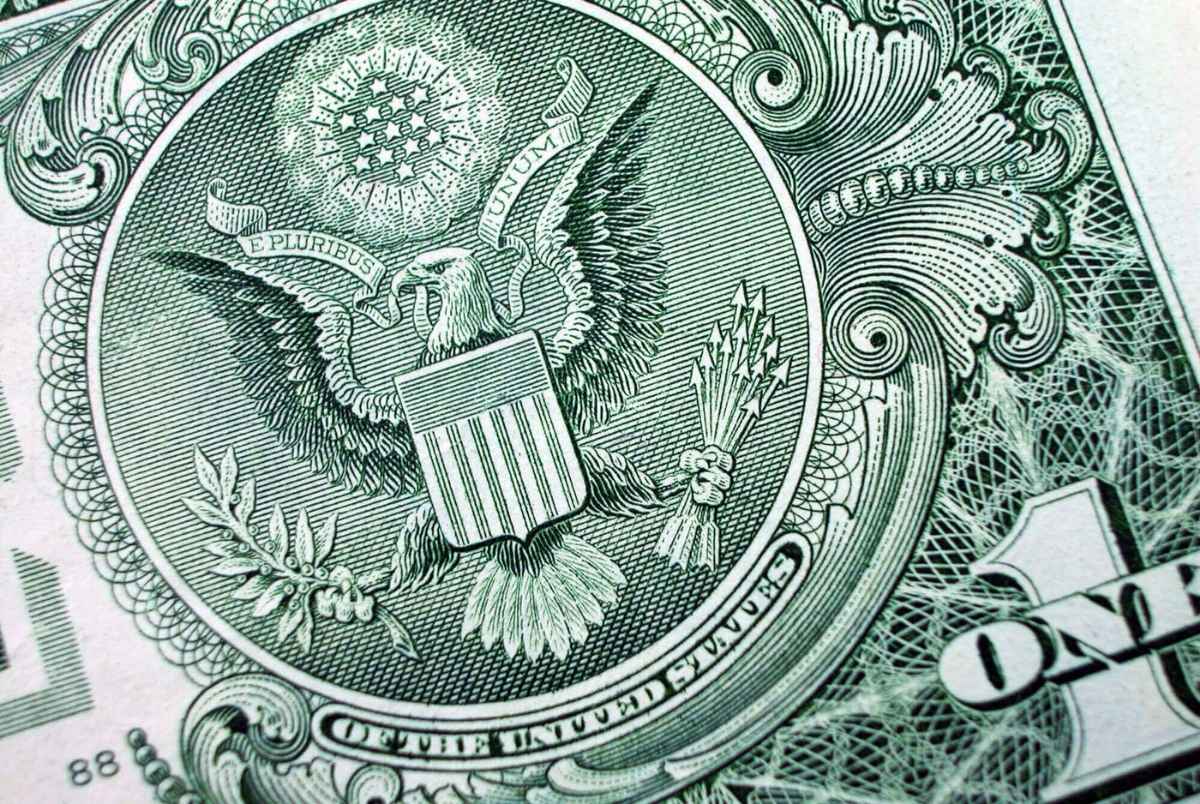
Few symbols are more distinctly American—and more consistently overlooked—than the Great Seal of the United States.
It appears on official documents, government buildings, and perhaps most familiarly, on the back of every one-dollar bill. It passes quietly from hand to hand, seen thousands of times, yet rarely examined.
That’s a missed opportunity.
The Great Seal was not designed as decoration. It was carefully constructed by the founders as a visual statement of the principles they believed would sustain the nation—principles rooted not only in government, but in individual character and a trust in Divine Providence.
On the front of the Great Seal, the bald eagle holds two contrasting elements: an olive branch and a bundle of arrows. Together, they represent a balance that remains as relevant today as it was at the nation’s founding—peace and strength. The eagle faces the olive branch, suggesting a clear priority: while strength is necessary, peace is the preferred course.
It’s a straightforward idea, but one that speaks to discipline and restraint. True strength does not seek conflict. It exists to preserve stability and to act decisively only when necessary.
Above the eagle is the ribbon bearing E pluribus unum—“Out of many, one.” More than a familiar phrase, it expresses the unity of purpose that made the American experiment possible. Thirteen separate colonies, with different interests and regional identities, chose to see themselves as one people united in freedom. That motto still carries a timely reminder: a free nation depends not only on independence, but on shared purpose, mutual trust, and a willingness to rise above division in service of the common good.
The shield on the eagle’s chest reinforces another foundational principle. It has no external support, symbolizing that the strength of a nation—and of its citizens—must come from within. Responsibility cannot be outsourced. A stable society depends on individuals who are grounded, accountable, and capable of self-governance under God.
Take a look at the back of the Great Seal, and the symbolism becomes even more revealing.
An unfinished pyramid rises upward, its top deliberately incomplete. The message is clear: the United States was never intended to be a finished product. It is an ongoing effort—something to be built, strengthened, and improved across generations.
Above it hovers the Eye of Providence, long understood by the founders as a symbol of God’s watchful care and guidance. It reflects a belief that a free people, guided by conscience and higher principle, could govern themselves more effectively than any external authority could govern them.
Two Latin phrases frame the image. Annuit Cœptis—“He [God] favors our undertakings”—and Novus Ordo Seclorum—“A new order of the ages.” Together, they reflect a bold and enduring idea: that a nation grounded in faith, responsibility, and trust in its people could chart a new course in human history.
What makes the Great Seal remarkable is not just its design, but its accessibility. These ideas are not confined to a monument or a museum. They are part of everyday life—carried in wallets, exchanged in stores, passed along without notice.
Perhaps that is by design.
The Great Seal does not call attention to itself. It simply remains—offering a quiet, consistent reminder of the values that shaped the country, and the same principles that continue to sustain it: balance, responsibility, purpose, faith, and the steady work of building something that endures.
In a time when the nation often looks outward for answers, the Great Seal suggests something simpler and more enduring—that the strength of America has always depended on the character of its people, guided by principle and sustained by faith.
It has been there all along—quietly reminding us that the strength of America was never in the symbol itself, but in the people willing to live up to it.
Darrell Fusaro is a Los Angeles–based author, artist, and U.S. Coast Guard veteran. He is the author of “The Great Seal: The Symbolic Guide for Happy and Successful Living,” which explores the deeper meaning behind America’s founding symbols and the principles they represent for everyday life.
The opinions expressed by columnists are their own and do not necessarily represent the views of AMAC or AMAC Action.




Those men were Godsend, what they did and accomplished is beyond comprehension, in a few years with few resources, but grit and determination, endurance and strength and absolute belief in the just cause ,God held his hand over that blessed land and the men who did not hesitate to die for it.
This article provides an important bit of historical knowledge by explaining the symbolism involved with the seal of the United States and the translation of the Latin phrases used. It is appreciated Darrell , Well done !
Great article. I like the true explanation of the meaning of the various symbols in the seal. Thank you, Darrell Fusaro.
Not mentioned is that the number of arrows the eagle is holding is thirteen. A very significant number in our early history.
For whatever reason, the reason for the arrangement of the stars in the cloud into a six-pointed star was (intentionally?) omitted: When Haym Solomon, the man more than anyone responsible for financing the American Revolution, was asked what reward he’d accept, all he asked was that the Mogen David – the Shield of David – appear as part of the symbol of the new republic.
so interesting.
Oh our great dollar bill, and yes it does pass so quickly, you really don’t pause to read it.Let all of us really live up to it, and preserve fits worth. Vote please, in 2026
There are so MANY things about OUR history that the average ‘Murican’ has little to no knowledge of, it is distressing. The folks who take the citizenship exams are so much better educated about our history than our current school kids.
A shame.
While, in this case, the eagle is a “Peace Eagle” facing the olive branch, there is also a “War Eagle”, in a military context, a “War Eagle” can also refer to a specific, rarer World War II-era variant of the US Army’s “full bird” colonel insignia, representing a bird facing the arrows (readiness for war) rather than the olive branch (peace).