
On April 18, 1775 – 251 years ago today – New England held its breath.
General Thomas Gage, the British commander in Boston, had his orders from London: seize the colonists’ gunpowder and arrest the ringleaders of the Provincial Congress. British officers on horseback already prowled the roads, stopping couriers, searching saddlebags, and eyeing suspicious movements.
In the quiet farm towns west of Boston – Lexington, Concord, Menotomy – farmers sharpened their axes, checked their powder horns, and whispered in meetinghouses. No one wanted war. But many had quietly decided what they would do if redcoats came marching to disarm them.
The tension had been building for weeks. Gage’s “secret” expedition was no longer secret. Riders like Paul Revere and William Dawes dashed into the night to raise the alarm. The countryside was a powder keg. As the sun set on April 18, it was only a matter of when the spark would touch it off.
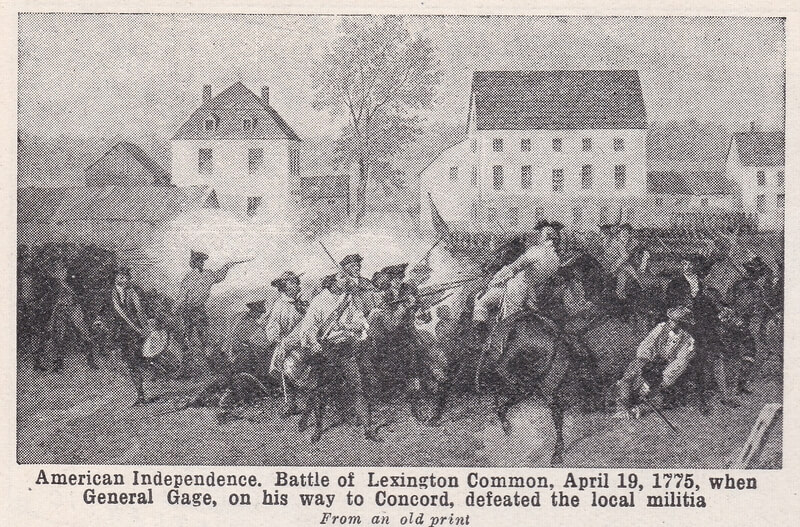
The next day, at dawn on April 19, that spark landed on Lexington Green.
Captain John Parker, a gaunt veteran of the French and Indian War wasting away from tuberculosis, mustered about seventy of his neighbors – farmers, tradesmen, husbands, and fathers – onto the dew-wet common. The drumbeat of young William Diamond had pulled them from their beds.
As the first rays of sun touched the grass, eyewitness reports say that Parker gave his men a command rooted in both restraint and steel: stand your ground, don’t fire unless fired upon. Some accounts add the quiet thunder of his resolve: “But if they mean to have a war, let it begin here.”
The British light infantry, hundreds strong under Major John Pitcairn, advanced with bayonets glinting. Shouts rang out – “Disperse, you rebels!” But the patriots held firm.
Then came that world-changing moment. A single, disputed shot – the shot heard round the world. To this day, no one knows who pulled the trigger. But before anyone had time to consider the gravity of what had happened came the British volley, an ear-splitting thunder that shattered the morning calm.
Eight Lexington men fell dead in those first chaotic moments. They had fired few, if any, shots in return. They had come not to start a fight, but to defend their town.
Among the casualties was Jonathan Harrington, a young father. Mortally wounded, he staggered and crawled toward his own doorstep just yards away, blood soaking his clothes. His wife Ruth watched the volley from the window in horror. Harrington made it to his door and collapsed at her feet, dying in her arms while their young son looked on.
Jonas Parker, Captain Parker’s cousin and a stout, determined man, had vowed he would never run. He didn’t. He stood his ground even as the volleys roared, loading his musket between his feet. Shot down, he struggled on the grass to reload until British bayonets finished him.
Others – Robert Munroe, a 64-year-old veteran, along with Samuel Hadley, John Brown, Caleb Harrington, Isaac Muzzy, and Asahel Porter – were ordinary men whose names had appeared for years only in church rolls and town ledgers. They left behind families, fields half-plowed, and lives suddenly cut short on their own village green.
Later that morning at Concord’s North Bridge, the first organized American counter-volley cracked through the air. Captain Isaac Davis of Acton, a skilled gunsmith, led his minutemen forward to the fife tune “The White Cockade” – a melody of old-world defiance. He had paused at his doorway that morning, four sick children inside, and told his wife Hannah simply, “Take good care of the children.”
Those were his last words to her.
A British musket ball struck him through the heart as he advanced.
Davis became the first American officer to die that day.
With him fell Abner Hosmer of Acton. Young schoolteacher James Hayward would die later in a skirmish, still exchanging fire.
These were not radicals spoiling for glory or professional soldiers chasing empire. They were the men who had hoped, right up to their final hours, that reason and rights as Englishmen would prevail. They believed they were defending their legal liberties, their town meetings, their powder stores, and their God-given duty to resist unlawful force.
The Massachusetts Provincial Congress had put it plainly just weeks earlier: the people must defend themselves “whenever the assaults of oppression render it necessary.” To them, redcoats marching to confiscate arms was the first step toward subjugation.
What makes the battles of Lexington and Concord so haunting is that none of these men knew they were igniting a revolution. Independence as a formal cause lay fifteen months in the future, still only whispered in the most radical sects of the patriot movement. They fought, bled, and died simply because free men do not submit quietly to oppression. They lift their voices and, when necessary, lift their arms.
As we mark the 250th anniversary of the independence that followed these opening clashes, the stories of the men who fell cut through nostalgia into something sharper: moral clarity. History’s great turning points rarely arrive with fanfare or famous speeches. They turn on the quiet courage of ordinary people – husbands kissing children goodbye, brothers vowing to stand fast, captains coughing through consumption to hold a line – who choose duty over safety when the moment demands it.
On April 18, 1775, the world had not yet heard the shot heard round the world. But the men who would answer it the next morning were already living the convictions that would birth a the most exceptional nation in human history. They believed that communities can govern themselves, that every individual citizen has an intrinsic dignity as a child of God that exceeds the power of government, and that liberty’s soil is fertilized by the sacrifice of men and women willing to bear its cost.
Though the world was smaller then, the question we face remains the same – what price are we willing to pay to defend liberty?
Phill Kline is a former state legislator and the former Attorney General of Kansas. He is currently a law professor.





Great article. I loved the historical context and putting names to actions. America needs many more patriotic people like those in this article to stand firm today and maintain the liberties and culture of our forefathers.
Thank you Mr. Kline for the article.
Beautifully portrayed – real people defending their freedom and loved ones for an ideal that is “larger than life”. I only wish the past 40 years were not spent by the leftist destuctionistas destroying this history of “The Greatest Country in the World”. The powers of darkness and evil and re-education seem to have won. I began fighting this in the late 80’s in the California school systems and political machination, to no avail.
My father was US Navy – back in the 50’s we moved a lot. But I got to go to school along Sleepy Hollow Road, I saw many of the battlefields.We found a Civil War Trench in our backyard. History came alive for me then, and has never faded. Thank you.
What a wonderful article, the story, this is the fiber this country is made of.
I copied and pasted the link to this article on my FB page. Stories about the USA are worth sharing for a lot of reasons.
Had today’s LEFT been around back then, they would have ratted out the colonies.