
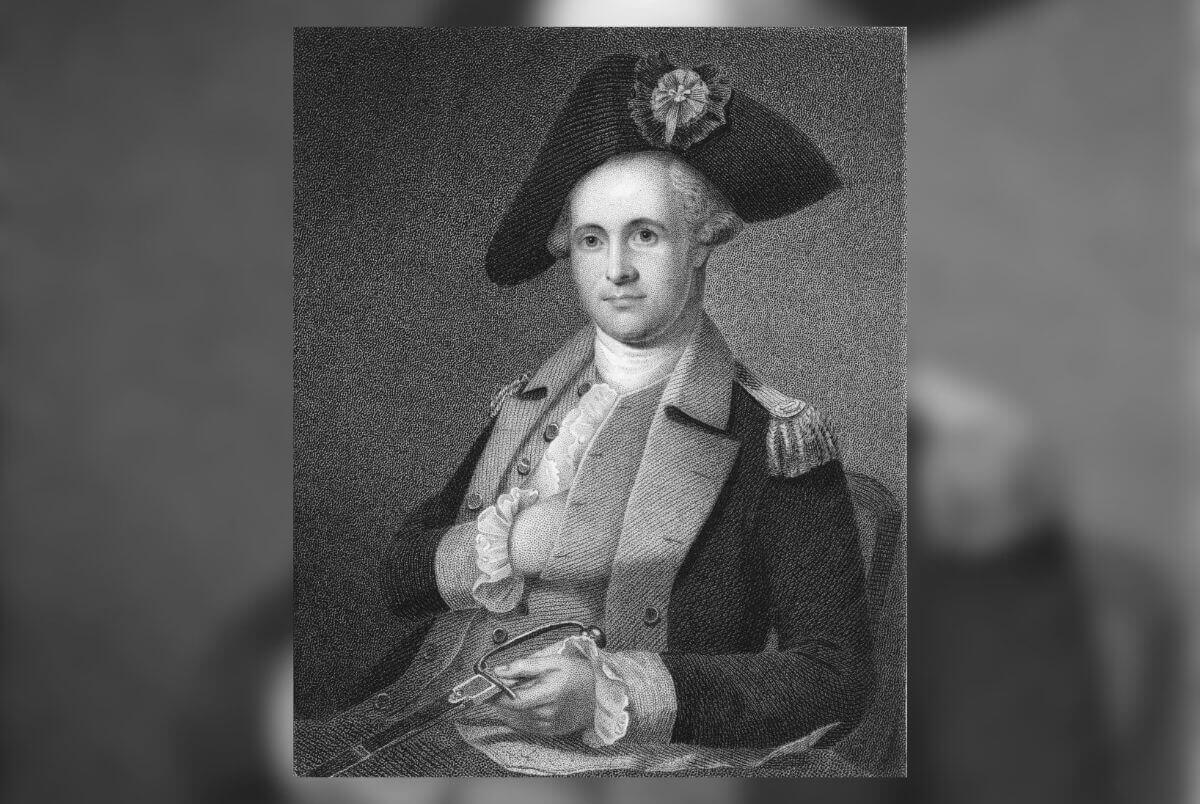
We celebrate, as we should, George Washington’s birthday on February 22. Yet Washington could well be considered a failed general – and the United States a failed experiment – if not for the humble courage of a Marylander born on February 22, one decade after Washington.
Thirty-four-year-old Mordecai Gist stepped into history on a humid battlefield in Brooklyn on August 27, 1776. There are no schools named after him, no towns bearing his memory, no statues in marble or bronze. Gist never sought such. But on that fateful day, he did ask the men and boys under his command to sacrifice, to stand, to charge, and to risk everything – just as he was willing to himself.
Five months earlier, in March 1776, the Continental Army had won a major victory under General Washington when the British were forced to abandon Boston and retreat to Nova Scotia to await reinforcements. Washington, correctly believing that New York City would be the next British target, moved the Continental Army to defend the city, dividing his forces between Manhattan and Long Island.
Meanwhile, the British, under General William Howe, assembled a massive expeditionary force – the largest Britain had ever sent overseas – supported by Admiral Richard Howe. By early July, British troops began landing unopposed on Staten Island, where they spent weeks organizing, training, and awaiting reinforcements, including Hessian auxiliaries.
Throughout July and August, Washington faced mounting challenges, including inexperienced troops, supply shortages, and uncertainty about British intentions. Believing Manhattan might be the primary target, he kept much of his army there while fortifying positions on Long Island under General Israel Putnam.
In late August, the British executed a carefully planned operation, landing tens of thousands of troops on the southern shore of Long Island and beginning a coordinated advance toward American defenses near Brooklyn. Critically, British forces used loyalist intelligence and superior reconnaissance to outflank the American left via the Jamaica Pass – an exposed route that Washington’s forces had failed to adequately secure – setting the stage for a decisive engagement that would become known as the Battle of Long Island.
The battle commenced on August 27 when British forces launched a coordinated assault against American positions. While Hessian troops engaged American forces head-on near the center, Howe’s main column executed a sweeping flanking maneuver through Jamaica Pass, crashing into the Continental Army’s exposed left and throwing units into confusion and retreat. As British regulars pressed forward and American lines began to collapse, thousands of Continental soldiers risked being cut off near the marshes and creeks around Brooklyn.
In this critical moment, Washington was witnessing what could have been a crushing blow to the Revolution and the Declaration of Independence that had just been signed six weeks earlier. Some of his best trained troops, the Maryland and Delaware regiments and several companies from Pennsylvania and New York – in all numbering 1,800-2,000 regulars – were at risk of capture or slaughter. In these early days of the war, Washington’s courage, at times, outpaced his tactical skill, and here it nearly cost him everything.
Washington knew the Revolution could not sustain the loss of these trained soldiers, yet he was powerless to stop it. He and his command were on the opposite side of a creek, watching the battle unfold from a small redoubt on Brooklyn Heights. He could see his soldiers hemmed in by water, facing overwhelming numbers. British General James Grant’s 6,000 pressed them from the front, while, as the sun climbed to midday, Washington could see Sir Henry Clinton’s 10,000-man flanking column sweep through the unguarded Jamaica Pass.
In all, nearly 20,000 British and Hessian regulars were moving to envelop the 2,000 Americans on the far side of the creek. The British trap closed. The only path of escape for the Americans was the tidal marsh and a narrow causeway already choked with men.
Mordecai Gist saw the danger. No one ordered him to sacrifice his command. He simply saw that it had to be done. He gathered roughly 260 Marylanders and wheeled them towards the approaching Hessians. They fixed bayonets and charged. Two hundred and sixty Americans charged thousands, storming into a hail of lead.
The Americans were thrown back. Gist reformed the survivors and charged again. Scores of Marylanders fell. Gist gathered the remnants and charged again. Accounts differ, but it is known that Gist’s 261 charged thousands of British and Hessian regulars at least five or six times. The remainder of Washington’s army was saved, but only about 60 of Gist’s command made it back across the lines. Gist was one of them.
With each charge, the lives of young Americans were lost, but time was purchased. With the Hessians delayed, the remainder of the Continental Army was beginning an orderly retreat across Gowanus Creek.
“Good God!” Washington exclaimed, “What brave fellows I must this day lose!”
Gist carried that day with him the remainder of his life. He went on to fight with distinction, rising to the rank of brigadier general, commanding the 2nd Maryland Brigade at Camden, and standing present at Yorktown when Cornwallis surrendered. Gist retired to South Carolina, dying of yellow fever in 1792 at the age of 49.
The surviving record suggests that the weight Gist bore from that day was not merely the physical toll of continued military service, but also the moral burden of a man who lived when so many others fell at his command.
A nation is not sustained by victory alone, but by people willing to sacrifice themselves for others when the causeway is narrow, and the tide is rising. Such sacrifice asks something of every generation. Responsibility is not measured by personal glory, but by what one holds in trust for those who come after. And memory itself is a moral act – refusing to let the cost be forgotten or cheapened into sentimentality.
Mordecai Gist and his Marylanders remind us that liberty often survives because someone – sometimes a handful of someones, many of them scarcely older than boys – choose to hold the line long enough for everyone else to regroup. Those men who fell for America that precious hour bought time so that we might inherit the responsibility to keep the Republic. We have a duty to honor their memory and their sacrifice.
Gist lived. And in living, he modeled what it means to carry the weight of sacrifice without letting it break the spirit of duty. The Marylanders’ stand did not look like a triumph the day it happened. It was disciplined, repeated obedience in the face of certain destruction. This is the seedbed of national endurance. And such endurance requires leaders who understand that their role is not to avoid loss at all costs, but to ensure that loss, when it comes, serves something larger than themselves.
The causeway at Gowanus is long gone, paved over by a modern city. But the narrow places in American life remain – the crucial moments when everything might be lost but not for the courage of a few who understand the price of liberty and are willing to pay it. Gist’s heroic stand should compel us to ask ourselves this: When the hour comes which demands that some sacrifice themselves so others may endure, will there be men and women ready to answer?
Just as importantly, will those who benefit from their sacrifice remember what was purchased, and for whom?
Phill Kline is a former state legislator and the former Attorney General of Kansas. He is currently a law professor.





So many brave souls that God placed in just the right time to do the right thing, so that others would have liberty. If only these lessons were taught in the public schools today. Thank you Mr. Kline for the history lesson.
Good article. I have to admit with my 50+ years of studying military history that I missed this one on Mordecai Gist. Have to do some more research.
Stories,moments like that should be a staple in the history classroom instead of WOKE poison and lies.What men they were, because of them America had a chance to become what it became.
Remembered by few, un-honored by the many, derided by some. This is the land that we now live in, where one political party disparages patriots and patriotism, and the other stands by and watches, taking no action, doing nothing but bemoaning their fate. This nation’s founders must be spinning like tops in their graves.
Wow, Mordecai Gist, just wow…the sacrifice of these unbelievably brave men…knowing that they probably wouldn’t live through the day.
We still have brave military people who have been beyond mere bravery when they were needed.
We need to be reminded of their stories throughout our history and those who are STILL sacrificing today.
I am humbled.
Excellent article about an unknown hero of the Amercian Revolution. It is so sad that the left seeks to rewrite our history in an attempt to make American out to be a racists and tyrannical nation like the British Empire our forefathers fought to be free from. We are not a perfect nation, but there is no such place…except Heaven. But America was founded on the belief that EVERYONE had some exceptionalism within them and, given the opportunity, can and will bring that out in order to make this a much better nation. We need to stop allowing people in who seek to destroy that exceptionalism and make us into yet another crap-hole nation like the ones they come from.